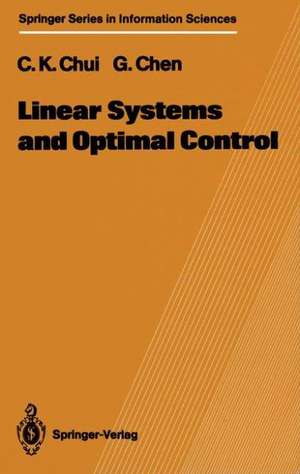
Linear Systems and Optimal Control: Springer Series in Information Sciences, cartea 18
Autor Charles K. Chui, Guanrong Chenen Limba Engleză Paperback – 15 apr 2014
Din seria Springer Series in Information Sciences
- 20%
 Preț: 340.57 lei
 - 18%
 Preț: 960.18 lei
 - 15%
 Preț: 650.40 lei
 - 20%
 Preț: 327.54 lei
 -
 Preț: 373.66 lei
 -
 Preț: 384.30 lei
 -
 Preț: 379.88 lei
 - 20%
 Preț: 314.03 lei
 - 18%
 Preț: 750.88 lei
 -
 Preț: 376.01 lei
 -
 Preț: 385.10 lei
 - 20%
 Preț: 320.37 lei
 -
 Preț: 385.01 lei
 - 15%
 Preț: 663.47 lei
 - 15%
 Preț: 642.81 lei
 - 20%
 Preț: 335.91 lei
 -
 Preț: 389.74 lei
 - 20%
 Preț: 657.71 lei
 - 15%
 Preț: 666.07 lei
 - 18%
 Preț: 1397.25 lei
 - 15%
 Preț: 641.55 lei
 - 15%
 Preț: 646.18 lei
 -
 Preț: 388.77 lei
 - 20%
 Preț: 624.51 lei
 - 18%
 Preț: 924.27 lei
 -
 Preț: 378.41 lei
 - 20%
 Preț: 656.89 lei
 - 20%
 Preț: 649.02 lei
 -
 Preț: 393.24 lei
 -
 Preț: 376.01 lei
 - 15%
 Preț: 558.59 lei
Preț: 383.03 lei
Puncte Express: 575
Carte tipărită la comandă
Livrare economică 27 noiembrie-11 decembrie
Livrare prin curier în România Termenul estimat este afișat lângă disponibilitate.
Transport gratuit de la 400.00 lei Plată online sau ramburs, în funcție de opțiunile comenzii.
Retur gratuit în 14 zile Comandă securizată și suport în română.
Specificații
ISBN-13: 9783642647871
ISBN-10: 3642647871
Pagini: 168
Ilustrații: VIII, 155 p. 1 illus.
Dimensiuni: 155 x 235 x 10 mm
Greutate: 0.27 kg
Ediția:Softcover reprint of the original 1st ed. 1989
Editura: Springer
Colecția Springer Series in Information Sciences
Seria Springer Series in Information Sciences
Locul publicării:Berlin, Heidelberg, Germany
ISBN-10: 3642647871
Pagini: 168
Ilustrații: VIII, 155 p. 1 illus.
Dimensiuni: 155 x 235 x 10 mm
Greutate: 0.27 kg
Ediția:Softcover reprint of the original 1st ed. 1989
Editura: Springer
Colecția Springer Series in Information Sciences
Seria Springer Series in Information Sciences
Locul publicării:Berlin, Heidelberg, Germany
V-ar putea interesa
-
 Preț: 237.05 lei
 -
 -18%Preț: 1381.25 lei1684.46 lei
 -
 Tychomancy – Inferring Probability from Causal StructureMichael StrevensPreț: 383.11 lei
 -
 Preț: 209.05 lei
 -
 Reinventing the Library for Online EducationFrederick Stielow-23%Preț: 427.93 lei555.74 lei
 -
 -18%Preț: 994.17 lei1212.40 lei
 -
 The Comparative Guide to WordPress in Libraries: A LITA GuideAmerican Library AssociationPreț: 479.68 lei
 -
 Biologically Inspired Networking and SensingPietro Lió-20%Preț: 1439.79 lei1799.74 lei
 -
 Decolonizing PeaceVictoria C. FontanPreț: 118.58 lei
 -
 COMPACT ILasse GerritsPreț: 416.71 lei
 -
 Global InsanityJames A CoffmanPreț: 197.00 lei
 -
 Book of ExtremesTed G. Lewis-15%Preț: 450.86 lei530.42 lei
 -
 Kalman FilteringCharles K. Chui-15%Preț: 492.45 lei579.35 lei
 -
 Optimal Periodic ControlFritz ColoniusPreț: 278.60 lei
 -
 -18%Preț: 1278.91 lei1559.64 lei
 -
 Preț: 267.53 lei
 -
 Preț: 264.89 lei
 -
 Complementarity ProblemsGeorge IsacPreț: 424.50 lei
 -
 MorphogenesisPaul Bourgine-18%Preț: 1036.44 lei1263.95 lei
 -
 -18%Preț: 982.96 lei1198.73 lei
 -
 Complex Systems and NetworksJinhu Lü-15%Preț: 680.36 lei800.42 lei
 -
 CHAOS IN CIRCUITS & SYSTEMS (V11)Chen Guanrong-18%Preț: 1391.51 lei1696.96 lei
Public țintă
ResearchCuprins
1. State-Space Descriptions.- 1.1 Introduction.- 1.2 An Example of Input-Output Relations.- 1.3 An Example of State-Space Descriptions.- 1.4 State-Space Models.- Exercises.- 2. State Transition Equations and Matrices.- 2.1 Continuous-Time Linear Systems.- 2.2 Picard’s Iteration.- 2.3 Discrete-Time Linear Systems.- 2.4 Discretization.- Exercises.- 3. Controllability.- 3.1 Control and Observation Equations.- 3.2 Controllability of Continuous-Time Linear Systems.- 3.3 Complete Controllability of Continuous-Time Linear Systems.- 3.4 Controllability and Complete Controllability of Discrete-Time Linear Systems.- Exercises.- 4. Observability and Dual Systems.- 4.1 Observability of Continuous-Time Linear Systems.- 4.2 Observability of Discrete-Time Linear Systems.- 4.3 Duality of Linear Systems.- 4.4 Dual Time-Varying Discrete-Time Linear Systems.- Exercises.- 5. Time-Invariant Linear Systems.- 5.1 Preliminary Remarks.- 5.2 The Kalman Canonical Decomposition.- 5.3 Transfer Functions.- 5.4 Pole-Zero Cancellation of Transfer Functions.- Exercises.- 6. Stability.- 6.1 Free Systems and Equilibrium Points.- 6.2 State-Stability of Continuous-Time Linear Systems.- 6.3 State-Stability of Discrete-Time Linear Systems.- 6.4 Input-Output Stability of Continuous-Time Linear Systems.- 6.5 Input-Output Stability of Discrete-Time Linear Systems.- Exercises.- 7. Optimal Control Problems and Variational Methods.- 7.1 The Lagrange, Bolza, and Mayer Problems.- 7.2 A Variational Method for Continuous-Time Systems.- 7.3 Two Examples.- 7.4 A Variational Method for Discrete-Time Systems.- Exercises.- 8. Dynamic Programming.- 8.1 The Optimality Principle.- 8.2 Continuous-Time Dynamic Programming.- 8.3 Discrete-Time Dynamic Programming.- 8.4 The Minimum Principle of Pontryagin.- Exercises.- 9.Minimum-Time Optimal Control Problems.- 9.1 Existence of the Optimal Control Function.- 9.2 The Bang-Bang Principle.- 9.3 The Minimum Principle of Pontryagin for Minimum-Time Optimal Control Problems.- 9.4 Normal Systems.- Exercises.- 10. Notes and References.- 10.1 Reachability and Constructibility.- 10.2 Differential Controllability.- 10.3 State Reconstruction and Observers.- 10.4 The Kalman Canonical Decomposition.- 10.5 Minimal Realization.- 10.6 Stability of Nonlinear Systems.- 10.7 Stabilization.- 10.8 Matrix Riccati Equations.- 10.9 Pontryagin’s Maximum Principle.- 10.10 Optimal Control of Distributed Parameter Systems.- 10.11 Stochastic Optimal Control.- References.- Answers and Hints to Exercises.- Notation.