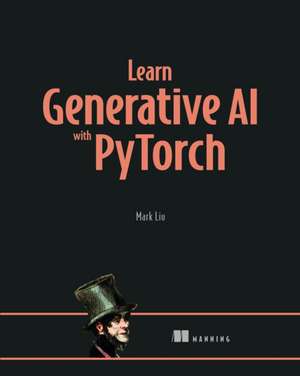
Learn Generative AI with PyTorch
Autor Mark Liuen Limba Engleză Hardback – 13 dec 2024
Prin parcurgerea acestui volum, cititorul va reuși să construiască funcțional un ecosistem complet de modele generative: de la un traducător automat și un generator de text cu o putere similară GPT-2, până la sisteme capabile să compună muzică în stilul lui Mozart sau să genereze imagini realiste prin modele de difuzie. Learn Generative AI with Pytorch elimină bariera dintre teorie și execuție, oferind o implementare linie cu linie a mecanismelor de „attention” și a arhitecturilor de tip Transformer. Abordarea aleasă de Mark Liu este una profund aplicată, structurând materia în patru părți logice care progresează de la rețele neuronale de bază la aplicații complexe de procesare a limbajului natural și viziune computerizată. Apreciem în mod deosebit rigoarea cu care sunt explicate rețelele GAN pentru generarea de forme și cifre, trecând apoi spre tehnici avansate precum CycleGAN pentru manipularea caracteristicilor vizuale. Merită menționat că, deși subiectele sunt de ultimă oră, autorul păstrează un ton accesibil, demonstrând cum aceste modele pot fi antrenate chiar și pe hardware de nivel consumer. Complementar volumului Generative Deep Learning de David Foster, care oferă o privire de ansamblu teoretică asupra peisajului modelelor de învățare profundă, lucrarea de față se concentrează strict pe implementarea practică în ecosistemul PyTorch. În timp ce Foster explorează fluxurile de normalizare și modelele bazate pe energie, Mark Liu prioritizează fluxul de lucru Python și integrarea cu librării moderne precum LangChain pentru agenți de tip „zero-shot”. Credem că această carte este un instrument tehnic esențial pentru cei care doresc să înțeleagă mecanica internă a inteligenței artificiale generative fără a se pierde în demonstrații matematice abstracte.
Preț: 346.95 lei
Preț vechi: 433.69 lei
-20%
Carte disponibilă
Livrare economică 17 noiembrie-01 decembrie
Livrare express 31 octombrie-06 noiembrie pentru 46.56 lei
Specificații
ISBN-10: 1633436462
Pagini: 432
Dimensiuni: 191 x 236 x 27 mm
Greutate: 0.73 kg
Editura: Manning Publications
V-ar putea interesa
-
 Building Generative AI Services with FastAPIAli Parandeh-20%Preț: 354.36 lei442.95 lei
 -
 -20%Preț: 193.06 lei241.33 lei
 -
 Generative AI For DummiesPam BakerPreț: 139.11 lei
 -
 Agentic AI For DummiesPam Baker-20%Preț: 146.02 lei182.53 lei
 -
 Generative AI with PythonBert Gollnick-20%Preț: 294.84 lei368.55 lei
 -
 Deep Learning with PyTorchEli Stevens-20%Preț: 293.41 lei366.76 lei
 -
 The Quick Python Book, Fourth EditionNaomi Ceder-20%Preț: 350.74 lei438.43 lei
 -
 Effective Conversational AIAndrew Freed-20%Preț: 369.22 lei461.53 lei
 -
 Preț: 404.96 lei
 -
 Generative AI in ActionAmit Bahree-20%Preț: 337.25 lei421.57 lei
 -
 The Complete Obsolete Guide to Generative AIDavid ClintonPreț: 264.46 lei
 -
 Introduction to Generative AIMaggie Engler-20%Preț: 279.00 lei348.75 lei
 -
 -20%Preț: 332.38 lei415.47 lei
 -
 Deep Learning Crash CourseGiovanni Volpe-35%Preț: 290.92 lei445.81 lei
 -
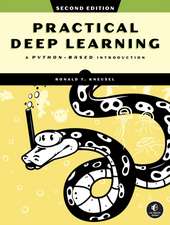 Practical Deep Learning, 2nd Edition: A Python-Based IntroductionRonald T. Kneusel-35%Preț: 333.73 lei515.68 lei
 -
 Generative AI ModelsJovan Pehcevski-20%Preț: 1211.58 lei1514.47 lei
 -
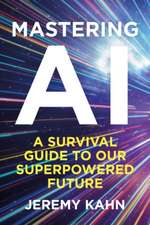 Mastering AIJeremy Kahn-20%Preț: 80.23 lei100.29 lei
 -
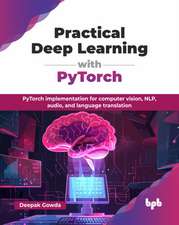 Practical Deep Learning with PyTorchDeepak Gowda-20%Preț: 225.42 lei281.77 lei
 -
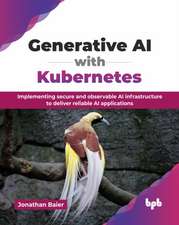 Generative AI with KubernetesJonathan Baier-20%Preț: 232.52 lei290.65 lei
 -
 Preț: 180.29 lei
De ce să citești această carte
Această resursă se adresează programatorilor care dețin cunoștințe de bază de Python și doresc să treacă la nivelul următor în inteligența artificială fără a fi experți în machine learning. Cititorul câștigă abilitatea de a construi de la zero modele de text, imagine și sunet, înțelegând exact ce se întâmplă sub „capota” unor tehnologii precum GPT-4 sau Stable Diffusion prin exerciții practice, gata de rulat pe propriul computer.