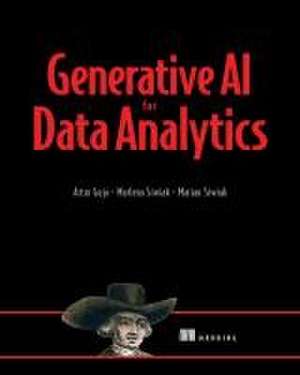
Starting Data Analytics with Generative AI and Python
Autor Artur Guja, Marlena Siwiak, Marian Siwiaken Limba Engleză Paperback – 19 noi 2024
În domeniul data analytics, integrarea inteligenței artificiale generative nu mai este o opțiune, ci o necesitate pentru eficiență. Găsim în lucrarea Starting Data Analytics with Generative AI and Python un ghid tehnic extrem de aplicat, care transformă promisiunile teoretice ale AI în fluxuri de lucru concrete. Suntem de părere că valoarea acestui volum rezidă în abordarea sa pragmatică: autorii Artur Guja, Marlena Siwiak și Marian Siwiak nu se limitează la prezentarea unor comenzi, ci construiesc o metodologie prin care ChatGPT devine un copilot capabil să scrie cod Python, să curețe seturi de date complexe și să asigure suport în inferența statistică. Abordarea diferă de Data Science and Analytics with Python de Jesus Rogel-Salazar prin focalizarea intensă pe scurtarea ciclului de dezvoltare — mai puțin abstract, mai mult aplicabil în sarcinile cotidiene de business. În timp ce alte titluri similare tratează AI ca pe un subiect de studiu, această carte publicată de Manning Publications o tratează ca pe o unealtă de productivitate, raportând reduceri ale timpului de lucru de până la 75%. Reținem structura logică a capitolelor care ghidează cititorul de la scrierea unor prompturi eficiente până la optimizarea performanței și scalare. Un element distinctiv este onestitatea tehnică: autorii dedică spațiu generos riscurilor, erorilor de logică ale modelelor lingvistice și strategiilor de atenuare a acestora, oferind o intuiție vitală despre limitele tehnologiei actuale. Este un manual de utilizare a Python-ului asistat de AI, esențial pentru cei care doresc să treacă de la simpla manipulare a datelor la analize strategice complexe într-un timp record.
Preț: 323.70 lei
Preț vechi: 404.62 lei
-20%
Carte disponibilă
Livrare economică 21 septembrie-05 octombrie
Livrare express 05-11 septembrie pentru 69.45 lei
Specificații
ISBN-10: 1633437213
Pagini: 360
Dimensiuni: 185 x 234 x 20 mm
Greutate: 0.41 kg
Editura: Manning Publications
V-ar putea interesa
-
 Using Artificial Intelligence Absolute Beginner's GuideMichael Miller-20%Preț: 194.58 lei243.22 lei
 -
 Generative AnalysisJim Arlow-20%Preț: 385.84 lei482.30 lei
 -
 -39%Preț: 385.64 lei635.42 lei
 -
 -9%Preț: 572.27 lei628.87 lei
 -
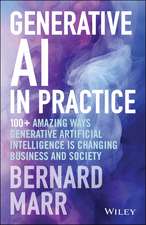 Generative AI in PracticeBernard Marr-20%Preț: 186.65 lei233.31 lei
 -
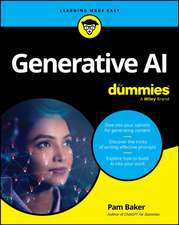 Generative AI For DummiesPam BakerPreț: 136.67 lei
 -
 Statistical Analysis with Python For DummiesJoseph SchmullerPreț: 193.89 lei
 -
 Agentic AI For DummiesPam Baker-20%Preț: 143.40 lei179.25 lei
 -
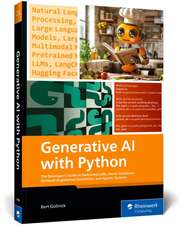 Generative AI with PythonBert Gollnick-20%Preț: 291.50 lei364.37 lei
 -
 Learn AI-Assisted Python Programming, Second EditionDaniel Zingaro-20%Preț: 333.47 lei416.84 lei
 -
 The Quick Python Book, Fourth EditionNaomi Ceder-20%Preț: 344.37 lei430.46 lei
 -
 Learn Generative AI with PyTorchMark Liu-20%Preț: 335.60 lei419.49 lei
 -
 -20%Preț: 335.44 lei419.30 lei
 -
 AI-Powered DeveloperNathan B Crocker-20%Preț: 273.49 lei341.87 lei
 -
 LLMs in ActionImmanuel Trummer-20%Preț: 217.85 lei272.31 lei
 -
 Data Storytelling with Altair and AIAngelica Lo Duca-20%Preț: 282.28 lei352.86 lei
 -
 Mastering AIJeremy Kahn-20%Preț: 67.19 lei83.98 lei
 -
 Preț: 433.14 lei
 -
 Multivariate Analysis and Machine Learning TechniquesSrikrishnan Sundararajan-20%Preț: 534.82 lei668.53 lei
 -
 HBR Guide to Generative AI for ManagersElisa Farri-20%Preț: 101.79 lei127.23 lei
De ce să citești această carte
Recomandăm această carte oricărui analist de date sau programator Python care dorește să își maximizeze productivitatea folosind ChatGPT. Veți câștiga o metodologie clară pentru a automatiza sarcinile repetitive de curățare și analiză, învățând în același timp cum să verificați critic rezultatele generate de AI. Este resursa ideală pentru a învăța să construiți pipeline-uri de date moderne, sigure și extrem de rapide.
Descriere
Notă biografică
Dr. Marlena Siwiak is an experienced data scientist and bioinformatician with a comprehensive scientific background who gained experience in developing business data applications. An individual who knows how to use both numbers and words.
Dr. Marian Siwiak is a data scientist with a track record of using data knowledge and managerial experience to successfully deliver multimillion IT, scientific and technical projects covering various areas, from life sciences to robotics.