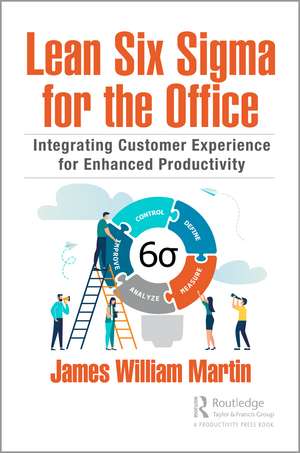
Lean Six Sigma for the Office: Integrating Customer Experience for Enhanced Productivity
Autor James William Martinen Limba Engleză Hardback – 23 mar 2021
Ceea ce diferențiază Lean Six Sigma for the Office de documentația oficială sau de manualele teoretice standard este pragmatismul cu care James William Martin adaptează rigorile industriale la fluiditatea mediului administrativ. Considerăm că marea provocare a proceselor de birou — dispersia globală și dependența de tehnologia informației — primește aici o soluție tehnică riguroasă. Autorul nu se limitează la a transfera concepte din fabrică în birou, ci recalibrează metodologiile pentru a aborda fluxuri de lucru invizibile, unde tranzacțiile digitale și interacțiunile umane formează un ecosistem complex.
Pe linia practică a lucrării Lean Office and Service Simplified, dar cu focus pe integrarea experienței clientului și a arhitecturilor IT, această a doua ediție extinde orizontul Lean Six Sigma către frontierele digitale actuale. Găsim în acest volum secțiuni detaliate despre Robotic Process Automation (RPA) și analitica Big Data, elemente care devin esențiale pentru sustenabilitatea soluțiilor automate. Structura cărții urmărește o progresie logică: începe cu alinierea strategică și identificarea oportunităților prin analiza fluxului de valoare (VSM), continuând cu planificarea riguroasă a evenimentelor Kaizen.
În contextul operei sale, dacă în Unexpected Consequences autorul analiza eșecurile sistemice și catastrofele tehnologice, în Lean Six Sigma for the Office el oferă antidotul: un model de schimbare organizațională bazat pe guvernanța datelor și eliminarea risipei informaționale. Cu peste 140 de ilustrații și tabele, volumul funcționează ca un manual de referință tehnic, oferind instrumente de evaluare și liste de verificare care transformă teoria în protocoale de lucru standardizate pentru echipele locale sau globale.
Preț: 434.24 lei
Preț vechi: 510.88 lei
-15%
Carte tipărită la comandă
Livrare economică 09-23 decembrie
Livrare express 03-07 noiembrie pentru 34.65 lei
Specificații
ISBN-10: 0367503271
Pagini: 372
Ilustrații: 23 Tables, black and white; 100 Illustrations, black and white
Dimensiuni: 152 x 229 x 28 mm
Greutate: 0.45 kg
Ediția:2 ed
Editura: Taylor & Francis
Colecția Productivity Press
Locul publicării:Oxford, United Kingdom
V-ar putea interesa
-
 What is Lean Six SigmaMichael George-13%Preț: 96.03 lei110.90 lei
 -
 -12%Preț: 119.40 lei135.04 lei
 -
 Lean Six Sigma StatisticsAlastair Muir-19%Preț: 578.23 lei713.86 lei
 -
 The Toyota Way FieldbookJeffrey Liker-15%Preț: 233.99 lei274.36 lei
 -
 Total Quality Control, Revised (Fortieth Anniversary Edition), Volume 1Armand V FeigenbaumPreț: 287.03 lei
 -
 Total Quality Control, Revised (Fortieth Anniversary Edition), Volume 2Armand V FeigenbaumPreț: 343.80 lei
 -
 -16%Preț: 194.29 lei230.54 lei
 -
 -16%Preț: 217.01 lei258.22 lei
 -
 -15%Preț: 217.89 lei257.36 lei
 -
 -41%Preț: 215.05 lei364.88 lei
 -
 Preț: 249.99 lei
 -
 The Improvement GuideGerald J Langley-19%Preț: 445.95 lei550.56 lei
 -
 -15%Preț: 428.79 lei504.46 lei
 -
 Lean ThinkingJames P. WomackPreț: 226.56 leiRecomandat
 -
 Lean Six Sigma For DummiesMartin Brenig-JonesPreț: 162.44 lei
 -
 Andy & Me: Crisis & Transformation on the Lean JourneyPascal DennisPreț: 317.17 lei
 -
 Leading the Lean Enterprise TransformationGeorge Koenigsaecker-8%Preț: 445.07 lei483.77 lei
 -
 -8%Preț: 509.79 lei554.12 lei
 -
 -8%Preț: 432.54 lei470.16 lei
 -
 5 Pillars of the Visual WorkplaceHiro-Yuki Hirano-9%Preț: 993.55 lei1091.81 lei
 -
 Preț: 341.45 lei
 -
 The Simplicity of LeanPhilip HoltPreț: 191.24 lei
Public țintă
Professional and Professional Practice & DevelopmentDe ce să citești această carte
Recomandăm această carte profesioniștilor care gestionează procese tranzacționale complexe și doresc să reducă timpii de ciclu fără a sacrifica calitatea. Cititorul câștigă acces la un set de instrumente verificate pentru implementarea RPA și gestionarea conformității GDPR în cadrul inițiativelor de îmbunătățire. Este o resursă indispensabilă pentru managerii care vor să alinieze cultura organizațională cu eficiența operațională, transformând biroul într-un motor de productivitate măsurabilă.
Despre autor
James William Martin este președintele Six Sigma Integration, Inc. și un consultant renumit cu gradul de Master Black Belt. Din 1988, acesta își exercită expertiza ca instructor la Providence College Graduate School of Business, unde predă cercetare operațională, managementul operațiunilor și prognoză economică. Experiența sa vastă, acumulată în industrii diverse — de la retail la servicii comerciale și guvernamentale — îi permite să ofere o perspectivă aplicată asupra modului în care metodele cantitative pot optimiza performanța organizațională.
Descriere scurtă
Cuprins
Introduction ......................................................................................... xiii
About the Author .............................................................................. xxvii
STEP 1 Align Improvement Opportunities
Chapter 1 Strategy Alignment ............................................................. 3
Chapter 2 Project Identification ....................................................... 51
Chapter 3 Lean Six Sigma Basics ...................................................... 83
STEP 2 Plan and Conduct the Rapid Improvement Event
Chapter 4 Rapid Improvement Events ............................................ 135
Chapter 5 Data Collection and Analysis ........................................ 167
Chapter 6 Process Improvement ..................................................... 225
STEP 3 Implementing Solutions
Chapter 7 Building a Case for Change ........................................... 259
Chapter 8 Implementing Solutions ................................................. 277
Chapter 9 Organizational Change .................................................. 303
Index .................................................................................................... 339
Notă biografică
Belt for 25 years and has trained and mentored several thousand executives,
champions, Black Belts, and Green Belts in process improvement methods
including manufacturing, services, and supply chain applications. He
led successful Lean Six Sigma assessments across Japan, China, Korea,
Singapore, Malaysia, Th ailand, Australia, North America, and Europe. Th is
work included organizations in hardware, soft ware, computer security,
retail sales, banking, insurance, fi nancial services, measurement systems,
automotive, electronics, aerospace component manufacturing, electronic
manufacturing, controls, building products, industrial equipment, and
consumer products. He served as an instructor at the Providence College
Graduate School of Business for 20 years. He holds an MS in Mechanical
Engineering, Northeastern University; an MBA, Providence College; a BS,
Industrial Engineering, University of Rhode Island; several patents; and he
has written numerous articles on process improvement.