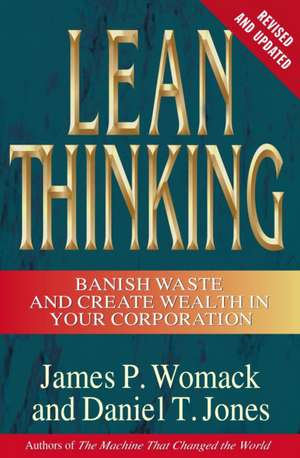
Lean Thinking
Autor James P. Womack, Daniel T Jonesen Limba Engleză Hardback – 10 iun 2003
Notăm cu interes că, spre deosebire de numeroasele titluri care promovează reinventarea constantă a modelelor de business, Lean Thinking propune o întoarcere riguroasă la fundamentele eficienței. Suntem de părere că forța acestui volum rezidă în capacitatea de a demonstra că excelența operațională nu este un concept abstract, ci un rezultat al eliminării sistematice a activităților care nu aduc valoare clientului (muda). Ca și Jeffrey Liker în The Toyota Way, autorii distilează experiența reală din modelul de producție japonez în principii acționabile universal, adaptate pentru contextul occidental. Dacă lucrarea anterioară a autorilor, The Machine That Changed the World, a introdus conceptul de producție lean, acest volum evoluează către o metodologie completă de management. Cartea este organizată strategic pentru a ghida cititorul de la înțelegerea teoretică la execuție: prima parte definește cei cinci piloni ai gândirii lean, în timp ce partea a doua oferă un plan de acțiune pas cu pas, fundamentat pe analiza a peste cincizeci de companii. Credem că secțiunea dedicată „întreprinderii lean” (Part III) este esențială pentru managerii care doresc să extindă eficiența dincolo de propria organizație, către întregul lanț de aprovizionare. Stilul este autoritar și pragmatic, evitând jargonul corporatist în favoarea unor metrici clare de performanță și a unor studii de caz relevante, precum transformarea spectaculoasă a producătorului Porsche.
Preț: 226.56 lei
Recomandat
Carte disponibilă
Livrare economică 09-23 noiembrie
Specificații
ISBN-10: 0743249275
Pagini: 400
Dimensiuni: 166 x 242 x 38 mm
Greutate: 0.59 kg
Ediția:2nd edition
Editura: Free Press
V-ar putea interesa
-
 What Really WorksWilliam JoycePreț: 123.47 lei
 -
 -16%Preț: 215.03 lei257.01 lei
 -
 -41%Preț: 213.71 lei364.88 lei
 -
 -37%Preț: 287.27 lei455.43 lei
 -
 How to Lie with StatisticsDarrell Huff-33%Preț: 61.38 lei91.39 lei
 -
 Business Model GenerationAlexander OsterwalderPreț: 216.97 lei
 -
 Art of the Long ViewPeter SchwartzPreț: 183.53 lei
 -
 Making Things Happen: Mastering Project ManagementScott BerkunPreț: 281.50 lei
 -
 The Effective ExecutivePeter F. DruckerPreț: 328.52 lei
 -
 Journey to LeanJohn Drew-15%Preț: 519.52 lei611.20 lei
 -
 Understanding A3 Thinking: A Critical Component of Toyota's PDCA Management SystemDurward K. Sobek II.Preț: 390.95 lei
 -
 The Lords of StrategyWalter KiechelPreț: 184.49 lei
 -
 -32%Preț: 117.27 lei171.82 lei
 -
 The Machine That Changed the WorldJames P. Womack-18%Preț: 76.92 lei94.24 lei
De ce să citești această carte
Suntem convinși că orice manager care dorește să obțină creștere sustenabilă fără investiții masive de capital va găsi în această carte un instrument indispensabil. Veți învăța cum să identificați risipa, cum să creați un flux continuu de producție bazat pe cererea reală a clientului și cum să implementați un plan de acțiune testat în industrii variate. Este ghidul definitiv pentru trecerea de la managementul prin criză la cel prin perfecțiune.
Despre autor
James P. Womack a fost director de cercetare al International Motor Vehicle Program (IMVP) în cadrul Massachusetts Institute of Technology (MIT) și este fondatorul Lean Enterprise Institute. Cariera sa a fost dedicată explorării și diseminării sistemelor de management care au revoluționat industria globală. Alături de Daniel T Jones, a documentat ascensiunea sistemului Toyota, oferind mediului de afaceri occidental o alternativă viabilă la producția în masă. Expertiza sa este ancorată în decenii de analiză a performanței industriale, fiind considerat unul dintre cei mai influenți gânditori în domeniul managementului calității.
Recenzii
Philip Caldwell Chairman and CEO, Ford Motor Company, 1980-1985 Truly remarkable....The most comprehensive, instructive, mind-stretching and provocative analysis of any major industry I have ever known. Why pay others huge consulting fees? Just read this book.
Richard J. Schonberger Author of "World Class Manufacturing: The Next Decade" The manufacturing book of the nineties.
"Automotive News" This is a book of great understanding, and of hope. It shows how to create an industrial world in which workers share the challenges and satisfactions of the business. It's a world in which assemblers communicate with suppliers and dealers in a way that improves life for all of them. Read it.
Peter F. Drucker Author of "The Post-Capitalist Society""The Machine That Changed the World" is a very important book. I am impressed.
"Business Week" The best current book on the changes reshaping manufacturing, and the most readable, too...conveys a very human sense of managers constrained by limited resources yet trying to do better.
Descriere
Expanded, updated, and more relevant than ever, this bestselling business classic by two internationally renowned management analysts describes a business system for the twenty-first century.
Expanded, updated, and more relevant than ever, this bestselling business classic by two internationally renowned management analysts describes a business system for the twenty-first century that supersedes the mass production system of Ford, the financial control system of Sloan, and the strategic system of Welch and GE. It is based on the Toyota (lean) model, which combines operational excellence with value-based strategies to produce steady growth through a wide range of economic conditions.
In contrast with the crash-and-burn performance of companies trumpeted by business gurus in the 1990s, the firms profiled in "Lean Thinking" -- from tiny Lantech to midsized Wiremold to niche producer Porsche to gigantic Pratt & Whitney -- have kept on keeping on, largely unnoticed, along a steady upward path through the market turbulence and crushed dreams of the early twenty-first century. Meanwhile, the leader in lean thinking -- Toyota -- has set its sights on leadership of the global motor vehicle industry in this decade.
Instead of constantly reinventing business models, lean thinkers go back to basics by asking what the customer really perceives as "value." (It's often not at all what existing organizations and assets would suggest.) The next step is to line up value-creating activities for a specific product along a "value stream" while eliminating activities (usually the majority) that don't add value. Then the lean thinker creates a "flow" condition in which the design and the product advance smoothly and rapidly at the "pull" of the customer (rather than the push of the producer). Finally, as flow and pull are implemented, the lean thinker speeds up the cycle of improvement in pursuit of "perfection." The first part of this book describes each of these concepts and makes them come alive with striking examples.
"Lean Thinking" clearly demonstrates that these simple ideas can breathe new life into any company in any industry in any country. But most managers need guidance on how to make the lean leap in their firm. Part II provides a step-by-step action plan, based on in-depth studies of more than fifty lean companies in a wide range of industries across the world.
Even those readers who believe they have embraced lean thinking will discover in Part III that another dramatic leap is possible by creating an extended lean enterprise for each of their product families that tightly links value-creating activities from raw materials to customer.
In Part IV, an epilogue to the original edition, the story of lean thinking is brought up-to-date with an enhanced action plan based on the experiences of a range of lean firms since the original publication of "Lean Thinking."
"Lean Thinking" does not provide a new management "program" for the one-minute manager. Instead, it offers a new method of thinking, of being, and, above all, of doing for the serious long-term manager -- a method that is changing the world.
Cuprins
Contents
Preface to the 2003 Edition
Preface to the First Edition: From Lean Production to Lean Enterprise
PART I: LEAN PRINCIPLES
Introduction: Lean Thinking versus Muda
1. Value
2. The Value Stream
3. Flow
4. Pull
5. Perfection
PART II: FROM THINKING TO ACTION: THE LEAN LEAP
6. The Simple Case
7. A Harder Case
8. The Acid Test
9. Lean Thinking versus German Technik
10. Mighty Toyota; Tiny Showa
11. An Action Plan
PART III: LEAN ENTERPRISE
12. A Channel for the Stream; a Valley for the Channel
13. Dreaming About Perfection
PART IV: EPILOGUE
14. The Steady Advance of Lean Thinking
15. Institutionalizing the Revolution
Afterword: The Lean Network
Appendix: Individuals and Organizations Who Helped
Glossary
Notes
Bibliography
Index