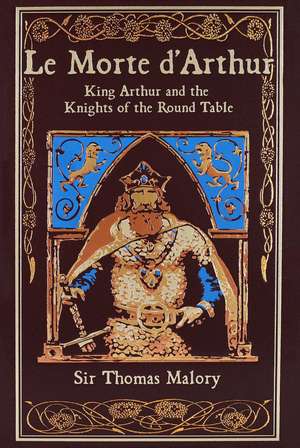
Le Morte d'Arthur: Leather-Bound Classics
Autor Thomas Maloryen Limba Engleză Legat în piele – 23 sep 2025
Central figures in medieval literature, King Arthur and his Knights of the Round Table still inspire many books and films today. Drawing on the legends of Camelot from French and English sources, Sir Thomas Malory compiled the drama of illicit love, the magic of sorcery, and the quest for the Holy Grail into a sordid and chivalrous tale that’s been recounted for centuries. This beautiful leather-bound volume, which includes intricate line illustrations by renowned artist Aubrey Beardsley, will be a treasured edition of classic Arthurian folklore in any home library.
| Toate formatele și edițiile | Preț | Express |
|---|---|---|
| Paperback (10) | 52.09 lei 3-5 săpt. | |
| Penguin Publishing Group – 2 feb 2010 | 52.09 lei 3-5 săpt. | |
| Penguin Publishing Group – 30 ian 1970 | 72.94 lei 21-33 zile | +33.78 lei 7-13 zile |
| Random House – 22 feb 1999 | 121.25 lei 3-5 săpt. | |
| Hackett Publishing Company,Inc – 5 mar 2015 | 121.55 lei 3-5 săpt. | +37.19 lei 7-13 zile |
| CreateSpace Independent Publishing Platform – 29 noi 2015 | 127.11 lei 6-8 săpt. | |
| LIGHTNING SOURCE INC – 11 sep 2018 | 147.82 lei 17-24 zile | |
| Blurb – 31 mai 2023 | 152.16 lei 6-8 săpt. | |
| Simon & Brown – 31 mai 2011 | 225.21 lei 3-5 săpt. | |
| Sharp Ink – 20 noi 2023 | 240.43 lei 38-45 zile | |
| Outlook Verlag – 19 oct 2022 | 530.60 lei 3-5 săpt. | |
| Hardback (5) | 258.21 lei 6-8 săpt. | |
| Hackett Publishing Company,Inc – 5 mar 2015 | 361.36 lei 3-5 săpt. | |
| Blurb – iun 2023 | 258.21 lei 6-8 săpt. | |
| Blurb – 29 mai 2019 | 262.47 lei 38-45 zile | |
| Blurb – 28 mai 2019 | 262.47 lei 38-45 zile | |
| Blurb – 28 mai 2019 | 278.87 lei 38-45 zile | |
| Legat în piele (2) | 139.26 lei 28-40 zile | +84.89 lei 7-13 zile |
| Simon + Schuster LLC – 23 sep 2025 | 139.26 lei 28-40 zile | +84.89 lei 7-13 zile |
| CANTERBURY CLASSICS – 9 sep 2015 | 162.02 lei 3-5 săpt. |





Preț: 139.26 lei
Preț vechi: 172.70 lei
-19%
Puncte Express: 209
Preț estimativ în valută:
24.62€ • 29.01$ • 21.47£
24.62€ • 29.01$ • 21.47£
Carte disponibilă
Livrare economică 27 martie-08 aprilie
Livrare express 06-12 martie pentru 94.88 lei
Specificații
ISBN-13: 9781667211527
ISBN-10: 1667211528
Pagini: 768
Ilustrații: B-W illustrations
Dimensiuni: 162 x 233 x 42 mm
Greutate: 1.15 kg
Editura: Simon + Schuster LLC
Colecția Canterbury Classics
Seria Leather-Bound Classics
ISBN-10: 1667211528
Pagini: 768
Ilustrații: B-W illustrations
Dimensiuni: 162 x 233 x 42 mm
Greutate: 1.15 kg
Editura: Simon + Schuster LLC
Colecția Canterbury Classics
Seria Leather-Bound Classics
V-ar putea interesa
-
 Le Morte D'Arthur Volume 2Thomas Malory-19%Preț: 73.60 lei90.75 lei
 -
 The Death of King ArthurPeter AckroydPreț: 75.62 lei
 -
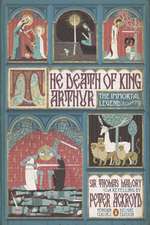 The Death of King ArthurThomas MaloryPreț: 102.44 lei
 -
 -19%Preț: 67.29 lei83.42 lei
 -
 Le Morte Darthur: The Winchester ManuscriptThomas Malory-18%Preț: 63.85 lei77.74 lei
 -
 Martha Stewart's AppetizersMartha Stewart-34%Preț: 147.72 lei225.00 lei
 -
 -28%Preț: 74.70 lei103.09 lei
 -
 The Once and Future KingT. H. WhitePreț: 58.41 lei
 -
 The Story Of King Arthur And His KnightsHoward PylePreț: 40.49 lei
 -
 -8%Preț: 446.99 lei485.86 lei
 -
 Kitchen SecretsRaymond Blanc-24%Preț: 120.52 lei157.86 lei
 -
 Anna KareninaLeo Tolstoy-32%Preț: 195.65 lei286.61 lei
 -
 The Arabian NightsRichard Burton-31%Preț: 197.34 lei287.00 lei
 -
 The Divine ComedyDante Dante-31%Preț: 196.09 lei286.26 lei
 -
 The Story of King Arthur & His KnightsHoward Pyle-28%Preț: 43.77 lei61.17 lei
 -
 Seven NovelsRobert Louis Stevenson-17%Preț: 122.88 lei148.03 lei
 -
 Mark Twain: Five NovelsMark Twain-15%Preț: 123.19 lei145.33 lei
 -
 Jules VerneJules Verne-16%Preț: 121.59 lei144.34 lei
 -
 Bulfinch's MythologyThomas Bulfinch-19%Preț: 117.08 lei144.89 lei
 -
 Les MisérablesVictor Hugo-17%Preț: 126.43 lei153.09 lei
 -
 Selected Works of Jack LondonJack LondonPreț: 169.83 lei
 -
 Tales of King Arthur & the Knights of the Round TableThomas Malory-10%Preț: 126.92 lei141.46 lei
 -
 The Canterbury TalesGeoffrey ChaucerPreț: 38.86 lei
 -
 PinocchioCarlo Collodi-18%Preț: 63.86 lei77.72 lei
 -
 Andersen, H: Fairy TalesHans Christian Andersen-17%Preț: 88.72 lei107.03 lei
 -
 -17%Preț: 77.17 lei92.92 lei
 -
 Grimms' Fairy TalesJacob Grimm-17%Preț: 77.69 lei93.22 lei
 -
 Jacobs, J: English Fairy TalesJoseph Jacobs-16%Preț: 78.63 lei93.80 lei
 -
 The Wind In The WillowsKenneth Grahame-28%Preț: 75.50 lei105.16 lei
 -
 Russian Fairy TalesGillian Avery-20%Preț: 83.07 lei103.57 lei
Descriere
All the legends of King Arthur and the Knights of the Round Table are collected in this illustrated volume.
Notă biografică
No one knows for sure who the author of Le Morte D'Arthur was, but the generally accepted theory is that of American scholar G.L. Kitteredge, who argued it was Sir Thomas Malory, born in the first quarter of the fifteenth century, and who spent the greatest part of his last twenty years in prison. Another possibility is a Thomas Malory of Studley and Hutton in Yorkshire, or an author living north of Warwickshire. It is generally accepted that the author was a member of the gentry and a Lancastrain.
John Lawlor was Professor of English Language and Literature at the University of Keele. He is the author of The Tragic Sense in Shakespeare, Piers Plowman: An Essay in Criticism and Chaucer. Janet Cowen is a senior lecturer in English at King's College, University of London.
John Lawlor was Professor of English Language and Literature at the University of Keele. He is the author of The Tragic Sense in Shakespeare, Piers Plowman: An Essay in Criticism and Chaucer. Janet Cowen is a senior lecturer in English at King's College, University of London.
Recenzii
"I've just finished reading Joseph Glaser's Le Morte D'Arthur. I'm very pleased with it: the introduction is helpful without becoming an extended essay, the suggested reading seems solid and diverse, and the index is VERY useful, even for someone who has read Malory before. At last, a reader can keep all the knights and ladies straight! A fine entry point to a grand text, and when I next have an occasion to teach a course involving chivalry, I'll plan to use this very affordable edition."
—Craig Caldwell, Department of History, Appalachian State University
—Craig Caldwell, Department of History, Appalachian State University
"A highly readable, reduced, and modernized Malory. . . . The effective condensation of a seemingly uncontainable network of narratives is an impressive feat. . . . Glaser's storylines are distinct, not dense, his dialogue is concise, not digressive, and his language is unassuming, not luxuriant. While these features do not match most readers' impressions of Malory's style, his Arthurian tales of adventure, love, death, and betrayal are all here for a new readership to relish.
"[T]his new narrative brings the intersections of plot lines to the fore, helping readers to see the larger structural connections between seemingly disparate episodes and themes. With some of the density removed, readers can more readily see storylines that often get submerged, such as the ongoing feud between the families of King Pellinor and King Lot that starts, stops, and reignites across multiple books. Glaser even appends a detailed index of characters and important objects that includes short descriptions of their appearances in sequence throughout the text. This index is exceedingly helpful because it highlights unifying themes and character development as well as clearly demonstrates that the main character of the Morte is Lancelot, not Arthur. Whereas Arthur's index entry is approximately a page and a half long, Tristram's is two pages, and Lancelot's is close to three. The index also reveals amusing repetitions and contradictions, including two dead Colgrevaunces and five Elaines."
—Alex Mueller, University of Massachusetts, Boston, in The Medieval Review
"[T]his new narrative brings the intersections of plot lines to the fore, helping readers to see the larger structural connections between seemingly disparate episodes and themes. With some of the density removed, readers can more readily see storylines that often get submerged, such as the ongoing feud between the families of King Pellinor and King Lot that starts, stops, and reignites across multiple books. Glaser even appends a detailed index of characters and important objects that includes short descriptions of their appearances in sequence throughout the text. This index is exceedingly helpful because it highlights unifying themes and character development as well as clearly demonstrates that the main character of the Morte is Lancelot, not Arthur. Whereas Arthur's index entry is approximately a page and a half long, Tristram's is two pages, and Lancelot's is close to three. The index also reveals amusing repetitions and contradictions, including two dead Colgrevaunces and five Elaines."
—Alex Mueller, University of Massachusetts, Boston, in The Medieval Review
"Glaser's project of modernizing and condensing Malory's Le Morte D'Arthur is refreshingly successful. Both an extremely accessible introduction to the text for beginners and a handy reference tool for experts, the compact volume can easily be enjoyed by all modern readers."
—Rachel Levinson-Emley, University of California, Santa Barbara, in Comitatus
—Rachel Levinson-Emley, University of California, Santa Barbara, in Comitatus
"Preserves most of the original and provides a simplified reduction for the bewildering array of plot lines and characters who wind in, and out, and often back in again to the narrative thread. Hackett Publishing Company and Joseph Glaser have provided an aesthetically appealing, serviceable, and inexpensive addition to the Malory shelf.”
—Katherine Haynes, Aquinas College Nashville, in Sixteenth Century Journal
—Katherine Haynes, Aquinas College Nashville, in Sixteenth Century Journal