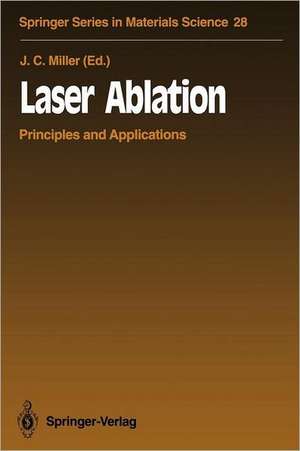
Laser Ablation: Springer Series in Materials Science, cartea 28
Editat de John C. Milleren Limba Engleză Paperback – 8 dec 2011
Din seria Springer Series in Materials Science
- 18%
 Preț: 1271.73 lei
 - 18%
 Preț: 1778.82 lei
 - 18%
 Preț: 1001.54 lei
 - 15%
 Preț: 581.81 lei
 - 18%
 Preț: 989.42 lei
 - 18%
 Preț: 940.77 lei
 - 18%
 Preț: 991.80 lei
 - 18%
 Preț: 1297.99 lei
 - 18%
 Preț: 1271.83 lei
 - 18%
 Preț: 1150.30 lei
 - 18%
 Preț: 1439.81 lei
 - 18%
 Preț: 924.14 lei
 -
 Preț: 447.75 lei
 - 24%
 Preț: 1014.10 lei
 - 18%
 Preț: 981.33 lei
 - 18%
 Preț: 1171.42 lei
 - 15%
 Preț: 644.51 lei
 - 18%
 Preț: 954.08 lei
 - 15%
 Preț: 667.19 lei
 - 24%
 Preț: 940.03 lei
 - 24%
 Preț: 1201.95 lei
 - 18%
 Preț: 1002.41 lei
 - 18%
 Preț: 1271.16 lei
 - 18%
 Preț: 1267.90 lei
 - 18%
 Preț: 944.71 lei
 - 18%
 Preț: 2061.38 lei
 - 15%
 Preț: 646.82 lei
 - 18%
 Preț: 1286.25 lei
 - 18%
 Preț: 993.27 lei
 - 15%
 Preț: 662.58 lei
 - 18%
 Preț: 1283.56 lei
 - 18%
 Preț: 983.13 lei
 - 18%
 Preț: 994.32 lei
 - 15%
 Preț: 664.14 lei
 - 18%
 Preț: 986.35 lei
Preț: 638.81 lei
Preț vechi: 751.54 lei
-15%
Puncte Express: 958
Carte tipărită la comandă
Livrare economică 02-16 decembrie
Livrare prin curier în România Termenul estimat este afișat lângă disponibilitate.
Transport gratuit pentru acest produs Plată online sau ramburs, în funcție de opțiunile comenzii.
Retur gratuit în 14 zile Comandă securizată și suport în română.
Specificații
ISBN-13: 9783642787225
ISBN-10: 3642787223
Pagini: 204
Ilustrații: XII, 187 p.
Dimensiuni: 155 x 235 x 12 mm
Greutate: 0.29 kg
Ediția:Softcover reprint of the original 1st ed. 1994
Editura: Springer
Colecția Springer Series in Materials Science
Seria Springer Series in Materials Science
Locul publicării:Berlin, Heidelberg, Germany
ISBN-10: 3642787223
Pagini: 204
Ilustrații: XII, 187 p.
Dimensiuni: 155 x 235 x 12 mm
Greutate: 0.29 kg
Ediția:Softcover reprint of the original 1st ed. 1994
Editura: Springer
Colecția Springer Series in Materials Science
Seria Springer Series in Materials Science
Locul publicării:Berlin, Heidelberg, Germany
V-ar putea interesa
-
 -30%Preț: 543.01 lei781.08 lei
 -
 Introduction to Organic SpectroscopyLaurence M. Harwood-13%Preț: 252.24 lei290.39 lei
 -
 Optical Spectroscopy of Inorganic SolidsBrian Henderson-32%Preț: 671.56 lei988.98 lei
 -
 Internal Reflection and ATR SpectroscopyMilan Milosevic-8%Preț: 650.06 lei706.59 lei
 -
 Impedance SpectroscopyLvovich-9%Preț: 768.96 lei845.01 lei
 -
 Mass Spectrometry in Structural Biology and BiophysicsIgor A Kaltashov-9%Preț: 1016.32 lei1116.83 lei
 -
 Applied Electrospray Mass Spectrometry: Practical Spectroscopy Series Volume 32Birendra N. Pramanik-18%Preț: 2332.53 lei2844.55 lei
 -
 Organic Spectroscopy WorkbookJean-Pierre Rabine-19%Preț: 437.96 lei540.69 lei
 -
 XAFS for EveryoneScott Calvin-28%Preț: 683.02 lei955.22 lei
 -
 Telescopes and TechniquesC. R. KitchinPreț: 423.04 lei
 -
 Using Commercial Amateur Astronomical SpectrographsJeffrey L. HopkinsPreț: 328.37 lei
 -
 -11%Preț: 524.67 lei589.52 lei
Public țintă
ResearchCuprins
1. History, Scope, and the Future of Laser Ablation.- 1.1 Introduction.- 1.2 History of Laser Ablation Studies and Applications.- References.- 2. Electronic Processes in Laser Ablation of Semiconductors and Insulators.- 2.1 Electronic Mechanisms in Desorption and Ablation.- 2.2 Interaction of Photons with Solids.- 2.3 Electron-Lattice Interactions and the Localized Excited State.- 2.4 Creation and De-Excitation of the Localized Excited State.- 2.5 Survey of Experimental Results.- 2.6 Models of Laser-Induced Desorption.- 2.7 Simulation of Laser Ablation.- 2.8 Summary and Conclusions.- References.- 3. Laser Ablation and Optical Surface Damage.- 3.1 Introductory Remarks.- 3.2 Characteristics of Optical Surface Damage.- 3.3 Possible Causes of Optical Damage.- 3.4 Investigation of Optical Surface Damage Mechanisms.- 3.5 Concluding Remarks.- References.- 4. Pulsed-Laser Deposition of High-Temperature Superconducting Thin Films.- 4.1 Advantages of Pulsed-Laser Deposition.- 4.2 Materials Base.- 4.3 Laser-Beam-Target Interaction.- 4.4 Dynamics of the Laser-Produced Plume.- 4.5 Evaporant-Substrate Interaction.- 4.6 Frontiers of High-Temperature Superconducting Thin-Film Research.- 4.7 Scaling-up to Larger Areas.- 4.8 Future Directions.- 4.9 Summary.- References.- 5. Interaction of Laser Radiation with Organic Polymers.- 5.1 History.- 5.2 Characteristics of UV-Laser Ablation.- 5.3 Chemical Physics of the Ablation Process.- 5.4 Theories of Ultraviolet-Laser Ablation.- 5.5 Contemporary Trends in UV-Laser Ablation.- References.- 6. Laser Ablation and Laser Desorption Techniques with Fourier-Transform Mass Spectrometry (FTMS).- 6.1 Principles of FTMS Operation.- 6.2 Laser-Ablation FTMS for Clusters.- 6.3 Laser-Desorption FTMS for Biomolecules.- 6.4 Future Directions.- 6.5 Conclusions.- References.- 7. Diagnostic Studies of Laser Ablation for Chemical Analysis.- 7.1 Laser Ablation in Vacuum.- 7.2 Laser Ablation in an Atmosphere.- References.