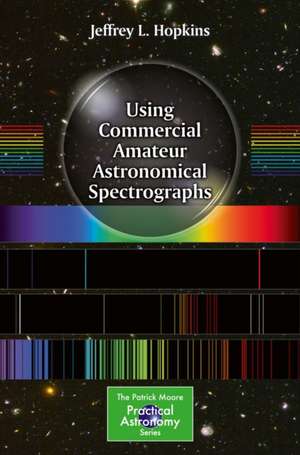
Using Commercial Amateur Astronomical Spectrographs: The Patrick Moore Practical Astronomy Series
Autor Jeffrey L. Hopkinsen Limba Engleză Paperback – 2 dec 2013
Bazându-ne pe documentația tehnică a editurii Springer, remarcăm că Using Commercial Amateur Astronomical Spectrographs se distinge prin pragmatismul său extrem. Spre deosebire de manualele care se limitează la optica teoretică, Jeffrey L. Hopkins structurează acest volum ca un ghid de implementare pentru astronomul amator care dorește să depășească etapa simplei observații vizuale. Reținem că autorul selectează patru instrumente etalon de pe piață pentru a exemplifica fluxul de lucru: de la accesibilul Star Analyser, ideal pentru inițiere, până la complexul Lhires III, capabil să furnizeze date de precizie pentru colaborări Pro-Am. Cititorii familiarizați cu Grating Spectroscopes and How to Use Them de Ken M. Harrison vor aprecia faptul că volumul de față nu se oprește la rețelele de difracție de tip filtru, ci avansează spre spectrografia de înaltă rezoluție și instrumente dedicate precum ALPY 600. Structura cărții facilitează o progresie logică: prima parte fundamentează teoria necesară în laborator și sub cerul liber, partea a doua se concentrează pe manipularea fizică a echipamentului și achiziția de date, în timp ce secțiunea finală este dedicată analizei post-procesare prin software-uri precum RSpec sau Vspec. Remarcăm includerea unor soluții accesibile pentru procesarea datelor, inclusiv utilizarea Excel-ului, ceea ce face ca tranziția către rigoarea științifică să fie mai puțin intimidantă pentru începători.
Din seria The Patrick Moore Practical Astronomy Series
-
 Preț: 293.27 lei
 -
 Preț: 270.98 lei
 -
 Preț: 277.52 lei
 -
 Preț: 205.97 lei
 -
 Preț: 261.62 lei
 -
 Preț: 198.45 lei
 -
 Preț: 306.34 lei
 -
 Preț: 260.10 lei
 -
 Preț: 218.04 lei
 -
 Preț: 253.36 lei
 -
 Preț: 214.61 lei
 -
 Preț: 317.37 lei
 -
 Preț: 213.03 lei
 -
 Preț: 262.69 lei
 -
 Preț: 419.67 lei
 -
 Preț: 253.68 lei
 -
 Preț: 280.23 lei
 -
 Preț: 221.36 lei
 -
 Preț: 314.96 lei
 -
 Preț: 324.65 lei
 -
 Preț: 265.51 lei
 -
 Preț: 174.23 lei
 -
 Preț: 242.50 lei
 -
 Preț: 361.15 lei
 -
 Preț: 198.30 lei
 -
 Preț: 152.91 lei
 -
 Preț: 251.24 lei
 -
 Preț: 198.62 lei
 -
 Preț: 289.34 lei
 -
 Preț: 245.95 lei
 -
 Preț: 207.71 lei
 -
 Preț: 185.35 lei
 -
 Preț: 295.69 lei
 -
 Preț: 314.31 lei
 -
 Preț: 292.61 lei
 -
 Preț: 265.17 lei
 -
 Preț: 199.42 lei
 -
 Preț: 203.03 lei
 -
 Preț: 200.54 lei
 -
 Preț: 293.13 lei
 -
 Preț: 202.74 lei
 -
 Preț: 325.25 lei
 -
 Preț: 234.37 lei
 - 15%
 Preț: 671.63 lei
 -
 Preț: 257.38 lei
 -
 Preț: 270.13 lei
 -
 Preț: 293.18 lei
 -
 Preț: 205.46 lei
 -
 Preț: 314.31 lei
 -
 Preț: 144.54 lei
Preț: 316.06 lei
Carte tipărită la comandă
Livrare economică 12-26 iunie
Specificații
ISBN-10: 3319014412
Pagini: 320
Ilustrații: XXXI, 286 p. 269 illus., 62 illus. in color.
Dimensiuni: 155 x 235 x 17 mm
Greutate: 0.55 kg
Ediția:2014
Editura: Springer
Colecția The Patrick Moore Practical Astronomy Series
Seria The Patrick Moore Practical Astronomy Series
Locul publicării:Cham, Switzerland
V-ar putea interesa
-
 MoongazingCollins AstronomyPreț: 61.33 lei
 -
 Northern LightsCollins AstronomyPreț: 61.48 lei
 -
 2026 Guide to the Night SkyCollins AstronomyPreț: 55.04 lei
 -
 The Backyard Astronomer's GuideAlan DyerPreț: 315.05 lei
 -
 XAFS for EveryoneScott Calvin-9%Preț: 723.66 lei795.24 lei
 -
 Turn Left at OrionGuy ConsolmagnoPreț: 236.54 lei
 -
 Introduction to SpectroscopyDonald Pavia-26%Preț: 564.19 lei766.90 lei
 -
 The Astronomy HandbookWilliam PotterPreț: 48.74 lei
 -
 AstronomyDinah L. MochePreț: 165.75 lei
 -
 TelescopesDalton RainsPreț: 49.65 lei
 -
 Preț: 103.98 lei
 -
 Practical Projects for AstronomersNeil WyattPreț: 126.13 lei
 -
 -26%Preț: 36.37 lei48.93 lei
 -
 The Amateur AstronomerPatrick MoorePreț: 294.25 lei
 -
 Galaxies and How to Observe ThemWolfgang SteinickePreț: 186.94 lei
 -
 Preț: 67.90 lei
 -
 AstrophotographyThierry Legault-20%Preț: 269.79 lei335.60 lei
 -
 A Deep Sky Astrophotography PrimerMichael O'BrienPreț: 253.68 lei
 -
 The Art and Science of CCD AstronomyDavid RatledgePreț: 288.22 lei
 -
 Aurora Borealis - Polarlicht 2026 - 16-MonatskalenderBrowntrout PublishersPreț: 92.92 lei
Public țintă
Popular/generalDe ce să citești această carte
Recomandăm această carte oricărui pasionat de astronomie care dorește să transforme telescopul dintr-un instrument de contemplare într-unul de cercetare. Cititorul câștigă expertiză practică în utilizarea directă a spectrografelor comerciale, învățând nu doar cum funcționează acestea, ci cum să obțină spectre de calitate ce pot fi utilizate în proiecte științifice reale. Este puntea ideală între hobby și astronomia profesionistă.
Despre autor
Jeffrey L. Hopkins este un astronom amator cu o experiență vastă în fotometrie și spectroscopie, fiind recunoscut pentru contribuțiile sale în comunitatea observațională. Prin publicațiile sale din seria The Patrick Moore Practical Astronomy Series, Hopkins s-a specializat în transformarea conceptelor astrofizice complexe în metodologii de lucru accesibile pentru amatori. Expertiza sa în utilizarea echipamentelor digitale și a software-ului de analiză este reflectată în modul detaliat în care explică operarea spectrografelor moderne în acest volum.
Descriere scurtă
The book includes a clear explanation of the laboratory theory behind astronomical spectrographs, and goes on to extensively cover the practical application of astronomical spectroscopy in detail. Four popular and reasonably-priced commercially available diffraction grating spectrographs are used as examples. The first is a low-resolution transmission diffraction grating, the Star Analyser spectrograph. The second is an inexpensive fiber optic coupled bench spectrograph that can be used to learn more about spectroscopy. The third is a newcomer, the ALPY 600 spectrograph. The fourth spectrograph considered is at the other end of the market both in performance and cost, the high-resolution Lhires III. While considerably more expensive, this is a popular and excellent scientific instrument, that allows more advanced amateur astronomers to produce scientifically valuable data.
With all of these tools in place, the amateur astronomer is well-prepared to forger deeper into the night sky using spectroscopy.
Cuprins
Notă biografică
Hopkins's publications include Zen and the Art of Photoelectric Photometry (1990), Workbook for Astronomical Photoelectric Photometry (1990, co-author Dr. Paul Schmidtke), AutoStar CCD Photometry (2007, co-author Gene Lucas), Epsilon Aurigae A Mysterious Star System (2008, co-author Dr. Robert Stencel), and Small Telescope Astronomical Spectroscopy (2012). He has had articles published in Astronomy, and Sky & Telescope magazines, and is the author of over 50 professional papers, including several presented at the Society for Astronomical Sciences Symposiums in Big Bear, California. In January 2011 he presented to the American Astronomical Society meeting in Seattle, Washington.