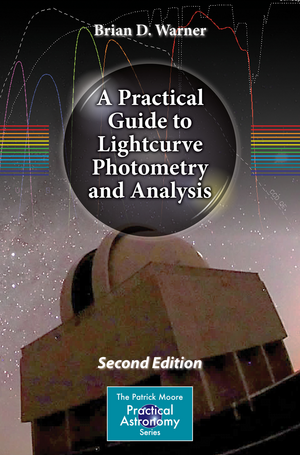
A Practical Guide to Lightcurve Photometry and Analysis: The Patrick Moore Practical Astronomy Series
Autor Brian D. Warneren Limba Engleză Paperback – 29 iun 2016
Evoluția astronomiei de amatori din ultimele decenii a transformat simpla astrofotografie estetică într-o contribuție științifică reală, proces reflectat fidel în această a doua ediție a lucrării A Practical Guide to Lightcurve Photometry and Analysis. Notăm cu interes cum Brian D. Warner reușește să sintetizeze progresele tehnologice recente în domeniul camerelor CCD și al telescoapelor, oferind un fundament metodologic pentru cei care doresc să treacă dincolo de observarea vizuală către analiza cantitativă.
Descoperim aici o structură riguroasă, organizată pentru a ghida cititorul prin toate etapele necesare cercetării: de la fundamentele fotometriei și reducerea datelor, până la analiza perioadelor și modelarea sistemelor stelare. Autorul insistă asupra aspectelor practice, precum extincția de ordinul doi sau utilizarea software-ului specializat, elemente critice pentru obținerea unor rezultate publicabile. Cartea reprezintă o alternativă aplicată la Introduction to Astronomical Photometry de Edwin Budding pentru cursurile de astronomie observațională, cu avantajul unei focalizări stricte pe analiza curbelor de lumină și pe evitarea capcanelor metodologice specifice asteroizilor și stelelor variabile.
Spre deosebire de ghidurile generale, A Practical Guide to Lightcurve Photometry and Analysis oferă instrumente concrete pentru determinarea proprietăților fizice ale corpurilor cerești — cum ar fi forma și perioada de rotație a asteroizilor sau orbitele sistemelor binare — folosind echipamente comerciale. Integrarea hărților de identificare și a pașilor detaliați pentru colectarea fotonilor transformă acest volum într-un manual de lucru esențial pentru orice astronom amator care urmărește rigoarea științifică.
Din seria The Patrick Moore Practical Astronomy Series
-
 Preț: 293.27 lei
 -
 Preț: 270.98 lei
 -
 Preț: 277.52 lei
 -
 Preț: 205.97 lei
 -
 Preț: 261.62 lei
 -
 Preț: 198.45 lei
 -
 Preț: 306.34 lei
 -
 Preț: 260.10 lei
 -
 Preț: 218.04 lei
 -
 Preț: 253.36 lei
 -
 Preț: 214.61 lei
 -
 Preț: 317.37 lei
 -
 Preț: 213.03 lei
 -
 Preț: 262.69 lei
 -
 Preț: 253.68 lei
 -
 Preț: 280.23 lei
 -
 Preț: 221.36 lei
 -
 Preț: 314.96 lei
 -
 Preț: 324.65 lei
 -
 Preț: 265.51 lei
 -
 Preț: 174.23 lei
 -
 Preț: 242.50 lei
 -
 Preț: 361.15 lei
 -
 Preț: 198.30 lei
 -
 Preț: 152.91 lei
 -
 Preț: 251.24 lei
 -
 Preț: 198.62 lei
 -
 Preț: 289.34 lei
 -
 Preț: 245.95 lei
 -
 Preț: 207.71 lei
 -
 Preț: 185.35 lei
 -
 Preț: 295.69 lei
 -
 Preț: 314.31 lei
 -
 Preț: 292.61 lei
 -
 Preț: 265.17 lei
 -
 Preț: 199.42 lei
 -
 Preț: 203.03 lei
 -
 Preț: 200.54 lei
 -
 Preț: 293.13 lei
 -
 Preț: 202.74 lei
 -
 Preț: 325.25 lei
 -
 Preț: 234.37 lei
 - 15%
 Preț: 671.63 lei
 -
 Preț: 257.38 lei
 -
 Preț: 270.13 lei
 -
 Preț: 293.18 lei
 -
 Preț: 205.46 lei
 -
 Preț: 314.31 lei
 -
 Preț: 144.54 lei
Preț: 419.67 lei
Carte disponibilă
Livrare economică 22 mai-05 iunie
Specificații
ISBN-10: 3319327496
Pagini: 432
Ilustrații: XXII, 410 p. 202 illus., 52 illus. in color.
Dimensiuni: 155 x 235 x 22 mm
Greutate: 0.73 kg
Ediția:2nd edition 2016
Editura: Springer
Colecția The Patrick Moore Practical Astronomy Series
Seria The Patrick Moore Practical Astronomy Series
Locul publicării:Cham, Switzerland
V-ar putea interesa
-
 Feynman's Lost LectureDavid L Goodstein-35%Preț: 49.01 lei74.83 lei
 -
 The Mathematical Theory of Black HolesS. Chandrasekhar-21%Preț: 593.42 lei752.46 lei
 -
 Flat and Curved Space-TimesG. F. R. Ellis-19%Preț: 459.35 lei565.20 lei
 -
 Astrophysical LasersVladilen Letokhov-34%Preț: 783.84 lei1182.73 lei
 -
 -23%Preț: 267.68 lei346.48 lei
 -
 In Search of Dark MatterKen FreemanPreț: 265.62 lei
 -
 Unmasking EuropaRichard GreenbergPreț: 278.13 lei
 -
 Measuring and Modeling the UniverseWendy L. FreedmanPreț: 363.41 lei
 -
 Compact Stellar X-ray SourcesWalter Lewin-11%Preț: 538.49 lei605.05 lei
 -
 -23%Preț: 697.87 lei906.32 lei
 -
 Astrophysics for PhysicistsArnab Rai Choudhuri-19%Preț: 534.75 lei660.19 lei
 -
 Nucleosynthesis and Chemical Evolution of GalaxiesBernard E. J. Pagel-19%Preț: 673.97 lei832.07 lei
 -
 Exploring the X-Ray UniverseFrederick D Seward-8%Preț: 526.53 lei572.32 lei
 -
 Stellar Spectral ClassificationRichard O. Gray-19%Preț: 611.63 lei755.10 lei
 -
 Black Holes, Wormholes and Time MachinesJim Al–khaliliPreț: 409.06 lei
 -
 Astrophysics of the Diffuse UniverseMichael A. Dopita-15%Preț: 573.56 lei674.77 lei
De ce să citești această carte
Această carte este ideală pentru astronomii amatori și studenții la fizică ce dețin un telescop și o cameră CCD și doresc să producă date cu valoare științifică. Cititorul câștigă expertiză în tehnici de fotometrie precisă, învățând să identifice perioade de rotație ale asteroizilor sau sateliți asteroidali. Este un salt necesar de la simpla imagine astronomică la „știința reală”, oferind toate instrumentele pentru publicarea rezultatelor în jurnale de specialitate.
Despre autor
Brian D. Warner este o figură proeminentă în comunitatea astronomică, recunoscut pentru expertiza sa în fotometria asteroizilor. Prin activitatea sa, a demonstrat că astronomii amatori pot juca un rol crucial în caracterizarea micilor corpuri din sistemul solar. Contribuțiile sale includ numeroase lucrări de cercetare și dezvoltarea de software dedicat analizei curbelor de lumină. În cadrul seriei The Patrick Moore Practical Astronomy Series, Warner acționează ca un mentor tehnic, punând accent pe precizia măsurătorilor și pe rigoarea analitică necesară pentru ca datele colectate de amatori să fie validate de comunitatea academică.
Cuprins
Recenzii
Notă biografică
Textul de pe ultima copertă
Brian Warner yet again delivers all the material needed for readers to understand the theory, and avoid the practical pitfalls of lightcurve photometry. Detailed examples are given for obtaining data, and of course for the exciting and rewarding task of analyzing the data to determine the physical properties of the objects. It also includes many detailed finder charts with magnitudes for reference and detailed steps on how to go about gathering data for specific projects without misinterpretation. Any college student or amateur astronomer who wants to go beyond mere imaging with a CCD camera and enter the challenging world of "real science" via the lightcurves of asteroids and binary stars will find everything necessary in this updated book.