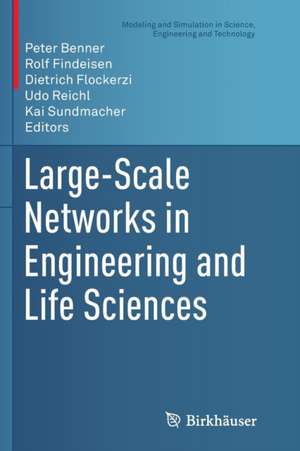
Large-Scale Networks in Engineering and Life Sciences: Modeling and Simulation in Science, Engineering and Technology
Editat de Peter Benner, Rolf Findeisen, Dietrich Flockerzi, Udo Reichl, Kai Sundmacheren Limba Engleză Paperback – 23 aug 2016
Relevanța acestui volum pentru programele de masterat și doctorat în matematică aplicată și inginerie derivă din capacitatea sa de a unifica metodologii care, de regulă, sunt predate separat. Găsim în această carte un fundament teoretic solid pentru analiza și controlul rețelelor de mari dimensiuni, o necesitate stringentă în contextul sistemelor complexe moderne. Merită menționat că volumul își are rădăcinile în cursurile predate la școala de vară a Institutului Max Planck din Magdeburg, ceea ce îi conferă o valoare pedagogică deosebită, fiecare capitol fiind conceput ca un suport de curs de sine stătător. Structura volumului reflectă o progresie logică: începe cu bazele teoretice ale ecuațiilor diferențiale ordinare aplicate în procese chimice și circuite electrice (capitolele 1-2), trece prin optimizarea combinatorie și fluxurile în rețele (capitolul 4), pentru a culmina cu aplicații avansate în biologia sistemelor și modelarea hibridă (capitolele 5-7). Această organizare permite cititorului să observe cum instrumente matematice similare pot fi aplicate atât în ingineria proceselor, cât și în științele vieții. În contextul operei editorului Peter Benner, volumul se aliniază preocupărilor sale centrale legate de eficientizarea sistemelor complexe, completând lucrări precum Model Reduction of Parametrized Systems. Dacă acele titluri se concentrează pe reducerea ordinului sistemelor, volumul de față extinde perspectiva către controlul și analiza interacțiunilor în rețea. Reținem că această lucrare completează perspectiva oferită de The Mathematics of Networks of Linear Systems, adăugând o dimensiune interdisciplinară esențială prin includerea sistemelor non-liniare și a aplicațiilor biologice specifice, elemente pe care un text pur algebric nu le acoperă integral.
Din seria Modeling and Simulation in Science, Engineering and Technology
- 18%
 Preț: 899.01 lei
 -
 Preț: 395.25 lei
 - 18%
 Preț: 1120.90 lei
 - 20%
 Preț: 888.14 lei
 - 15%
 Preț: 555.47 lei
 - 15%
 Preț: 643.25 lei
 - 18%
 Preț: 1174.74 lei
 - 15%
 Preț: 647.09 lei
 - 24%
 Preț: 586.79 lei
 - 15%
 Preț: 671.87 lei
 - 15%
 Preț: 647.04 lei
 - 15%
 Preț: 620.23 lei
 - 15%
 Preț: 643.90 lei
 - 18%
 Preț: 1432.11 lei
 - 15%
 Preț: 647.44 lei
 - 15%
 Preț: 656.74 lei
 - 15%
 Preț: 680.17 lei
 - 15%
 Preț: 649.61 lei
 - 19%
 Preț: 459.48 lei
 -
 Preț: 385.06 lei
 - 18%
 Preț: 707.66 lei
 - 27%
 Preț: 714.32 lei
 - 18%
 Preț: 979.20 lei
 -
 Preț: 394.52 lei
 - 18%
 Preț: 1226.11 lei
 - 18%
 Preț: 910.89 lei
 - 15%
 Preț: 662.05 lei
 - 15%
 Preț: 625.09 lei
 -
 Preț: 397.79 lei
 -
 Preț: 399.70 lei
 - 15%
 Preț: 669.27 lei
 -
 Preț: 395.45 lei
 - 20%
 Preț: 671.27 lei
 - 15%
 Preț: 598.33 lei
 - 15%
 Preț: 667.62 lei
 - 24%
 Preț: 529.41 lei
 -
 Preț: 451.99 lei
 - 18%
 Preț: 746.75 lei
 - 15%
 Preț: 615.85 lei
 -
 Preț: 390.01 lei
Preț: 397.70 lei
Carte tipărită la comandă
Livrare economică 20 noiembrie-04 decembrie
Livrare express 15-21 octombrie pentru 70.43 lei
Specificații
ISBN-10: 3319361287
Pagini: 404
Ilustrații: XIV, 388 p. 111 illus., 63 illus. in color.
Dimensiuni: 155 x 235 x 22 mm
Greutate: 0.61 kg
Ediția:Softcover reprint of the original 1st edition 2014
Editura: birkhäuser
Colecția Modeling and Simulation in Science, Engineering and Technology
Seria Modeling and Simulation in Science, Engineering and Technology
Locul publicării:Cham, Switzerland
V-ar putea interesa
-
 -31%Preț: 851.26 lei1238.43 lei
 -
 The Factorization Method for Inverse ProblemsAndreas Kirsch-31%Preț: 724.25 lei1052.81 lei
 -
 An Introduction to Difference EquationsSaber Elaydi-15%Preț: 520.57 lei612.43 lei
 -
 Hyperbolic Partial Differential EquationsSerge AlinhacPreț: 461.98 lei
 -
 Critical Point Theory and Hamiltonian SystemsJean Mawhin-18%Preț: 1008.06 lei1229.34 lei
 -
 -11%Preț: 446.62 lei501.82 lei
 -
 Trends in PDE Constrained OptimizationGünter Leugering-18%Preț: 803.80 lei980.24 lei
 -
 Stochastic Integration and Differential EquationsPhilip Protter-18%Preț: 742.85 lei905.90 lei
 -
 Ordinary Differential EquationsVladimir I. Arnold-17%Preț: 525.45 lei633.08 lei
 -
 Nonlinear Differential Equations and Dynamical SystemsFerdinand VerhulstPreț: 459.23 lei
 -
 Random Dynamical SystemsLudwig Arnold-18%Preț: 827.90 lei1009.63 lei
De ce să citești această carte
Această carte este o resursă esențială pentru cercetătorii și studenții la nivel postuniversitar care doresc să stăpânească modelarea matematică a sistemelor complexe. Cititorul câștigă o înțelegere riguroasă a modului în care teoria grafurilor, optimizarea și controlul interacționează în inginerie și biologie. Este o alegere excelentă pentru cei care au nevoie de un fundament teoretic solid, testat în cadrul academic de elită al Institutului Max Planck.
Despre autor
Peter Benner este un matematician de renume, director la Institutul Max Planck pentru Dinamica Sistemelor Tehnice Complexe din Magdeburg. Expertiza sa se concentrează pe controlul sistemelor, algebra liniară numerică și reducerea ordinului modelelor. Împreună cu co-editorii Rolf Findeisen și Dietrich Flockerzi, acesta a coordonat numeroase volume în seria Modeling and Simulation in Science, Engineering and Technology. Lucrările sale sunt fundamentale pentru dezvoltarea algoritmilor utilizați în simularea sistemelor dinamice de mari dimensiuni, fiind un reper în literatura de specialitate pentru rigoarea și aplicabilitatea metodelor propuse.
Descriere scurtă
The book originates from the interdisciplinary summer school “Large Scale Networks in Engineering and Life Sciences” hosted by the International Max Planck Research School Magdeburg, September 26-30, 2011, and will therefore be of interest to mathematicians, engineers, physicists, biologists, chemists, and anyone involved in the network sciences. In particular, due to their introductory nature the chapters can serve individually or as a whole as the basis of graduate courses and seminars, future summer schools, or as reference material for practitioners in the network sciences.
Cuprins
Notă biografică
Prof. Dr.-Ing. Rolf Findeisen is a professor of Mathematics and Chair for Systems Theory and Automatic Control at Otto-von-Guericke-University Magdeburg, Institute for Automation Engineering.
Prof. Dr. Dietrich Flockerzi is a professor of Mathematics and a Member of the organizational unit: Max Planck Institute for Dynamics of Complex Technical Systems and Systems and Control Theory.
Prof. Dr.-Ing. Udo Reichl has held the Chair of Bioprocess Engineering at the University of Magdeburg, and he was appointed Director at the MPI for the Dynamics of Complex Technical Systems in 2000.
Prof. Dr.-Ing. Kai Sundmacher is head of Research Group "Physical and Chemical Process Engineering", Max Planck Institute for Dynamics of Complex Technical Systems, Magdeburg and a professor for Process Systems Engineering at Otto-von-Guericke-University Magdeburg. He is also a director and scientific member at the Max Planck Institute for Dynamics of Complex Technical Systems, Magdeburg.