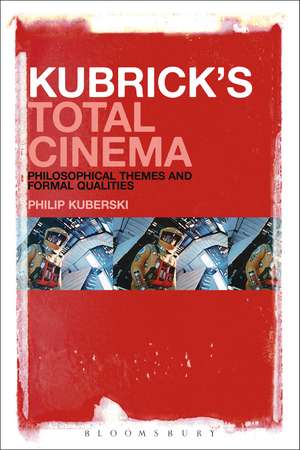
Kubrick's Total Cinema: Philosophical Themes and Formal Qualities
Autor Philip Kuberskien Limba Engleză Paperback – 13 feb 2014
În capitolul dedicat Luminii, suntem invitați să percepem cum Stanley Kubrick folosește claritatea vizuală nu doar ca estetică, ci ca instrument de „de-realizare” a realismului cinematografic. Kubrick's Total Cinema reprezintă o incursiune senzorială în mecanismele profunde ale unei viziuni care a refuzat convențiile, propunând în schimb o experiență de o onestitate tehnică aproape vertiginoasă. Apreciem modul în care Philip Kuberski reușește să izoleze acea „răceală” distinctivă a regizorului, transformând analiza formală într-o explorare a modului în care filmul poate deveni un vehicul pentru gândirea pură.
Pe raftul de artă, alături de Stanley Kubrick de Mario Falsetto, acest volum se distinge prin abandonarea structurii cronologice în favoarea unei organizări pe elemente fundamentale. Dacă studiul lui Falsetto urmărește evoluția regizorului de la primele pelicule la capodoperele târzii, Kuberski preferă o abordare transversală. Structura cărții, fragmentată în unsprezece capitole tematice precum Timpul, Erosul, Muzica sau Tehnologia, indică o dorință de a diseca „cinematograful total” ca pe un organism viu, nu ca pe o succesiune de evenimente istorice. Credem că această perspectivă oferă cititorului o înțelegere mai profundă a unității tematice kubrickiene, unde discursul și corporeitatea sunt la fel de relevante ca strategiile de război.
Raportându-ne la opera anterioară a autorului, în special la The Persistence of Memory – Organism, Myth, Text, observăm o continuitate în interesul său pentru intersecția dintre mit, tehnologie și memorie. În acest nou volum, Kuberski aplică rigoarea sa academică asupra paradoxurilor vizuale, oferind un context filosofic ce variază de la idealismul kantian la psihanaliza modernă, totul pentru a explica acea ambiguitate intratabilă care face filmele lui Kubrick să rămână actuale.
Preț: 205.81 lei
Preț vechi: 278.04 lei
-26%
Carte tipărită la comandă
Livrare economică 08-22 decembrie
Specificații
ISBN-10: 1628929472
Pagini: 202
Dimensiuni: 150 x 228 x 14 mm
Greutate: 0.3 kg
Editura: Bloomsbury Publishing
Colecția Bloomsbury Academic
Locul publicării:New York, United States
V-ar putea interesa
-
 Sculpting in Time: Reflections on the CinemaAndrey TarkovskyPreț: 245.90 lei
 -
 Voice & Vision: A Creative Approach to Narrative FilmmakingMick Hurbis-Cherrier-8%Preț: 543.81 lei591.10 leiRecomandat
 -
 Tarkovsky: Films, Stills, Polaroids & WritingsAndrey A. Tarkovsky-17%Preț: 232.05 lei280.82 lei
 -
 The Mysteries of CinemaPeter ConradPreț: 191.44 lei
 -
 Suddenly Something ClickedWalter MurchPreț: 238.95 lei
 -
 KubrickRobert P. KolkerPreț: 149.68 lei
 -
 The Dehumanization of Art and Other Essays on Art, Culture, and LiteratureJosé Ortega Y. GassetPreț: 93.58 lei
 -
 -14%Preț: 555.37 lei645.78 lei
 -
 David Lynch: Revised & Updated EditionColin Odell-19%Preț: 97.07 lei120.29 lei
 -
 Bong Joon Ho: Philosopher and FilmmakerAnthony Curtis Adler-15%Preț: 163.64 lei193.34 lei
 -
 Lynchian: The Spell of David LynchJohn Higgs-26%Preț: 78.64 lei106.84 lei
 -
 Cinema I: The Movement-ImageGilles Deleuze-19%Preț: 171.63 lei211.51 lei
 -
 The Transitional Human BeingRon KubatiPreț: 314.46 lei
 -
 -31%Preț: 450.53 lei657.11 lei
 -
 2001: A Space OdysseyPeter Krämer-32%Preț: 66.78 lei98.89 lei
 -
 On KubrickJames NaremorePreț: 252.44 lei
 -
 In the Blink of An Eye: New EditionWalter MurchPreț: 79.33 lei
 -
 -17%Preț: 138.31 lei166.83 lei
 -
 The Stanley Kubrick ArchivesAlison CastlePreț: 192.65 lei
 -
 A Cinematic Mode of Existence: Perspectival Analytic of the ImageHalbe Hessel Kuipers-32%Preț: 628.64 lei926.98 lei
De ce să citești această carte
Recomandăm această carte studenților și pasionaților de cinematografie care doresc să treacă dincolo de simpla recenzie de film. Cititorul câștigă un aparat critic sofisticat prin care poate decoda simbolismul ascuns în lumina și sunetul capodoperelor kubrickiene. Este o lectură esențială pentru a înțelege cum rigoarea tehnică și viziunea filosofică se contopesc pentru a crea ceea ce numim, pe bună dreptate, cinema total.
Despre autor
Philip Kuberski este profesor de limba engleză la Wake Forest University și un cercetător respectat al literaturii moderne și al conexiunilor acesteia cu știința, tehnologia și mitologia. Cu o experiență vastă concretizată în numeroase eseuri și volume de critică, Kuberski aduce în analiza cinematografică o perspectivă interdisciplinară rară. Lucrările sale anterioare explorează adesea mecanismele memoriei și ale mitului, teme care își găsesc ecoul și în analiza sa dedicată universului cerebral și complex al lui Stanley Kubrick.
Descriere
As Kubrick's cinema moves between the possibilities of human transcendence dramatized in 2001: A Space Odyssey and the dismal limitations of human nature exhibited in A Clockwork Orange, the filmmaker's style "de-realizes" cinematic realism while, paradoxically, achieving an unprecedented frankness of vision and documentary and technical richness. The result is a kind of vertigo: the audience is made aware of both the de-realized and the realized nature of cinema. As opposed to the usual studies providing a summary and commentary of individual films, this will be the first to provide an analysis of the "elements" of Kubrick's total cinema.
Cuprins
Chapter Two: Corporeality
Chapter Three: Time
Chapter Four: War
Chapter Five: Light
Chapter Six: Eros
Chapter Seven: Music
Chapter Eight: Technology
Chapter Nine: Speech
Chapter Ten: Poiesis
Chapter Eleven: Transcendence
Recenzii
Kubrick's Total Cinema by Philip Kuberski belongs to a vanishingly small number of books that treat the films of Stanley Kubrick with the delicate combination of critical virtues they demand and deserve: a thorough knowledge of the medium of film, a penetrating insight into the aesthetic and philosophical perspectives informing Kubrick's choices, a capacious imagination, and discerning taste. For the first time, Kubrick's cinema is understood in ways that fully acknowledge the cognitive, metaphysical, and spiritual themes that are pertinent to his art as well as the dazzling visual achievements for which the films are justly famous. Kuberski makes a persuasive case for Kubrick not only as an important filmmaker but as one of the great artists of the twentieth century - one who addressed the central aesthetic and moral issues of modernity in a manner that was both artistically unimpeachable and able to reach a popular audience. Kubrick's Total Cinema will find avid readers among those coming to the filmmaker for the first time as well as professionals in critical theory, film studies, and the humanities generally.
Kuberski attempts what would seem to be the impossible - refute standard views of Stanley Kubrick, then propose an entirely new view - and he succeeds[.]He treats film as a means of thinking, a notion that works well for the cerebral Kubrick. Philosophical applications range from Kant to Kristeva, dipping into the Jungian archetype at times. The result is a bold reading that shifts the paradigm on Kubrick's work. Summing Up: Essential.