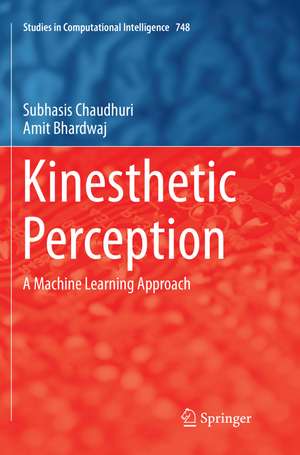
Kinesthetic Perception
Autor Subhasis Chaudhuri, Amit Bhardwajen Limba Engleză Paperback – 30 ian 2019
Preț: 637.46 lei
Preț vechi: 749.95 lei
-15%
Puncte Express: 956
Carte disponibilă
Livrare economică 17 noiembrie-01 decembrie
Livrare prin curier în România Termenul estimat este afișat lângă disponibilitate.
Transport gratuit pentru acest produs Plată online sau ramburs, în funcție de opțiunile comenzii.
Retur gratuit în 14 zile Comandă securizată și suport în română.
Specificații
ISBN-13: 9789811349317
ISBN-10: 9811349312
Pagini: 156
Ilustrații: XV, 138 p. 50 illus., 44 illus. in color.
Dimensiuni: 155 x 235 x 9 mm
Greutate: 0.28 kg
Ediția:Softcover reprint of the original 1st edition 2018
Editura: Springer
Locul publicării:Singapore, Singapore
ISBN-10: 9811349312
Pagini: 156
Ilustrații: XV, 138 p. 50 illus., 44 illus. in color.
Dimensiuni: 155 x 235 x 9 mm
Greutate: 0.28 kg
Ediția:Softcover reprint of the original 1st edition 2018
Editura: Springer
Locul publicării:Singapore, Singapore
V-ar putea interesa
-
 Joysticks to HapticsLost in CultPreț: 266.56 lei
 -
 SensehackingCharles Spence-17%Preț: 60.61 lei72.83 lei
 -
 HapticsLynette JonesPreț: 97.04 lei
 -
 Sabiston Textbook of Surgery: The Biological Basis of Modern Surgical PracticeDouglas Scott Tyler-28%Preț: 1180.35 lei1644.95 leiRecomandat
 -
 -39%Preț: 628.79 lei1028.93 lei
 -
 Introduction to Robotics, Global EditionJohn Craig-9%Preț: 596.70 lei655.72 lei
 -
 -20%Preț: 1255.74 lei1569.68 lei
 -
 Advances in Visual Perception ResearchThomas Heinen-27%Preț: 1797.51 lei2449.51 lei
 -
 -18%Preț: 88.10 lei107.57 lei
 -
 Engineering Haptic DevicesThorsten A. Kern-20%Preț: 338.26 lei422.82 lei
 -
 Advances in Haptics and Virtual RealityJianbo Su-20%Preț: 1498.00 lei1872.50 lei
 -
 Advances in Service and Industrial RoboticsDoina Pisla-24%Preț: 1713.83 lei2255.03 lei
 -
 Wearable Haptic Devices for Realistic Scenario ApplicationsFederica Barontini-20%Preț: 1202.59 lei1503.23 lei
 -
 -20%Preț: 327.36 lei409.20 lei
 -
 Pervasive HapticsHiroyuki Kajimoto-15%Preț: 672.83 lei791.56 lei
 -
 Human Motion Awareness and Robot TeleoperationHonghao Lyu-18%Preț: 1148.15 lei1400.19 lei
 -
 Control Design for Haptic SystemsSuyong Kim-18%Preț: 752.57 lei917.77 lei
Cuprins
Introduction.- Perceptual compression.- Predictive sampler design.- Perceptual deadzone for vector valued stimulus.- Temporal resolvability of kinesthetic stimuli.- Effect of rate of change of stimulus.- Dependence of deadzone on task specificity.- Sequential effect on kinesthetic perception.
Notă biografică
Prof. Subhasis Chaudhuri received his B.Tech. Degree in Electronics and Electrical Communication Engineering from the Indian Institute of Technology Kharagpur, Kharagpur in 1985. He received his M.Sc. and Ph.D. degrees, both in Electrical Engineering, from the University of Calgary, Canada, and the University of California, San Diego, respectively. He joined the Department of Electrical Engineering at the Indian Institute of Technology Bombay, Bombay in 1990 as an Assistant Professor and is currently serving as the KN Bajaj Chair Professor. He has also served as the Head of the Department, the Dean (International Relations) and a Deputy Director. He has also served as a Visiting Professor at the University of Erlangen-Nuremberg, the Technical University of Munich and the University of Paris XI. He is a Fellow of the science and engineering Academies in India. He is a recipient of the Dr. Vikram Sarabhai Research Award (2001), the Swarnajayanti Fellowship (2003), the S.S. BhatnagarPrize in engineering sciences (2004) and the J.C. Bose National Fellowship (2008). He is a co-author of the books ‘Depth from Defocus: A Real Aperture Imaging Approach’, ‘Motion-Free Super-Resolution’, and ‘Blind Image Deconvolution: Methods and Convergence’, all published by Springer, New York (NY). He is currently an associate editor for the journal International Journal of Computer Vision. His primary areas of research include image processing and computational haptics.
Amit Bhardwaj received his B.Tech. and M.E. degrees in Electronics and Communication Engineering from the YMCA Institute of Engineering, Faridabad, Haryana, and the Delhi College of Engineering, Delhi, in 2009 and 2011, respectively. He has recently completed his Ph.D in Electrical Engineering at the Indian Institute of Technology Bombay, Bombay, and is currently an Alexander von Humboldt Fellow at the Technical University of Munich. His current research areas include signal processing, haptics, kinesthetic perception, haptic data communication and applications of machine learning.
Textul de pe ultima copertă
This book focuses on the study of possible adaptive sampling mechanisms for haptic data compression aimed at applications like tele-operations and tele-surgery. Demonstrating that the selection of the perceptual dead zones is a non-trivial problem, it presents an exposition of various issues that researchers must consider while designing compression algorithms based on just noticeable difference (JND). The book begins by identifying perceptually adaptive sampling strategies for 1-D haptic signals, and goes on to extend the findings on multidimensional signals to study directional sensitivity, if any. The book also discusses the effect of the rate of change of kinesthetic stimuli on the JND, temporal resolution for the perceivability of kinesthetic force stimuli, dependence of kinesthetic perception on the task being performed, the sequential effect on kinesthetic perception, and, correspondingly, on the perceptual dead zone. Offering a valuable resource for researchers, professionals,and graduate students working on haptics and machine perception studies, the book can also support interdisciplinary work focused on automation in surgery.
Caracteristici
Presents a unique study of haptic perception as a machine learning problem Relates directly to the “up and coming” application areas of tele-operation and tele-surgery Includes extensive experimental validation of all outcomes studied Includes supplementary material: sn.pub/extras