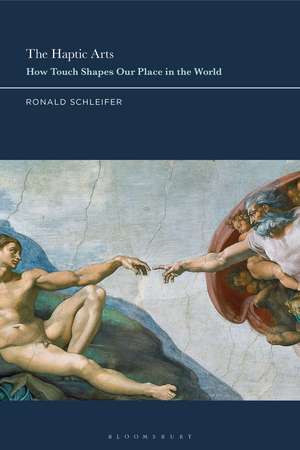
The Haptic Arts: How Touch Shapes Our Place in the World
Autor Ronald Schleiferen Limba Engleză Hardback – 6 noi 2026
Touch is a form of reciprocal interchange - touching always involves being touched in return. It creates a sense of embeddedness in a world that promotes a willingness to take social action, and it heightens concern with spatial perception and metamorphosis with an eye towards transforming experience itself. Focusing on subjects as diverse as Helen Keller, the evolutionary history of the human hand, and practical "haptic" endeavors such as tool-making, The Haptic Arts situates the arts and value within everyday cares and pursuits as tools that extend and strengthen our reach into the world.
Preț: 565.15 lei
Preț vechi: 831.31 lei
-32% Precomandă
Puncte Express: 848
Carte nepublicată încă
Livrare prin curier în România Precomanda se expediază când titlul devine disponibil.
Transport gratuit pentru acest produs Plată online sau ramburs, în funcție de opțiunile comenzii.
Retur gratuit în 14 zile Comandă securizată și suport în română.
Doresc să fiu notificat când acest titlu va fi disponibil:
Se trimite...
Specificații
ISBN-13: 9781350589483
ISBN-10: 1350589489
Pagini: 256
Ilustrații: 6 bw illus
Dimensiuni: 158 x 236 x 20 mm
Greutate: 0.54 kg
Editura: Bloomsbury Publishing
Colecția Bloomsbury Academic
Locul publicării:London, United Kingdom
ISBN-10: 1350589489
Pagini: 256
Ilustrații: 6 bw illus
Dimensiuni: 158 x 236 x 20 mm
Greutate: 0.54 kg
Editura: Bloomsbury Publishing
Colecția Bloomsbury Academic
Locul publicării:London, United Kingdom
Cuprins
Acknowledgments
Prologue: Experience, Practical Reasoning, and Wisdom
Part 1: Touch; or, Introduction to the Haptic Arts
1. The Engagements, Knowledge, and Feelings of the Haptic Arts
2. Interchapter: Cataloguing the Haptic Arts
3. Haptic Worldliness: The Evolutionary History and Semiotics of the Human Hand
Part 2: Our Place in the World; or, Reciprocity, Embeddedness, Transformation
4. The Haptic Art of Medicine: Inferential Comprehensions and The Aesthetics of Worldliness
5. The Haptic Art of Nation-ness: Benedict Anderson, Imagined Communities, and Irish Caricature
6. Mimesis as a Haptic Art: Translations of Language, Translations of Culture
Part 3: Haptic Art; or, Bewilderment, Rumination, Happiness
7. Haptic Gestures of Music and Theater: Samuel Beckett and Performed Bewilderment
8. Interchapter: Cataloguing the Interested Arts
9. Haptic Storytelling, Haptic Desire: The Mosaic Art of Don Giovanni and Isak Dinesen
References
Prologue: Experience, Practical Reasoning, and Wisdom
Part 1: Touch; or, Introduction to the Haptic Arts
1. The Engagements, Knowledge, and Feelings of the Haptic Arts
2. Interchapter: Cataloguing the Haptic Arts
3. Haptic Worldliness: The Evolutionary History and Semiotics of the Human Hand
Part 2: Our Place in the World; or, Reciprocity, Embeddedness, Transformation
4. The Haptic Art of Medicine: Inferential Comprehensions and The Aesthetics of Worldliness
5. The Haptic Art of Nation-ness: Benedict Anderson, Imagined Communities, and Irish Caricature
6. Mimesis as a Haptic Art: Translations of Language, Translations of Culture
Part 3: Haptic Art; or, Bewilderment, Rumination, Happiness
7. Haptic Gestures of Music and Theater: Samuel Beckett and Performed Bewilderment
8. Interchapter: Cataloguing the Interested Arts
9. Haptic Storytelling, Haptic Desire: The Mosaic Art of Don Giovanni and Isak Dinesen
References
Recenzii
With wonderful dexterity and warm companionship, The Haptic Arts leads us out of an isolated and goal-driven approach to comprehension and back into the authentic experience of being embedded in a fulfilling world of reciprocity and transformation. The work's advocacy of touch, as a moment and an approach that entails engagement, embodiment and realisation, draws together an absorbing array of examples from art, literature, memoirs, political theory, science and translation; while the caring craft of successive chapters genially performs its own espoused practice of ruminative enrichment and widening understanding. Convincingly demonstrating how even the most austere conceptualization can be underpinned and nurtured by gestural meaning, and in a time of increasing digitalisation of our worldliness, Ronald Schleifer enjoins us here to connect with a more ecumenical vision in which our whole being can celebrate its situatedness and embrace a worldly wisdom.
The Haptic Arts invites us to rethink aesthetics from the ground up. Restoring touch to the center of human experience, Ronald Schleifer shows how art, care, community, and meaning emerge from embodied, worldly engagement. Learned yet generous, this book offers a compelling account of how we come to know, feel, and live through contact with others and with the world. It should be read by anyone with an interest in the humanities, aesthetics, and the forms of knowledge that emerge from lived experience.
The Haptic Arts invites us to rethink aesthetics from the ground up. Restoring touch to the center of human experience, Ronald Schleifer shows how art, care, community, and meaning emerge from embodied, worldly engagement. Learned yet generous, this book offers a compelling account of how we come to know, feel, and live through contact with others and with the world. It should be read by anyone with an interest in the humanities, aesthetics, and the forms of knowledge that emerge from lived experience.