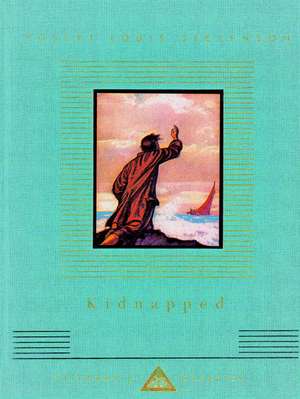
Kidnapped
Autor Robert Louis Stevenson Ilustrat de Rowland Hilderen Limba Engleză Hardback – 27 sep 1994
Lectura romanului Kidnapped impune un ritm stratificat, unde goana palpitantă a aventurii se împletește cu o contemplare melancolică a peisajului scoțian și a onoarei pierdute. Observăm cum Robert Louis Stevenson reușește să transforme ceea ce părea o simplă „carte pentru băieți” într-o explorare profundă a identității, navigând între loialitățile politice fracturate ale Scoției de după răscoala iacobită. Ne-a atras atenția modul în care autorul construiește tensiunea: de la scările neterminate ale casei Shaws, care se termină brusc într-un abis întunecat, până la atmosfera sufocantă de la bordul corabiei Covenant. Atmosfera te trimite cu gândul la Treasure Island, deși aici realismul istoric și nuanțele politice marchează o voce proprie, mult mai matură și mai ancorată în geografia natală a autorului. Dacă în Dr Jekyll and Mr Hyde Stevenson explora dualitatea psihologică a individului, în Kidnapped el proiectează această dualitate asupra întregii națiuni scoțiene, reprezentată prin contrastul dintre David Balfour, un Lowlander prudent și rațional, și Alan Breck Stewart, Highland-erul impulsiv și flamboaiant. Găsim în această lucrare nu doar un itinerar geografic prin munții sălbatici, ci și unul moral, în care maturizarea lui David se produce prin suferință și expunere la nedreptate. Este o operă care, sub masca memoriilor de aventură, ascunde o finețe stilistică ce i-a atras admirația unor maeștri precum Jorge Luis Borges, confirmând statutul lui Stevenson de povestitor universal.
Preț: 146.42 lei
Carte disponibilă
Livrare economică 10-24 noiembrie
Livrare express 24-30 octombrie pentru 37.62 lei
Specificații
ISBN-10: 0679436383
Pagini: 340
Dimensiuni: 160 x 210 x 25 mm
Greutate: 0.59 kg
Editura: Knopf Doubleday Publishing Group
V-ar putea interesa
-
 Robinson CrusoeDaniel DefoePreț: 28.01 lei
 -
 Treasure IslandRobert Louis StevensonPreț: 28.01 lei
 -
 Preț: 80.13 lei
 -
 The English GirlDaniel SilvaPreț: 80.95 lei
 -
 The Fallen AngelDaniel SilvaPreț: 66.27 lei
 -
 The English GirlDaniel SilvaPreț: 71.56 lei
 -
 Friends In High PlacesDonna Leon-19%Preț: 57.79 lei71.34 lei
 -
 Fatal RemediesDonna Leon-18%Preț: 59.20 lei72.33 lei
 -
 The BrethrenJohn Grisham-24%Preț: 61.05 lei80.35 lei
 -
 Cross FireJames Patterson-25%Preț: 54.87 lei72.75 lei
 -
 KidnappedR. L Stevenson-16%Preț: 43.33 lei51.76 lei
 -
 Oxford Bookworms Library: Level 3: KidnappedRobert Louis StevensonPreț: 88.18 lei
 -
 Storyteller: The Life of Robert Louis StevensonLeo DamroschPreț: 222.91 lei
 -
 Sudden PreyJohn SandfordPreț: 64.77 lei
 -
 The Final DetailHarlan CobenPreț: 58.77 lei
 -
 The Gray Man: Now a major Netflix filmMark Greaney-22%Preț: 58.32 lei74.64 lei
 -
 -26%Preț: 57.83 lei78.38 lei
 -
 Mind PreyJohn Sandford-64%Preț: 37.78 lei106.37 lei
 -
 -23%Preț: 63.29 lei82.02 lei
 -
 Robert Louis Stevenson: Seven NovelsRobert Louis Stevenson-11%Preț: 140.95 lei158.02 lei
 -
 Patterson, J: The Candies Save ChristmasJames Patterson-16%Preț: 36.43 lei43.38 lei
 -
 The Count of Monte CristoAlexandre DumasPreț: 43.01 lei
 -
 KidnappedAlan GrantPreț: 110.26 lei
De ce să citești această carte
Recomandăm această carte cititorilor care caută o aventură clasică, dar rafinată literar. Veți câștiga o perspectivă imersivă asupra istoriei Scoției și o poveste despre prietenie și supraviețuire. Este lectura ideală pentru cei care apreciază proza de atmosferă, unde mediul natural devine un personaj în sine, oferind mai mult decât un simplu roman de gen: o meditație asupra onoarei și a maturizării forțate.
Despre autor
Robert Louis Stevenson (1850–1894) a fost un romancier, eseist și poet scoțian, recunoscut drept unul dintre cei mai mari povestitori ai literaturii universale. Născut în Edinburgh, a luptat întreaga viață cu probleme de sănătate, fapt care l-a împins să călătorească în căutarea unor climate mai blânde, stabilindu-se în final în Samoa. Deși faima sa inițială s-a datorat unor lucrări precum Treasure Island, Stevenson a evoluat spre un realism mai întunecat. În prezent, este unul dintre cei mai traduși autori din lume, opera sa fiind celebrată pentru profunzimea psihologică și măiestria narativă.
Notă biografică
All his life Stevenson traveled–often in a desperate quest for health. He and Fanny, having married in California and spent their honeymoon by an abandoned silver mine, traveled back to Scotland, then to Switzerland, to the South of France, to the American Adirondacks, and finally to the south of France, to the South Seas. As a novelist he was intrigued with the genius of place: Treasure Island (1883) began as a map to amuse a boy. Indeed, all his works reveal a profound sense of landscape and atmosphere: Kidnapped (1886); The Strange Case of Dr. Jekyll and Mr. Hyde (1886); The Master of Ballantrae (1889).
In 1889 Stevenson’s deteriorating health exiled him to the tropics, and he settled in Samoa, where he was given patriarchal status by the natives. His health improved, yet he remained homesick for Scotland, and it was to the “cold old huddle of grey hills” of the Lowlands that he returned in his last, unfinished masterpiece, Weir of Hermiston (1896).
Stevenson dies suddenly on December 3, 1894, not of the long-feared tuberculosis, but of a cerebral hemorrhage. The kindly author of Jekyll and Hyde went down to the cellar to fetch a bottle of his favorite burgundy, uncorked it in the kitchen, abruptly cried out to his wife, “What’s the matter with me, what is this strangeness, has my face changed?”–and fell to the floor. The brilliant storyteller and master of transformations had been struck down at forty-four, at the height of his creative powers.
Extras
I.
When I was growing up in Scotland, Robert Louis Stevenson was the first author whom I knew by name, and he remains the only one whom I can truthfully claim to have been reading all my life. From an early age, my parents read to me from A Child's Garden of Verses, and I soon learned some of the poems by heart.
I have a little shadow
that goes in and out with me,
And what can be the use of him
is more than I can see.
Perhaps I recognized, even then, Stevenson's unique gift for keeping a foot in two camps. While the poems vividly captured my childish concerns, somewhere in the margins shimmered the mystery of adult life. A few years later Kidnapped was the first chapter book I read, and I can still picture the maroon binding and the black-and-white drawings that illustrated David Balfour's adventures. At the age of seven, a book without pictures would have been out of the question, but, in fact, they turned out to be superfluous. I could imagine everything that happened just from the words on the page, although I must admit to the small advantage that the view from my bedroom window--bare hills, rocks, heather--was very much like the landscape of Kidnapped.
At first glance such early acquaintance might seem like a good omen for an author's reputation. In actuality, that Stevenson is so widely read by children has tended to make him seem like an author from who, as adults, we have little to learn. It is worth noting that his contemporaries would not have shared this prejudice. Nineteenth-century readers did not regard children's books as separate species. Stevenson's own father often reread The Parent's Assistant, a volume of children's stories, and Leslie Stephen, Virginia Woolf's father, writes of staying up late to finish Treasure Island.
Like the shadow of his poem, Stevenson's reputation has waxed and waned at an alarming rate. He died in a blaze of hagiography, which perhaps in part explains the fury of later critics. F.R. Leavis in The Great Tradition dismisses Stevenson (in a footnote, no less) as a romantic writer, guilty of fine writing, and in general Stevenson has not fared as well as his friend Henry James. People comment with amazement that Borges and Nabokov praised his novels. Still, his best work has remained in print for over a hundred years, and his is among that small group of authors to have given a phrase to the language: Jekyll and Hyde.
Besides our perception of Stevenson as a children's author, two other factors may have contributed to his ambiguous reputation. Although his list of publications is much longer than most people realize--he wrote journalism and travel pieces for money--he failed to produce a recognizable oeuvre, a group of works that stand together, each resonating with the others. In addition, the pendulum of literary taste has swung in a direction that Stevenson disliked and was determined to avoid: namely, pessimism. After reading The Portrait of a Lady he wrote to James begging him to write no more such books, and while he admired the early work of Thomas Hardy, he hated the darker Tess of the d'Urbervilles. The English writer John Galsworthy commented memorably on this aspect of Stevenson when he said that the superiority of Stevenson over Hardy was that Stevenson was all life, while Hardy was all death.
From the Trade Paperback edition.
Descriere scurtă
Descriere
'Your bed shall be the moorcock's, and your life shall be like the hunted deer's, and ye shall sleep with your hand upon your weapons.'Tricked out of his inheritance, shanghaied, shipwrecked off the west coast of Scotland, David Balfour finds himself fleeing for his life in the dangerous company of Jacobite outlaw and suspected assassin Alan Breck Stewart. Their unlikely friendship is put to the test as they dodge government troops across the Scottish Highlands. Set in the aftermath of the 1745 rebellion, Kidnapped transforms the Romantic historical novel into the modern thriller. Its heart-stopping scenes of cross-country pursuit, distilled to a pure intensity in Stevenson's prose, have become a staple of adventure stories from John Buchan to Alfred Hitchcock and Ian Fleming. Kidnapped remains as exhilarating today as when it was first published in 1886.This new edition is based on the 1895 text, incorporating Stevenson's last thoughts about the novel before his death. It includes Stevenson's 'Note to Kidnapped', reprinted for the first time since 1922.ABOUT THE SERIES: For over 100 years Oxford World's Classics has made available the widest range of literature from around the globe. Each affordable volume reflects Oxford's commitment to scholarship, providing the most accurate text plus a wealth of other valuable features, including expert introductions by leading authorities, helpful notes to clarify the text, up-to-date bibliographies for further study, and much more.