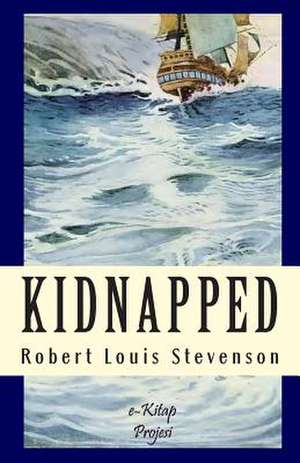
Kidnapped
Autor Robert Louis Stevenson Ilustrat de Louis Rheaden Limba Engleză Paperback
Vezi toate premiile Carte premiată
Lectura romanului Kidnapped impune un ritm stratificat, unde goana palpitantă a aventurii se împletește cu o contemplare melancolică a peisajului scoțian și a onoarei pierdute. Observăm cum Robert Louis Stevenson reușește să transforme ceea ce părea o simplă „carte pentru băieți” într-o explorare profundă a identității, navigând între loialitățile politice fracturate ale Scoției de după răscoala iacobită. Ne-a atras atenția modul în care autorul construiește tensiunea: de la scările neterminate ale casei Shaws, care se termină brusc într-un abis întunecat, până la atmosfera sufocantă de la bordul corabiei Covenant.
Atmosfera te trimite cu gândul la Treasure Island, deși aici realismul istoric și nuanțele politice marchează o voce proprie, mult mai matură și mai ancorată în geografia natală a autorului. Dacă în Dr Jekyll and Mr Hyde Stevenson explora dualitatea psihologică a individului, în Kidnapped el proiectează această dualitate asupra întregii națiuni scoțiene, reprezentată prin contrastul dintre David Balfour, un Lowlander prudent și rațional, și Alan Breck Stewart, Highland-erul impulsiv și flamboaiant. Găsim în această lucrare nu doar un itinerar geografic prin munții sălbatici, ci și unul moral, în care maturizarea lui David se produce prin suferință și expunere la nedreptate. Este o operă care, sub masca memoriilor de aventură, ascunde o finețe stilistică ce i-a atras admirația unor maeștri precum Jorge Luis Borges, confirmând statutul lui Stevenson de povestitor universal.
Preț: 116.78 lei
Carte indisponibilă temporar
Specificații
ISBN-10: 1514100665
Pagini: 360
Dimensiuni: 140 x 216 x 20 mm
Greutate: 0.46 kg
Editura: CreateSpace Independent Publishing Platform
V-ar putea interesa
-
 Robinson CrusoeDaniel DefoePreț: 28.01 lei
 -
 Treasure IslandRobert Louis StevensonPreț: 28.01 lei
 -
 The Fallen AngelDaniel SilvaPreț: 80.13 lei
 -
 The English GirlDaniel SilvaPreț: 80.95 lei
 -
 The Fallen AngelDaniel SilvaPreț: 66.27 lei
 -
 The English GirlDaniel SilvaPreț: 71.56 lei
 -
 Friends In High PlacesDonna Leon-19%Preț: 57.79 lei71.34 lei
 -
 Fatal RemediesDonna Leon-18%Preț: 59.16 lei72.33 lei
 -
 The BrethrenJohn Grisham-24%Preț: 61.05 lei80.35 lei
 -
 Cross FireJames Patterson-25%Preț: 54.87 lei72.75 lei
 -
 KidnappedR. L Stevenson-16%Preț: 43.33 lei51.76 lei
 -
 Oxford Bookworms Library: Level 3: KidnappedRobert Louis StevensonPreț: 88.18 lei
 -
 Storyteller: The Life of Robert Louis StevensonLeo DamroschPreț: 222.91 lei
 -
 Sudden PreyJohn SandfordPreț: 64.77 lei
 -
 The Final DetailHarlan CobenPreț: 58.77 lei
 -
 The Gray Man: Now a major Netflix filmMark Greaney-22%Preț: 58.32 lei74.64 lei
 -
 -26%Preț: 57.83 lei78.38 lei
 -
 Mind PreyJohn Sandford-64%Preț: 37.78 lei106.37 lei
 -
 -23%Preț: 63.29 lei82.02 lei
 -
 Robert Louis Stevenson: Seven NovelsRobert Louis Stevenson-11%Preț: 140.95 lei158.02 lei
 -
 Patterson, J: The Candies Save ChristmasJames Patterson-16%Preț: 36.43 lei43.38 lei
 -
 The Count of Monte CristoAlexandre DumasPreț: 43.01 lei
 -
 Preț: 110.26 lei
De ce să citești această carte
Recomandăm această carte cititorilor care caută o aventură clasică, dar rafinată literar. Veți câștiga o perspectivă imersivă asupra istoriei Scoției și o poveste despre prietenie și supraviețuire. Este lectura ideală pentru cei care apreciază proza de atmosferă, unde mediul natural devine un personaj în sine, oferind mai mult decât un simplu roman de gen: o meditație asupra onoarei și a maturizării forțate.
Despre autor
Robert Louis Stevenson (1850–1894) a fost un romancier, eseist și poet scoțian, recunoscut drept unul dintre cei mai mari povestitori ai literaturii universale. Născut în Edinburgh, a luptat întreaga viață cu probleme de sănătate, fapt care l-a împins să călătorească în căutarea unor climate mai blânde, stabilindu-se în final în Samoa. Deși faima sa inițială s-a datorat unor lucrări precum Treasure Island, Stevenson a evoluat spre un realism mai întunecat. În prezent, este unul dintre cei mai traduși autori din lume, opera sa fiind celebrată pentru profunzimea psihologică și măiestria narativă.
Notă biografică
All his life Stevenson traveled–often in a desperate quest for health. He and Fanny, having married in California and spent their honeymoon by an abandoned silver mine, traveled back to Scotland, then to Switzerland, to the South of France, to the American Adirondacks, and finally to the south of France, to the South Seas. As a novelist he was intrigued with the genius of place: Treasure Island (1883) began as a map to amuse a boy. Indeed, all his works reveal a profound sense of landscape and atmosphere: Kidnapped (1886); The Strange Case of Dr. Jekyll and Mr. Hyde (1886); The Master of Ballantrae (1889).
In 1889 Stevenson’s deteriorating health exiled him to the tropics, and he settled in Samoa, where he was given patriarchal status by the natives. His health improved, yet he remained homesick for Scotland, and it was to the “cold old huddle of grey hills” of the Lowlands that he returned in his last, unfinished masterpiece, Weir of Hermiston (1896).
Stevenson dies suddenly on December 3, 1894, not of the long-feared tuberculosis, but of a cerebral hemorrhage. The kindly author of Jekyll and Hyde went down to the cellar to fetch a bottle of his favorite burgundy, uncorked it in the kitchen, abruptly cried out to his wife, “What’s the matter with me, what is this strangeness, has my face changed?”–and fell to the floor. The brilliant storyteller and master of transformations had been struck down at forty-four, at the height of his creative powers.
Extras
I SET OFF UPON MY JOURNEY TO THE HOUSE OF SHAWS
I will begin the story of my adventures with a certain morning early in the month of June, the year of grace 1751, when I took the key for the last time out of the door of my father's house. The sun began to shine upon the summit of the hills as I went down the road; and by the time I had come as far as the manse, the blackbirds were whistling in the garden lilacs, and the mist that hung around the valley in the time of the dawn was beginning to arise and die away.
Mr. Campbell, the minister of Essendean, was waiting for me by the garden gate, good man! He asked me if I had breakfasted; and hearing that I lacked for nothing, he took my hand in both of his and cupped it kindly under his arm.
"Well, Davie lad," said he, "I will go with you as far as the ford, to set you on the way."
And we began to walk forward in silence.
"Are ye sorry to leave Essendean?" said he, after a while.
"Why, sir," said I, "if I knew where I was going, or what was likely to become of me, I would tell you candidly. Essendean is a good place indeed, and I have been very happy there; but then I have never been anywhere else. My father and mother, since they are both dead, I shall be no nearer to in Essendean than in the Kingdom of Hungary; and, to speak truth, if I thought I had a chance to better myself where I was going I would go with a good will."
"Ay?" said Mr. Campbell. "Very well, Davie. Then it behoves me to tell your fortune; or so far as I may. When your mother was gone, and your father (the worthy, Christian man) began to sicken for his end, he gave me in charge a certain letter, which he said was your inheritance. 'So soon,' says he, 'as I am gone, and the house is redd up and the gear disposed of' (all which, Davie, hath been done), 'give my boy this letter into his hand, and start him off to the house of Shaws, not far from Cramond. That is the place I came from,' he said, 'and it's where it befits that my boy should return. He is a steady lad,' your father said, 'and a canny goer; and I doubt not he will come safe, and be well liked where he goes.'"
"The house of Shaws!" I cried. "What had my poor father to do with the house of Shaws?"
"Nay," said Mr. Campbell, "who can tell that for a surety? But the name of that family, Davie boy, is the name you bear–Balfours of Shaws: an ancient, honest, reputable house, peradventure in these latter days decayed. Your father, too, was a man of learning as befitted his position; no man more plausibly conducted school; nor had the manner or the speech of a common dominie; but (as ye will yourself remember) I took aye a pleasure to have him to the manse to meet the gentry; and those of my own house, Campbell of Kilrennet, Campbell of Dunswire, Campbell of Minch, and others, all well-kenned gentlemen, had pleasure in his society. Lastly, to put all the elements of this affair before you, here is the testamentary letter itself, superscrived by the own hand of our departed brother."
He gave me the letter, which was addressed in these words: "To the hands of Ebenezer Balfour, Esquire, of Shaws, in his house of Shaws, these will be delivered by my son, David Balfour." My heart was beating hard at this great prospect now suddenly opening before a lad of seventeen years of age, the son of a poor country dominie in the Forest of Ettrick.
"Mr. Campbell," I stammered, "and if you were in my shoes, would you go?"
"Of a surety," said the minister, "that would I, and without pause. A pretty lad like you should get to Cramond (which is near in by Edinburgh) in two days of walk. If the worst came to the worst, and your high relations (as I cannot but suppose them to be somewhat of your blood) should put you to the door, ye can but walk the two days back again and risp1 at the manse door. But I would rather hope that ye shall be well received, as your poor father forecast for you, and for anything that I ken come to be a great man in time. And here, Davie laddie," he resumed, "it lies near upon my conscience to improve this parting, and set you on the right guard against the dangers of the world."
Here he cast about for a comfortable seat, lighted on a big boulder under a birch by the trackside, sate down upon it with a very long, serious upper lip, and, the sun now shining in upon us between two peaks, put his pocket-handkerchief over his cocked hat to shelter him. There, then, with uplifted forefinger, he first put me on my guard against a considerable number of heresies, to which I had no temptation, and urged upon me to be instant in my prayers and reading of the Bible. That done, he drew a picture of the great house that I was bound to, and how I should conduct myself with its inhabitants.
"Be soople, Davie, in things immaterial," said he. "Bear ye this in mind, that, though gentle born, ye have had a country rearing. Dinna shame us, Davie, dinna shame us! In yon great, muckle2 house, with all these domestics, upper and under, show yourself as nice, as circumspect, as quick at the conception, and as slow of speech as any. As for the laird–remember he's the laird; I say no more: honour to whom honour. It's a pleasure to obey a laird; or should be, to the young."
"Well, sir," said I, "it may be; and I'll promise you I'll try to make it so."
"Why, very well said," replied Mr. Campbell, heartily. "And now to come to the material, or (to make a quibble) to the immaterial. I have here a little packet which contains four things." He tugged it, as he spoke, and with some great difficulty, from the skirt pocket of his coat. "Of these four things, the first is your legal due: the little pickle money for your father's books and plenishing, which I have bought (as I have explained from the first) in the design of re-selling at a profit to the incoming dominie. The other three are gifties that Mrs. Campbell and myself would be blithe of your acceptance. The first, which is round, will likely please ye best at the first off-go; but, O Davie laddie, it's but a drop of water in the sea; it'll help you but a step, and vanish like the morning. The second, which is flat and square and written upon, will stand by you through life, like a good staff for the road, and a good pillow to your head in sickness. And as for the last, which is cubical, that'll see you, it's my prayerful wish, into a better land."
With that he got upon his feet, took off his hat, and prayed a little while aloud, and in affecting terms, for a young man setting out into the world; then suddenly took me in his arms and embraced me very hard; then held me at arm's-length, looking at me with his face all working with sorrow; and then whipped about, and crying goodbye to me, set off backward by the way that we had come at a sort of jogging run. It might have been laughable to another; but I was in no mind to laugh. I watched him as long as he was in sight; and he never stopped hurrying, nor once looked back. Then it came in upon my mind that this was all his sorrow at my departure; and my conscience smote me hard and fast, because I, for my part, was overjoyed to get away out of that quiet countryside, and go to a great, busy house, among rich and respected gentlefolk of my own name and blood.
"Davie, Davie," I thought, "was ever seen such black ingratitude? Can you forget old favours and old friends at the mere whistle of a name? Fie, fie; think shame!"
And I sat down on the boulder the good man had just left, and opened the parcel to see the nature of my gifts. That which he had called cubical, I had never had much doubt of; sure enough it was a little Bible; to carry in a plaid-neuk.1 That which he had called round, I found to be a shilling piece; and the third, which was to help me so wonderfully both in health and sickness all the days of my life, was a little piece of coarse yellow paper, written upon thus in red ink:
"To make lilly of the valley water.–Take the flowers of lilly of the valley and distil them in sack, and drink a spooneful or two as there is occasion. It restores against the Gout; it comforts the heart and strengthens the memory; and the flowers, put into a Glasse, close stopt, and set into ane hill of ants for a month, then take it out, and you will find a liquor which comes from the flowers, which keep in a vial; it is good, ill or well, and whether man or woman."
And then, in the minister's own hand, was added:
"Likewise for sprains, rub it in; and for the cholic, a great spooneful in the hour."
To be sure, I laughed over this; but it was rather tremulous laughter; and I was glad to get my bundle on my staff's end and set out over the ford and up the hill upon the farther side; till, just as I came on the green droveroad running wide through the heather, I took my last look of Kirk Essendean, the trees about the manse, and the big rowans in the kirkyard where my father and my mother lay.
Chapter Two
I COME TO MY JOURNEY'S END
On the forenoon of the second day, coming to the top of a hill, I saw all the country fall away before me down to the sea; and in the midst of this descent, on a long ridge, the city of Edinburgh smoking like a kiln. There was a flag upon the castle, and ships moving or lying anchored in the firth; both of which, for as far away as they were, I could distinguish clearly; and both brought my country heart into my mouth.
Presently after, I came by a house where a shepherd lived, and got a rough direction for the neighbourhood of Cramond; and so, from one to another, worked my way to the westward of the capital by Colinton, till I came out upon the Glasgow road. And there, to my great pleasure and wonder, I beheld a regiment marching to the fifes, every foot in time; an old redfaced general on a grey horse at the one end, and at the other the company of Grenadiers, with their Pope's-hats. The pride of life seemed to mount into my brain at the sight of the red coats and the hearing of that merry music.
A little farther on, and I was told I was in Cramond parish, and began to substitute in my inquiries the name of the house of Shaws. It was a word that seemed to surprise those of whom I sought my way. At first I thought the plainness of my appearance, in my country habit, and that all dusty from the road, consorted ill with the greatness of the place to which I was bound. But after two, or maybe three, had given me the same look and the same answer, I began to take it in my head there was something strange about the Shaws itself.
The better to set this fear at rest, I changed the form of my inquiries; and spying an honest fellow coming along a lane on the shaft of his cart, I asked him if he had ever heard tell of a house they called the house of Shaws.
He stopped his cart and looked at me, like the others.
"Ay," said he. "What for?"
"It's a great house?" I asked.
"Doubtless," says he. "The house is a big, muckle house."
"Ay," said I, "but the folk that are in it?"
"Folk?" cried he. "Are ye daft? There's nae folk there–to call folk."
"What?" say I; "not Mr. Ebenezer?"
"Ou, ay," says the man; "there's the laird, to be sure, if it's him you're wanting. What'll like be your business, mannie?"
"I was led to think that I would get a situation," I said, looking as modest as I could.
"What?" cries the carter, in so sharp a note that his very horse started; and then, "Well, mannie," he added, "it's nane of my affairs; but ye seem a decent-spoken lad; and if ye'll take a word from me, ye'll keep clear of the Shaws."
The next person I came across was a dapper little man in a beautiful white wig, whom I saw to be a barber on his rounds; and knowing well that barbers were great gossips, I asked him plainly what sort of a man was Mr. Balfour of the Shaws.
"Hoot, hoot, hoot," said the barber, "nae kind of a man, nae kind of a man at all"; and began to ask me very shrewdly what my business was; but I was more than a match for him at that, and he went on to his next customer no wiser than he came.
I cannot well describe the blow this dealt to my illusions. The more indistinct the accusations were, the less I liked them, for they left the wider field to fancy. What kind of a great house was this, that all the parish should start and stare to be asked the way to it? or what sort of a gentleman, that his ill-fame should be thus current on the wayside? If an hour's walking would have brought me back to Essendean, I had left my adventure then and there, and returned to Mr. Campbell's. But when I had come so far a way already, mere shame would not suffer me to desist till I had put the matter to the touch of proof; I was bound, out of mere self-respect, to carry it through; and little as I liked the sound of what I heard, and slow as I began to travel, I still kept asking my way and still kept advancing.
It was drawing on to sundown when I met a stout, dark, sour-looking woman coming trudging down a hill; and she, when I had put my usual question, turned sharp about, accompanied me back to the summit she had just left, and pointed to a great bulk of building standing very bare upon a green in the bottom of the next valley. The country was pleasant round about, running in low hills, pleasantly watered and wooded, and the crops, to my eyes, wonderfully good; but the house itself appeared to be a kind of ruin; no road led up to it; no smoke arose from any of the chimneys; nor was there any semblance of a garden. My heart sank. "That!" I cried.
The woman's face lit up with a malignant anger.
"That is the house of Shaws!" she cried. "Blood built it; blood stopped the building of it; blood shall bring it down. See here!" she cried again–"I spit upon the ground, and crack my thumb at it! Black be its fall! If ye see the laird, tell him what ye hear; tell him this makes the twelve hunner and nineteen time that Jennet Clouston has called down the curse on him and his house, byre and stable, man, guest, and master, wife, miss, or bairn–black, black be their fall!"
And the woman, whose voice had risen to a kind of eldritch1 sing-song, turned with a skip, and was gone. I stood where she left me, with my hair on end. In those days folk still believed in witches and trembled at a curse; and this one, falling so pat, like a wayside omen, to arrest me ere I carried out my purpose, took the pith out of my legs.
I sat me down and stared at the house of Shaws. The more I looked, the pleasanter that country-side appeared; being all set with hawthorn bushes full of flowers; the fields dotted with sheep; a fine flight of rooks in the sky; and every sign of a kind soil and climate; and yet the barrack in the midst of it went sore against my fancy.
Country folk went by from the fields as I sat there on the side of the ditch, but I lacked the spirit to give them a good-e'en. At last the sun went down, and then, right up against the yellow sky, I saw a scroll of smoke go mounting, not much thicker, as it seemed to me, than the smoke of a candle; but still there it was, and meant a fire, and warmth, and cookery, and some living inhabitant that must have lit it; and this comforted my heart.
So I set forward by a little faint track in the grass that led in my direction. It was very faint indeed to be the only way to a place of habitation; yet I saw no other. Presently it brought me to stone uprights, with an unroofed lodge beside them, and coats of arms upon the top. A main entrance it was plainly meant to be, but never finished; instead of gates of wrought iron, a pair of hurdles were tied across with a straw rope; and as there were no park walls, nor any sign of avenue, the track that I was following passed on the right hand of the pillars, and went wandering on toward the house.
The nearer I got to that, the drearier it appeared. It seemed like the one wing of a houes that had never been finished. What should have been the inner end stood open on the upper floors, and showed against the sky with steps and stairs of uncompleted masonry. Many of the windows were unglazed, and bats flew in and out like doves out of a dove-cote.
The night had begun to fall as I got close; and in three of the lower windows, which were very high up and narrow, and well barred, the changing light of a little fire began to glimmer.
Was this the place I had been coming to? Was it within these walls that I was to seek new friends and begin great fortunes? Why, in my father's house on Essen-Waterside, the fire and the bright lights would show a mile away, and the door open to a beggar's knock!
I came forward cautiously, and giving ear as I came, heard some one rattling with dishes, and a little dry, eager cough that came in fits; but there was no sound of speech, and not a dog barked.
The door, as well as I could see it in the dim light, was a great piece of wood all studded with nails; and I lifted my hand with a faint heart under my jacket, and knocked once. Then I stood and waited. The house had fallen into a dead silence; a whole minute passed away, and nothing stirred but the bats overhead. I knocked again, and hearkened again. By this time my ears had grown so accustomed to the quiet, that I could hear the ticking of the clock inside as it slowly counted out the seconds; but whoever was in that house kept deadly still, and must have held his breath.
I was in two minds whether to run away; but anger got the upper hand, and I began instead to rain kicks and buffets on the door, and to shout out aloud for Mr. Balfour. I was in full career, when I heard the cough right overhead, and jumping back and looking up, beheld a man's head in a tall nightcap, and the bell mouth of a blunderbuss, at one of the first story windows.
"It's loaded," said a voice.
"I have come here with a letter," I said, "to Mr. Ebenezer Balfour of Shaws. Is he here?"
"From whom is it?" asked the man with the blunderbuss.
"That is neither here nor there," said I, for I was growing very wroth.
"Well," was the reply, "ye can put it down upon the doorstep, and be off with ye."
"I will do no such thing," I cried. "I will deliver it into Mr. Balfour's hands, as it was meant I should. It is a letter of introduction."
"A what?" cried the voice, sharply.
I repeated what I had said.
"Who are ye yourself?" was the next question, after a considerable pause.
"I am not ashamed of my name," said I. "They call me David Balfour."
At that, I made sure the man started, for I heard the blunderbuss rattle on the windowsill; and it was after quite a long pause, and with a curious change of voice, that the next question followed:
"Is your father dead?"
I was so much surprised at this, that I could find no voice to answer, but stood staring.
"Ay," the man resumed, "he'll be dead, no doubt; and that'll be what brings ye chapping to my door." Another pause, and then defiantly, "Well, man," he said, "I'll let ye in"; and he disappeared from the window.
Descriere
'Your bed shall be the moorcock's, and your life shall be like the hunted deer's, and ye shall sleep with your hand upon your weapons.'Tricked out of his inheritance, shanghaied, shipwrecked off the west coast of Scotland, David Balfour finds himself fleeing for his life in the dangerous company of Jacobite outlaw and suspected assassin Alan Breck Stewart. Their unlikely friendship is put to the test as they dodge government troops across the Scottish Highlands. Set in the aftermath of the 1745 rebellion, Kidnapped transforms the Romantic historical novel into the modern thriller. Its heart-stopping scenes of cross-country pursuit, distilled to a pure intensity in Stevenson's prose, have become a staple of adventure stories from John Buchan to Alfred Hitchcock and Ian Fleming. Kidnapped remains as exhilarating today as when it was first published in 1886.This new edition is based on the 1895 text, incorporating Stevenson's last thoughts about the novel before his death. It includes Stevenson's 'Note to Kidnapped', reprinted for the first time since 1922.ABOUT THE SERIES: For over 100 years Oxford World's Classics has made available the widest range of literature from around the globe. Each affordable volume reflects Oxford's commitment to scholarship, providing the most accurate text plus a wealth of other valuable features, including expert introductions by leading authorities, helpful notes to clarify the text, up-to-date bibliographies for further study, and much more.
Recenzii
Premii
- Audies Finalist, 2016