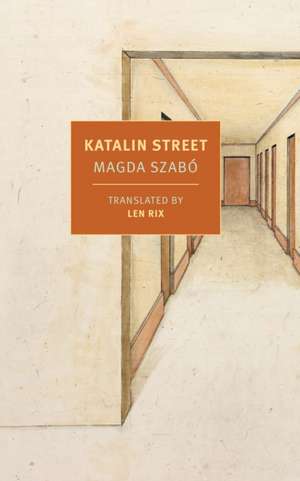
Katalin Street
Autor Magda Szabó Traducere de Len Rixen Limba Engleză Paperback – 12 sep 2017
Preț: 104.97 lei
Puncte Express: 157
Carte disponibilă
Livrare economică 16-30 noiembrie
Livrare prin curier în România Termenul estimat este afișat lângă disponibilitate.
Transport gratuit de la 400.00 lei Plată online sau ramburs, în funcție de opțiunile comenzii.
Retur gratuit în 14 zile Comandă securizată și suport în română.
Specificații
ISBN-13: 9781681371528
ISBN-10: 1681371529
Pagini: 248
Dimensiuni: 126 x 200 x 17 mm
Greutate: 0.25 kg
Editura: NEW YORK REVIEW OF BOOKS
ISBN-10: 1681371529
Pagini: 248
Dimensiuni: 126 x 200 x 17 mm
Greutate: 0.25 kg
Editura: NEW YORK REVIEW OF BOOKS
V-ar putea interesa
-
 The Art of Computer ProgrammingDonald Knuth-20%Preț: 499.14 lei623.93 lei
 -
 CompilersAlfred V. Aho-20%Preț: 637.81 lei797.26 lei
 -
 Black Rabbit HallEve Chase-25%Preț: 60.25 lei79.90 lei
 -
 A Carnival of Snackery: Diaries: Volume TwoDavid Sedaris-20%Preț: 84.74 lei106.36 lei
 -
 -23%Preț: 46.22 lei59.75 lei
 -
 -31%Preț: 54.67 lei79.46 lei
 -
 The Last Wild Trilogy: The Last Wild: Book 1Piers Torday-25%Preț: 48.96 lei65.50 lei
 -
 The Art of DyingAmbrose ParryPreț: 73.12 lei
 -
 The Last Wild Trilogy: The Dark Wild: Book 2Piers Torday-25%Preț: 49.52 lei65.77 lei
 -
 The Last Wild Trilogy: The Wild Beyond: Book 3Piers Torday-24%Preț: 50.18 lei66.17 lei
Notă biografică
Magda Szabó (1917-2007) was born into an old Protestant family in Debrecen, Hungary's "Calvinist Rome," on the eastern side of the great Hungarian plain. Szabó., whose father taught her to converse with him in Latin, German, English, and French, attended the University of Debrecen, studying Latin and Hungarian, and went on to work as a teacher throughout the German and Soviet occupations of Hungary in 1944 and 1945. In 1947, she published two volumes of poetry, Bárány (The Lamb) and Vissza az emberig (Return to Man), for which she received the Baumgarten Prize in 1949. Under Communist rule, the prize was repealed and her work was banned, and Szabó. turned to writing fiction. Her first novel, Freskó (Fresco), came out in 1958, followed closely by Az őz (The Fawn). In 1959 she won the József Attila Prize, after which she went on to write many more novels, among them Katalin utca (Katalin Street, 1969), Ókút (The Ancient Well, 1970), Régimódi történet (An Old-Fashioned Tale, 1971), and Az ajtó (The Door, 1987). Szabó also wrote verse for children, plays, short stories, and nonfiction, including a tribute to her husband, Tibor Szobotka, a writer and translator who died in 1982. A member of the European Academy of Sciences and a warden of the Calvinist Theological Seminary in Debrecen, Szabó. died in the city in which she was born, a book in her hand. Len Rix is a poet, critic, and former literature professor who has translated six books by Antal Szerb, including the novel Journey by Moonlight (available as an NYRB Classic) and, most recently, The Martian's Guide to Budapest. In 2006 he was awarded the Oxford-Weidenfeld Translation Prize for his translation of Magda Szabó's The Door (also available as an NYRB Classic), which was one of The New York Times Book Review's ten best books of 2015.
Descriere
Descriere de la o altă ediție sau format:
The lives of three intertwined families in prewar Budapest are shattered in the German occupation - by the bestselling author of THE DOOR.
Recenzii
[U]nusual, piercing, and - given Hungary's current political climate - oddly percipient
In Katalin Street, the past is never dormant, never settled. The past is an open wound, a life force busily shaping an increasingly bewildering present. In describing Henriette's plight, Szabó writes: 'From the moment she arrived she had been left to work out the rules and the customs of the place entirely by herself.' In this extraordinary novel, the same could be said for the living.
This is a love story and a ghost story . . . From the height of war through to Stalinism, the 1956 Hungarian uprising and its 1968 reprise, Szabó moves us across the decades.
The book depicts humanity at its rawest and saddest. As a
reminder of the impact of war on humans who survive it, Katalin Street is stark, and at times harrowing; Szabó asks us to bear
witness to a punishing postwar regime through a locally trained lens and the troubled, intimate lives of its inhabitants
A gorgeous elegy for the joy and the life once shared among three neighboring families in prewar Budapest...This is a brilliant and unforgettable novel.
Szabó's quietly captivating novel excavates the tangled history of Hungary's capital from the portentous moments before the German occupation to its suffocating postwar regime...A visceral, sweeping depiction of life in the shuddering wake of wartime.
[Katalin Street] is a brightly shining star in the Szabó universe, offering us a glimpse of Eastern Europe at a time when we need to be reminded of what happened there more than ever
Katalin Street's effect on me was so extraordinary that at first I couldn't decide what was most extraordinary about it: its gentle unpeeling of the tragic lives of the characters, or its gentle unpeeling of tragic life in general . . . quite unforgettable
Her fiction shows the travails of modern Hungarian history from oblique but sharply illuminating angles . . . Szabo summons the cosy, closed world with a lyrical, quicksilver touch that makes the thuggish intrusions of despotic power all the more wrenching.
In Katalin Street, the past is never dormant, never settled. The past is an open wound, a life force busily shaping an increasingly bewildering present. In describing Henriette's plight, Szabó writes: 'From the moment she arrived she had been left to work out the rules and the customs of the place entirely by herself.' In this extraordinary novel, the same could be said for the living.
This is a love story and a ghost story . . . From the height of war through to Stalinism, the 1956 Hungarian uprising and its 1968 reprise, Szabó moves us across the decades.
The book depicts humanity at its rawest and saddest. As a
reminder of the impact of war on humans who survive it, Katalin Street is stark, and at times harrowing; Szabó asks us to bear
witness to a punishing postwar regime through a locally trained lens and the troubled, intimate lives of its inhabitants
A gorgeous elegy for the joy and the life once shared among three neighboring families in prewar Budapest...This is a brilliant and unforgettable novel.
Szabó's quietly captivating novel excavates the tangled history of Hungary's capital from the portentous moments before the German occupation to its suffocating postwar regime...A visceral, sweeping depiction of life in the shuddering wake of wartime.
[Katalin Street] is a brightly shining star in the Szabó universe, offering us a glimpse of Eastern Europe at a time when we need to be reminded of what happened there more than ever
Katalin Street's effect on me was so extraordinary that at first I couldn't decide what was most extraordinary about it: its gentle unpeeling of the tragic lives of the characters, or its gentle unpeeling of tragic life in general . . . quite unforgettable
Her fiction shows the travails of modern Hungarian history from oblique but sharply illuminating angles . . . Szabo summons the cosy, closed world with a lyrical, quicksilver touch that makes the thuggish intrusions of despotic power all the more wrenching.