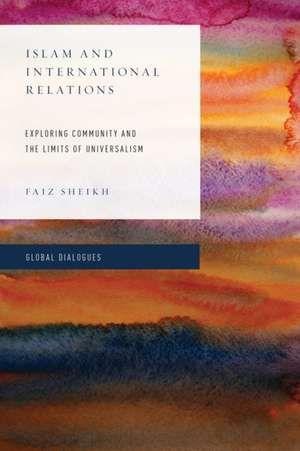
Islam and International Relations: Exploring Community and the Limits of Universalism: Global Dialogues: Non Eurocentric Visions of the Global
Autor Faiz Sheikhen Limba Engleză Paperback – 11 iul 2016






Preț: 329.49 lei
Preț vechi: 426.44 lei
-23%
Puncte Express: 494
Carte tipărită la comandă
Livrare economică 23 noiembrie-07 decembrie
Livrare prin curier în România Termenul estimat este afișat lângă disponibilitate.
Transport gratuit de la 400.00 lei Plată online sau ramburs, în funcție de opțiunile comenzii.
Retur gratuit în 14 zile Comandă securizată și suport în română.
Specificații
ISBN-13: 9781783484584
ISBN-10: 1783484586
Pagini: 240
Dimensiuni: 150 x 230 x 16 mm
Greutate: 0.36 kg
Editura: Bloomsbury Publishing
Colecția Rowman & Littlefield
Seria Global Dialogues: Non Eurocentric Visions of the Global
Locul publicării:New York, United States
ISBN-10: 1783484586
Pagini: 240
Dimensiuni: 150 x 230 x 16 mm
Greutate: 0.36 kg
Editura: Bloomsbury Publishing
Colecția Rowman & Littlefield
Seria Global Dialogues: Non Eurocentric Visions of the Global
Locul publicării:New York, United States
V-ar putea interesa
-
 Covering IslamEdward W. Said-20%Preț: 74.57 lei92.64 lei
 -
 Inside the Jihad: My Life with Al QaedaOmar NasiriPreț: 75.42 lei
 -
 Osman's Dream: The Story of the Ottoman Empire 1300–1923Caroline Finkel-24%Preț: 95.47 lei125.64 lei
 -
 Medieval Islamic Political ThoughtPatricia Crone-12%Preț: 208.03 lei236.39 lei
 -
 Return to the ShadowsAlison PargeterPreț: 130.24 lei
 -
 Is Islam an Enemy of the West?Tamara SonnPreț: 148.71 lei
 -
 My Journey Into the Heart of TerrorJürgen TodenhöferPreț: 153.77 lei
 -
 Jihadi JohnRobert VerkaikPreț: 72.04 lei
 -
 50 Islam Ideas You Really Need to KnowMona Siddiqui-23%Preț: 75.10 lei97.14 lei
 -
 -26%Preț: 200.30 lei269.10 lei
 -
 -24%Preț: 157.98 lei208.16 lei
Descriere
International Relations tends to rely on concepts that developed on the European continent, obscuring the fact that its history is far less 'international' than one might expect. But in today's global world, who does this ignore and marginalize? And what impact does that have on the discipline's potential to assess world politics?
This book explores an Islamic approach to the 'international', showing that Islam can contribute keen insights into how we 'do' IR, and how we might change that practice to be more inclusive, while also highlighting the limits of an 'Islamic International Relations'. Exploring conceptualizations of community and difference in Islamic traditions, the book relates these notions to concepts that are considered universal in IR, such as state-based politics and the necessity for secularism. In this way, the book shows how the study of political Islam might help to interrogate and redefine key concepts within international politics. In a world of continuing polarization between 'Islam' and 'the West', this book offers IR a chance to engage in a constructive dialogue with Islamic traditions, in order to better understand global politics.
This book explores an Islamic approach to the 'international', showing that Islam can contribute keen insights into how we 'do' IR, and how we might change that practice to be more inclusive, while also highlighting the limits of an 'Islamic International Relations'. Exploring conceptualizations of community and difference in Islamic traditions, the book relates these notions to concepts that are considered universal in IR, such as state-based politics and the necessity for secularism. In this way, the book shows how the study of political Islam might help to interrogate and redefine key concepts within international politics. In a world of continuing polarization between 'Islam' and 'the West', this book offers IR a chance to engage in a constructive dialogue with Islamic traditions, in order to better understand global politics.
Cuprins
Acknowledgements / List of Abbreviations / Glossary of Arabic Terminology / 1. Introduction / PART I: CRITIQUING INTERNATIONAL RELATIONS / 2. Islam(ism) and International Relations / 3. International Relations, Islam, and the Secular Bias / 4. A Framework for Studying Religion in International Relations / PART II: DEVELOPING ALTERNATIVES / 5: Sovereignty and Political Islam / 6. Accounting for Community / PART III: PLURALISM OR POLARIZATION: POSTSTRUCTURALISM AND RELIGION / 7. Value Pluralism and the 'International' of International Relations / 8. Conclusion / Bibliography / Index
Recenzii
Faiz Sheikh judiciously examines the widely held assumption that a system of states and Islam rub uncomfortably against each other. In so doing, he rescues political Islam from radicalised interpretations and international relations from preconceived secularism. Avoiding a facile reconciliation of value pluralism and religious certainty, moreover, he sensibly holds out hope of counter-balancing restraint. Therein lies wisdom, and a path forward from supposed civilisational antipathy.
The past twenty years has witnessed a paradigmatic attempt to transcend Western-centric conceptualization of international relations and to reach a global understanding of IR. In this welcome contribution by Faiz Sheikh, we are invited to re-consider the secularist, liberal-individualist and territorialist biases in Western IR as well as the relative insularity of Western values. I believe this book will be of great interest to all of us, scholars and students of IR, political Islam and sociology of Islam
Faiz Sheikh explores the enduring contention between Islamic political thought and International Relations. This contention has deep roots in ontological, epistemological, and normative differences, and most IR scholars unfortunately rely on easy models of convergence or divergence, or commit to reductionism or generalizations. Faiz Sheikh avoids these pitfalls. What emerges is a careful groundwork to help us to think through the building blocks of Islamic international political thought and have a sense for what that intellectual project may contribute to International Relations.
The past twenty years has witnessed a paradigmatic attempt to transcend Western-centric conceptualization of international relations and to reach a global understanding of IR. In this welcome contribution by Faiz Sheikh, we are invited to re-consider the secularist, liberal-individualist and territorialist biases in Western IR as well as the relative insularity of Western values. I believe this book will be of great interest to all of us, scholars and students of IR, political Islam and sociology of Islam
Faiz Sheikh explores the enduring contention between Islamic political thought and International Relations. This contention has deep roots in ontological, epistemological, and normative differences, and most IR scholars unfortunately rely on easy models of convergence or divergence, or commit to reductionism or generalizations. Faiz Sheikh avoids these pitfalls. What emerges is a careful groundwork to help us to think through the building blocks of Islamic international political thought and have a sense for what that intellectual project may contribute to International Relations.
Notă biografică
Faiz Sheikh is Honorary Lecturer in International Relations at the University of Exeter. He is involved in the European Commission funded Initial Training Network, Power and Region in a Multipolar World, a collaborative project involving 11 institutions across 9 countries. He has published articles in Politics, Religion & Ideology.