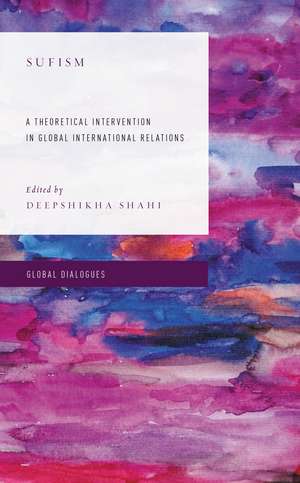
Sufism: A Theoretical Intervention in Global International Relations: Global Dialogues: Non Eurocentric Visions of the Global
Editat de Deepshikha Shahien Limba Engleză Hardback – 22 iun 2020
Against this backdrop, Sufism: A Theoretical Intervention in Global International Relations performs a multidisciplinary research to explore how 'Sufism' - as an established non-Western philosophy with a remarkable temporal-spatial spread across the globe - facilitates a creative intervention in the theoretical understanding of Global IR.






Preț: 697.17 lei
Preț vechi: 1004.87 lei
-31%
Puncte Express: 1046
Carte tipărită la comandă
Livrare economică 28 noiembrie-12 decembrie
Livrare prin curier în România Termenul estimat este afișat lângă disponibilitate.
Transport gratuit pentru acest produs Plată online sau ramburs, în funcție de opțiunile comenzii.
Retur gratuit în 14 zile Comandă securizată și suport în română.
Specificații
ISBN-13: 9781786613851
ISBN-10: 1786613859
Pagini: 192
Dimensiuni: 152 x 230 x 20 mm
Greutate: 0.54 kg
Editura: Bloomsbury Publishing
Colecția Rowman & Littlefield
Seria Global Dialogues: Non Eurocentric Visions of the Global
Locul publicării:New York, United States
ISBN-10: 1786613859
Pagini: 192
Dimensiuni: 152 x 230 x 20 mm
Greutate: 0.54 kg
Editura: Bloomsbury Publishing
Colecția Rowman & Littlefield
Seria Global Dialogues: Non Eurocentric Visions of the Global
Locul publicării:New York, United States
Cuprins
Introduction
1. The Entry of Sufism into Global IR: A Move Beyond the State-of-the-Art, Deepshikha Shahi
Part I: Sufism and Global IR
2. Al-Ghazali, Ibn al-Arabi and Global IR: A Sufi Re-reading of Knowledge-Power Nexus, Ali Balci
3. Rumi and Global IR: A Sufi Review of Epistemology, Ontology and Methodology, Deepshikha Shahi
Part II: Debating Sufi 'Oneness of Reality': Insights from the Non-Western Worlds
4. The Potentials of the Sufi Idea of 'Oneness of Reality' in Global IR, Fait Muedini
5. Sufism and the Preservation of Syrian Spiritual Identity, Omar Imady
6. The Limits of the Sufi Idea of 'Oneness of Reality' in Global IR, Giuseppe Cecere
7. The Sufi Rhetoric in Contemporary Turkey: Find Peace in My Hegemony! Ayse Cavdar
8. 'Textual-Contextual Tension' in the Sufi Study of Global IR: Learning from Sudan, Meir Hatina
Part III: Analysing Manifestations of Sufism: Encounters with the Western Worlds
9. The American Discourse on Sufism: On the Resilience of Mystical Isla
1. The Entry of Sufism into Global IR: A Move Beyond the State-of-the-Art, Deepshikha Shahi
Part I: Sufism and Global IR
2. Al-Ghazali, Ibn al-Arabi and Global IR: A Sufi Re-reading of Knowledge-Power Nexus, Ali Balci
3. Rumi and Global IR: A Sufi Review of Epistemology, Ontology and Methodology, Deepshikha Shahi
Part II: Debating Sufi 'Oneness of Reality': Insights from the Non-Western Worlds
4. The Potentials of the Sufi Idea of 'Oneness of Reality' in Global IR, Fait Muedini
5. Sufism and the Preservation of Syrian Spiritual Identity, Omar Imady
6. The Limits of the Sufi Idea of 'Oneness of Reality' in Global IR, Giuseppe Cecere
7. The Sufi Rhetoric in Contemporary Turkey: Find Peace in My Hegemony! Ayse Cavdar
8. 'Textual-Contextual Tension' in the Sufi Study of Global IR: Learning from Sudan, Meir Hatina
Part III: Analysing Manifestations of Sufism: Encounters with the Western Worlds
9. The American Discourse on Sufism: On the Resilience of Mystical Isla
Recenzii
Sufism: A Theoretical Intervention in Global International Relations is a valuable and timely contribution to the increasing interest in non-Western traditions of thought. It will be of interest to IR theorists as well as scholars in other disciplines who are interested in non-Western traditions of thought and is sure to motivate further research in IR that is inspired by Sufism.
A theoretically ambitious and often captivating opening shot exploring Islamic mysticism and politics in the international realm, featuring a wide variety of academic scholars, spatial settings, disciplinary approaches and topical interpretations.
A theoretically ambitious and often captivating opening shot exploring Islamic mysticism and politics in the international realm, featuring a wide variety of academic scholars, spatial settings, disciplinary approaches and topical interpretations.