
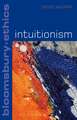
Intuitionism: Bloomsbury Ethics
Autor Dr David Kasparen Limba Engleză Hardback – 11 oct 2012
Or do we already know what's right and wrong?
Throughout modern history philosophers have tried to construct elaborate moral systems to determine what's right. Recently, however, some have revived the position that we have intuitive knowledge of right and wrong. In this book, David Kaspar introduces and explores the perspective known as 'Intuitionism'. Charting intuitionism's fall in the twentieth century and its recent resurgence, Kaspar looks at the intuitionist approach to the most important topics in ethics, from moral knowledge to intrinsically good moral action.
David Kaspar defends intuitionism against criticisms from competing metaethical schools, such as moral nihilism and ethical naturalism. It also takes on normative rivals, such as utilitarianism, Kantianism, and virtue ethics. By consolidating the stronger claims of both early analytic and contemporary intuitionists, Kaspar goes on to make a robust case for a rigorously intuitionist approach to explaining morality. Intuitionism also includes chapter summaries and guides to further reading throughout to help readers explore and master this important school of contemporary ethical thought. This is an ideal resource for undergraduates and postgraduates taking courses in ethics, metaethics and moral philosophy.


Preț: 771.19 lei
Preț vechi: 1020.94 lei
-24%
Puncte Express: 1157
Carte tipărită la comandă
Livrare economică 30 noiembrie-14 decembrie
Livrare prin curier în România Termenul estimat este afișat lângă disponibilitate.
Transport gratuit pentru acest produs Plată online sau ramburs, în funcție de opțiunile comenzii.
Retur gratuit în 14 zile Comandă securizată și suport în română.
Specificații
ISBN-13: 9781441114464
ISBN-10: 1441114467
Pagini: 208
Dimensiuni: 138 x 216 x 20 mm
Greutate: 0.54 kg
Ediția:New.
Editura: Bloomsbury Publishing
Colecția Bloomsbury Academic
Seria Bloomsbury Ethics
Locul publicării:London, United Kingdom
ISBN-10: 1441114467
Pagini: 208
Dimensiuni: 138 x 216 x 20 mm
Greutate: 0.54 kg
Ediția:New.
Editura: Bloomsbury Publishing
Colecția Bloomsbury Academic
Seria Bloomsbury Ethics
Locul publicării:London, United Kingdom
V-ar putea interesa
-
 In Praise of DesireNomy Arpaly-31%Preț: 572.21 lei827.53 lei
 -
 The Ajax Dilemma: Justice, Fairness, and RewardsPaul Woodruff-17%Preț: 142.42 lei171.61 lei
 -
 A Sentimentalist Theory of the MindMichael Slote-29%Preț: 503.44 lei704.94 lei
 -
 -12%Preț: 342.10 lei390.52 lei
 -
 Contractualism and the Foundations of MoralityNicholas Southwood-12%Preț: 356.50 lei404.22 lei
 -
 How We Fight: Ethics in WarHelen Frowe-28%Preț: 505.57 lei706.15 lei
 -
 Human Interests: or Ethics for PhysicalistsJoseph Mendola-31%Preț: 746.38 lei1079.76 lei
 -
 Oxford Studies in Normative Ethics, Volume 3Mark Timmons-13%Preț: 355.47 lei406.78 lei
 -
 The Human ConditionJohn Kekes-12%Preț: 336.25 lei380.24 lei
 -
 Oxford Studies in Agency and Responsibility, Volume 1David Shoemaker-11%Preț: 345.61 lei387.28 lei
 -
 From Individual to Collective Intentionality: New EssaysSara Rachel Chant-35%Preț: 626.06 lei960.03 lei
 -
 Environmental EthicsRobin AttfieldPreț: 226.05 lei
 -
 Rational PolemicsRichard Todd DevensPreț: 152.24 lei
 -
 Moral Matters: A Philosophy of HomecomingMark Dooley-11%Preț: 307.98 lei346.82 lei
 -
 The Bloomsbury Companion to EthicsDr Christian B. Miller-14%Preț: 281.47 lei326.83 lei
 -
 After VirtueProfessor Alasdair MacIntyre-14%Preț: 169.66 lei197.15 lei
 -
 Assholes: A TheoryAaron James-41%Preț: 68.21 lei114.64 lei
Cuprins
Acknowledgements \ Introduction \ 1. Thinking About Morality \ 2. The Story of Contemporary Intuitionism \ 3. Moral Knowledge \ 4. New Challenges to Intuitionism \ 5. The Grounds of Morality \ 6. The Right and the Good Reconsidered \ 7. Intuitionism's Rivals \ 8. Practical and Ultimate Moral Issues\ Conclusion \ Notes \ Bibliography \ Index
Recenzii
Kaspar has succeeded in creating a lucid and engaging guide for those unfamiliar with intuitionism. The book will certainly be accessible to undergraduates - its chapter summaries are especially helpful in this regard - so I think it is likely to make a very useful teaching resource. Kaspar draws on both contemporary literature and on the work of important early intuitionists, thereby charting the course that he thinks intuitionism should take. Whether or not moral intuitionism is more successful than its rivals, Kaspar does an excellent job of showcasing its attractions.
'The book's constructive project is worthy of attention. Kaspar uses the many objections to intuitionism to pare the theory down to its essentials; then, he develops a framework that promises to solve the explanatory and epistemological puzzles that the view faces. His account of moral facts deserves further discussion; his observations about the centrality of moral relations to ethics are quite compelling; and his diagnosis of moral disagreement (in terms of different weightings of known prima facie duties) seems promising.
'The book's constructive project is worthy of attention. Kaspar uses the many objections to intuitionism to pare the theory down to its essentials; then, he develops a framework that promises to solve the explanatory and epistemological puzzles that the view faces. His account of moral facts deserves further discussion; his observations about the centrality of moral relations to ethics are quite compelling; and his diagnosis of moral disagreement (in terms of different weightings of known prima facie duties) seems promising.