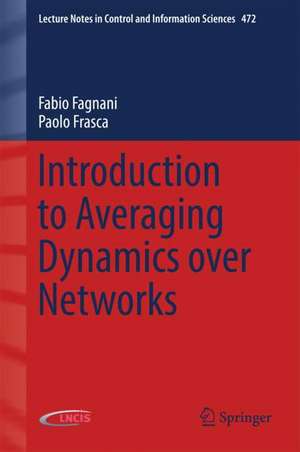
Introduction to Averaging Dynamics over Networks: Lecture Notes in Control and Information Sciences, cartea 472
Autor Fabio Fagnani, Paolo Frascaen Limba Engleză Hardback – 12 noi 2017
În literatura tehnică dedicată sistemelor complexe, Introduction to Averaging Dynamics over Networks se distinge prin rigoarea cu care unifică rezultate dispersate anterior în numeroase publicații academice. Subliniem faptul că, spre deosebire de documentația oficială a algoritmilor de consens care adesea presupune o bază solidă în procese stocastice, autorii Fabio Fagnani și Paolo Frasca optează pentru o abordare pedagogică. Aceștia construiesc proprietățile matricelor stocastice direct din structura topologică a grafurilor asociate, facilitând înțelegerea modului în care comunicarea între agenți influențează convergența sistemului. Notăm cu interes structura logică a volumului: acesta debutează cu fundamentele teoriei grafurilor, avansează spre rețele invariante și variabile în timp, și culminează cu analiza robusteții și a intrărilor exogene. Dacă Graph Theoretic Methods in Multiagent Networks v-a oferit cadrul teoretic extins al metodelor de graf, această carte oferă instrumentele practice necesare pentru a modela evoluția puterilor unei matrice stocastice și scalabilitatea acestora în rețele de mari dimensiuni. Această lucrare reprezintă o evoluție naturală față de Mathematical Foundations of Complex Networked Information Systems, unde Fabio Fagnani a explorat bazele matematice ale sistemelor complexe. Aici, focusul se mută pe dinamica liniară de mediere, oferind o perspectivă actualizată asupra estimărilor din măsurători relative și a agenților „încăpățânați” (stubborn agents). Descoperim astfel un ghid esențial pentru înțelegerea fuziunii de date și a coordonării grupurilor de vehicule fără pilot, transformând concepte abstracte în soluții de inginerie electrică și control.
Din seria Lecture Notes in Control and Information Sciences
- 18%
 Preț: 922.72 lei
 - 18%
 Preț: 992.74 lei
 - 18%
 Preț: 811.63 lei
 - 18%
 Preț: 930.57 lei
 - 18%
 Preț: 1152.69 lei
 - 20%
 Preț: 343.21 lei
 - 11%
 Preț: 506.65 lei
 - 20%
 Preț: 647.32 lei
 -
 Preț: 373.03 lei
 -
 Preț: 393.04 lei
 -
 Preț: 367.68 lei
 -
 Preț: 389.72 lei
 -
 Preț: 385.58 lei
 - 15%
 Preț: 621.46 lei
 - 15%
 Preț: 638.23 lei
 -
 Preț: 369.60 lei
 -
 Preț: 373.68 lei
 - 15%
 Preț: 644.94 lei
 - 15%
 Preț: 676.36 lei
 - 20%
 Preț: 336.37 lei
 -
 Preț: 367.42 lei
 -
 Preț: 555.85 lei
 -
 Preț: 393.66 lei
 -
 Preț: 420.47 lei
 -
 Preț: 388.03 lei
 -
 Preț: 370.42 lei
 - 18%
 Preț: 725.74 lei
 -
 Preț: 380.77 lei
 - 15%
 Preț: 624.45 lei
 - 15%
 Preț: 627.39 lei
 -
 Preț: 371.48 lei
 -
 Preț: 386.21 lei
 -
 Preț: 403.03 lei
 -
 Preț: 402.44 lei
 -
 Preț: 373.12 lei
 -
 Preț: 390.25 lei
 -
 Preț: 372.67 lei
 -
 Preț: 389.72 lei
 -
 Preț: 379.38 lei
 -
 Preț: 371.77 lei
 -
 Preț: 391.66 lei
 -
 Preț: 368.43 lei
 -
 Preț: 399.61 lei
 -
 Preț: 387.70 lei
 -
 Preț: 372.58 lei
 -
 Preț: 369.60 lei
 -
 Preț: 374.51 lei
 -
 Preț: 397.91 lei
 -
 Preț: 391.66 lei
Preț: 721.06 lei
Preț vechi: 848.31 lei
-15%
Carte disponibilă
Livrare economică 09-23 noiembrie
Specificații
ISBN-10: 3319680218
Pagini: 148
Ilustrații: XII, 135 p. 22 illus., 3 illus. in color.
Dimensiuni: 160 x 241 x 14 mm
Greutate: 0.37 kg
Ediția:1st edition 2018
Editura: Springer
Colecția Lecture Notes in Control and Information Sciences
Seria Lecture Notes in Control and Information Sciences
Locul publicării:Cham, Switzerland
V-ar putea interesa
-
 Computer Networks: A Systems ApproachLarry L. Peterson-41%Preț: 558.53 lei941.05 lei
 -
 Networks: OxfordGuido Caldarelli-36%Preț: 48.40 lei75.59 lei
 -
 SpeedVaclav SmilPreț: 137.51 lei
 -
 The Mathematical Theory of CommunicationClaude E ShannonPreț: 170.90 lei
 -
 Formal Methods for Multi-Agent Feedback Control SystemsDimos V. Dimarogonas-20%Preț: 610.14 lei762.68 lei
 -
 -19%Preț: 430.60 lei531.60 lei
 -
 Optimal Control and EstimationRobert F. Stengel-20%Preț: 212.35 lei264.50 lei
 -
 The ScoreC. Thi NguyenPreț: 194.17 lei
 -
 Distributed Control of Robotic NetworksFrancesco Bullo-19%Preț: 546.66 lei674.89 lei
 -
 Logic, Information and AgencyJohan van BenthemPreț: 246.36 lei
 -
 Dots and LinesAnthony BonatoPreț: 211.93 lei
 -
 The Dark Forest Theory of the InternetBogna KoniorPreț: 86.72 lei
 -
 Systems UltraGeorgina VossPreț: 130.76 lei
 -
 Robust and Adaptive ControlEugene LavretskyPreț: 533.14 lei
 -
 Networked SystemsSalem Lahlou-20%Preț: 996.76 lei1245.95 lei
 -
 Emerging Applications of Control and Systems TheoryRoberto Tempo-18%Preț: 994.17 lei1212.41 lei
 -
 -20%Preț: 642.40 lei803.00 lei
 -
 -18%Preț: 924.85 lei1127.87 lei
 -
 -18%Preț: 980.42 lei1195.64 lei
 -
 Stochastic Approximation: A Dynamical Systems ViewpointVivek S. Borkar-15%Preț: 729.92 lei858.74 lei
De ce să citești această carte
Această carte este indispensabilă cercetătorilor și studenților la masterat care doresc să stăpânească dinamica sistemelor multi-agent fără a se pierde în formalismul excesiv al lanțurilor Markov. Veți câștiga o înțelegere clară a modului în care topologia unei rețele dictează viteza de propagare a informației, un avantaj competitiv în proiectarea rețelelor de senzori sau a sistemelor de control distribuit.
Despre autor
Fabio Fagnani este un expert recunoscut în matematică aplicată și teoria sistemelor, cu un interes de lungă durată în rețelele complexe și sistemele de informații. Lucrările sale anterioare au pus bazele matematice pentru înțelegerea structurilor de graf în context fizic și economic. Paolo Frasca completează această expertiză prin cercetări axate pe controlul și dinamica rețelelor, contribuind la dezvoltarea unor algoritmi eficienți pentru coordonarea agenților autonomi. Împreună, cei doi autori transformă experiența lor academică într-un manual tehnic coerent, publicat sub egida prestigioasă a editurii Springer.
Cuprins
Recenzii
Notă biografică
Textul de pe ultima copertă
Starting from the classical evolution of the powers of a fixed stochastic matrix, the text then considers more general evolutions of products of a sequence of stochastic matrices, either deterministic or randomized. The theory needed for a full understanding of the models is constructed without assuming any knowledge of Markov chains or Perron–Frobenius theory. Jointly with their analysis of the convergence of averaging dynamics, theauthors derive the properties of stochastic matrices. These properties are related to the topological structure of the associated graph, which, in the book’s perspective, represents the communication between agents. Special attention is paid to how theseproperties scale as the network grows in size.
Finally, the understanding of stochastic matrices is applied to the study of other problems in multi-agent coordination: averaging with stubborn agents and estimation from relative measurements. The dynamics described in the book find application in the study of opinion dynamics in social networks, of information fusion in sensor networks, and of the collective motion of animal groups and teams of unmanned vehicles. Introduction to Averaging Dynamics over Networks will be of material interest to researchers in systems and control studying coordinated or distributed control, networked systems or multiagent systems and to graduate students pursuing courses in these areas.