
Distributed Impulsive Coordination of Multi-Agent Systems: Intelligent Control and Learning Systems, cartea 15
Autor Zhengle Zhang, Tiedong Ma, Bing Cuien Limba Engleză Hardback – 16 noi 2024
Observăm că lucrarea Distributed Impulsive Coordination of Multi-Agent Systems impune un nivel de experiență avansat, fiind destinată cercetătorilor și studenților de la facultățile de automatică și calculatoare care stăpânesc deja bazele teoriei sistemelor de control. Premisa volumului semnat de Zhengle Zhang, Tiedong Ma și Bing Cui este eficientizarea comunicării în sistemele multi-agent (MAS) prin utilizarea controlului impulsiv. Spre deosebire de controlul continuu, această metodă discontinuă permite interacțiunea informațională doar la anumite momente critice, reducând semnificativ resursele de rețea. Apreciem rigoarea tehnică cu care autorii tratează limitările hardware reale, precum dificultatea aplicării semnalelor la momente fixe sau coordonarea asincronă. Ca și Wei Wang în Distributed Adaptive Consensus Control of Uncertain Multi-Agent Systems, autorii de față distilează experiența reală în principii acționabile, însă se concentrează specific pe controlul impulsiv în condiții de topologii stocastice și atacuri cibernetice. Structura cărții este una liniară și logică: începe cu introducerea fundamentelor, trece prin consensul asincron și sistemele cu întârzieri (delayed systems), culminând cu un capitol dens despre controlul adaptiv pentru sisteme cu grad ridicat de incertitudine. Stilul este unul pur academic, orientat spre demonstrații matematice susținute de peste 100 de ilustrații color care clarifică dinamica agenților în rețea. Această ediție 2025 publicată de Springer reprezintă o resursă esențială pentru înțelegerea modului în care constrângerile fizice pot fi integrate în modelele matematice de coordonare.
Din seria Intelligent Control and Learning Systems
- 18%
 Preț: 980.42 lei
 - 18%
 Preț: 1164.31 lei
 - 18%
 Preț: 1044.45 lei
 - 24%
 Preț: 872.55 lei
 - 24%
 Preț: 854.23 lei
 - 24%
 Preț: 793.34 lei
 - 24%
 Preț: 878.75 lei
 - 18%
 Preț: 750.48 lei
 - 24%
 Preț: 776.96 lei
 - 24%
 Preț: 733.92 lei
 - 18%
 Preț: 925.23 lei
 - 24%
 Preț: 907.80 lei
 - 24%
 Preț: 838.65 lei
 - 24%
 Preț: 1022.88 lei
 - 24%
 Preț: 892.54 lei
 - 24%
 Preț: 827.79 lei
 - 20%
 Preț: 1067.30 lei
 -
 Preț: 442.60 lei
 - 18%
 Preț: 856.81 lei
 - 18%
 Preț: 783.54 lei
 - 18%
 Preț: 811.98 lei
 - nou
 Preț: 784.26 lei
Preț: 924.85 lei
Preț vechi: 1127.87 lei
-18%
Carte disponibilă
Livrare economică 09-23 noiembrie
Specificații
ISBN-10: 9819762618
Pagini: 204
Ilustrații: Approx. 200 p. 100 illus. in color.
Dimensiuni: 160 x 241 x 16 mm
Greutate: 0.46 kg
Ediția:2025
Editura: Springer
Colecția Intelligent Control and Learning Systems
Seria Intelligent Control and Learning Systems
Locul publicării:Singapore, Singapore
V-ar putea interesa
-
 Multi-Agent Reinforcement LearningFilippos Christianos-20%Preț: 487.36 lei609.19 lei
 -
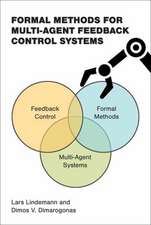 Formal Methods for Multi-Agent Feedback Control SystemsDimos V. Dimarogonas-20%Preț: 610.14 lei762.68 lei
 -
 -23%Preț: 1108.02 lei1438.99 lei
 -
 Distributed Control of Robotic NetworksFrancesco Bullo-19%Preț: 546.66 lei674.89 lei
 -
 -23%Preț: 1294.93 lei1681.72 lei
 -
 -23%Preț: 1206.24 lei1566.54 lei
 -
 Cooperative Control of Multi-agent SystemsZhenwei Liu-24%Preț: 952.08 lei1252.73 lei
 -
 Robust and Adaptive ControlEugene LavretskyPreț: 533.14 lei
 -
 -15%Preț: 664.57 lei781.85 lei
 -
 Control Subject to Computational and Communication ConstraintsSophie Tarbouriech-18%Preț: 992.74 lei1210.65 lei
 -
 -20%Preț: 623.89 lei779.85 lei
 -
 -20%Preț: 853.33 lei1066.67 lei
 -
 -20%Preț: 1115.74 lei1394.67 lei
 -
 -24%Preț: 751.64 lei989.00 lei
 -
 Distributed Coordination Control SystemYongnan Jia-18%Preț: 812.36 lei990.69 lei
 -
 -18%Preț: 985.27 lei1201.54 lei
 -
 Data-Driven Cyber Physical SystemsFangyu Li-18%Preț: 1046.51 lei1276.23 lei
 -
 Singularly Perturbed Jump SystemsHao Shen-18%Preț: 928.44 lei1132.24 lei
 -
 -18%Preț: 980.42 lei1195.64 lei
De ce să citești această carte
Recomandăm această carte inginerilor de sistem care doresc să reducă traficul de date în rețelele de agenți autonomi. Veți câștiga o înțelegere profundă a controlului impulsiv asincron, învățând cum să gestionați întârzierile de timp și atacurile cibernetice. Este un ghid teoretic solid pentru cei care proiectează sisteme de control complexe unde eficiența comunicării este vitală.
Despre autor
Zhengle Zhang, Tiedong Ma și Bing Cui sunt cercetători activi în domeniul ingineriei electrice și al sistemelor de control inteligent. Expertiza lor cumulată se concentrează pe dinamica sistemelor complexe și pe controlul rețelelor multi-agent. Prin această contribuție în seria Intelligent Control and Learning Systems, autorii aduc în prim-plan soluții pentru problemele de consens și formare în MAS, integrând metode de control discontinuu și adaptiv. Lucrările lor sunt recunoscute pentru modul în care adresează incertitudinile de model și perturbațiile stocastice în mediile de control moderne.
Descriere scurtă
Cuprins
Notă biografică
He focuses on the research of impulsive control in multi-agent systems. His recent research interests include coordination of multi-agent systems, impulsive control, adaptive control, cyberattacks, etc. Since 2017, he has published 17 papers in international journals and conferences.
Dr. Tiedong Ma received his B.E. degree in Electrical Engineering and Automation from Changchun University of Technology, Changchun, China, in 2001, M.E. and Ph.D. degrees in Control Theory and Control Engineering from Northeastern University, Shenyang, China, in 2005 and 2009, respectively. Since Sep. 2011, he has been in School of Automation, Chongqing University, as an associate professor.
He focuses on the research of discontinuous control and its applications. His recent research interests include fractional-order system control, impulsive control, intermittent control, coordination control of multi-agent system, cluster control of unmanned system, etc. Since 2007, he has published 91 papers in international journals and conferences. In addition, he has published one monograph ("Impulsive Control Theory", Science Press, 2016) and obtained second prize in Chongqing Natural Science Award (ranked second).
Dr. Bing Cui received the Ph.D. degree in Information and Communication Engineering from the Harbin Engineering University, Harbin, China, in 2016. He was a visiting scholar with the Automation and Robotics Research Institute, University of Texas at Arlington, Arlington, TX, USA, from 2013 to 2015, and a visiting researcher with the School of Aerospace, Transport and Manufacturing, Cranfield University, Cranfield, UK, in 2019. From 2017 to 2019, he was a postdoctoral researcher with the School of Automation, Beijing Institute of Technology, Beijing, China, where he has been an associate professor, since 2019.
He focuses on the research of distributed control, spacecraft attitude control, and finite-time control, etc. Since 2013, he has published 46 papers in international journals and conferences.