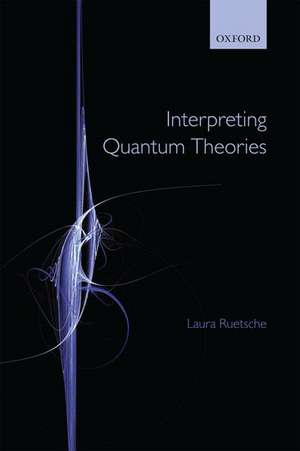
Interpreting Quantum Theories
Autor Laura Ruetscheen Limba Engleză Hardback – 2 iun 2011
Preț: 819.97 lei
Preț vechi: 1169.25 lei
-30%
Puncte Express: 1230
Carte tipărită la comandă
Livrare economică 04-15 decembrie
Livrare prin curier în România Termenul estimat este afișat lângă disponibilitate.
Transport gratuit pentru acest produs Plată online sau ramburs, în funcție de opțiunile comenzii.
Retur gratuit în 14 zile Comandă securizată și suport în română.
Specificații
ISBN-13: 9780199535408
ISBN-10: 019953540X
Pagini: 398
Dimensiuni: 159 x 239 x 30 mm
Greutate: 0.77 kg
Editura: OUP OXFORD
Colecția OUP Oxford
Locul publicării:Oxford, United Kingdom
ISBN-10: 019953540X
Pagini: 398
Dimensiuni: 159 x 239 x 30 mm
Greutate: 0.77 kg
Editura: OUP OXFORD
Colecția OUP Oxford
Locul publicării:Oxford, United Kingdom
V-ar putea interesa
-
 Emergence: From Chaos to OrderJohn H. Holland-16%Preț: 166.67 lei199.49 lei
 -
 The Essential TuringB. Jack. Copeland-9%Preț: 255.91 lei280.24 lei
 -
 -35%Preț: 441.66 lei682.78 lei
 -
 -19%Preț: 132.89 lei164.44 lei
 -
 Visual Cultures in Science and Technology: A Comparative HistoryKlaus Hentschel-32%Preț: 817.98 lei1205.99 lei
 -
 -18%Preț: 343.20 lei419.95 lei
 -
 -27%Preț: 369.47 lei503.22 lei
 -
 -32%Preț: 815.71 lei1192.95 lei
 -
 -11%Preț: 284.88 lei319.89 lei
 -
 Evidence, Explanation, and Realism: Essays in Philosophy of SciencePeter Achinstein-27%Preț: 524.91 lei719.99 lei
 -
 -28%Preț: 377.50 lei521.84 lei
 -
 The Quark And The Jaguar: Adventures in the Simple and the ComplexMurray Gell-Mann-26%Preț: 79.42 lei107.77 lei
 -
 The Evolutionary MindRupert SheldrakePreț: 103.71 lei
 -
 A Sense of the MysteriousAlan LightmanPreț: 108.03 lei
 -
 The Quantum and the LotusMatthieu RicardPreț: 105.22 lei
Recenzii
Each of these chapters by itself makes an important contribution to philosophy of physics; but amazingly, Ruetsche ties them each to the overarching argument against pristine interpretations and for a modification of traditional scientific realism. ... It is a book that repays close study and which should be discussed extensively by philosophers in the years to come.
All in all, the book is a remarkable achievement: at one and the same time a cohesive account of a major body of work by the author and others, an accessible and philosophically sensitive introduction to the field, a powerful defence of a largely novel position in philosophy of science through careful attention to scientific details, and an impressive advertisement for the value of that strategy in philosophy of science that places a high premium on mathematical rigour, without losing focus on the philosophical issues at hand. It is not the only strategy available but, in Reutsches hands at least, it is remarkably effective.
Ruetsche's book is set apart from many of the recent books of the philosophy of physics, not only in its engagement with the quantum theory of infinite systems (including quantum field theory), but also in its explicit engagement with questions from general philosophy of science ... It is a book that repays close study and which should be discussed extensively by philosophers in the years to come.
All in all, the book is a remarkable achievement: at one and the same time a cohesive account of a major body of work by the author and others, an accessible and philosophically sensitive introduction to the field, a powerful defence of a largely novel position in philosophy of science through careful attention to scientific details, and an impressive advertisement for the value of that strategy in philosophy of science that places a high premium on mathematical rigour, without losing focus on the philosophical issues at hand. It is not the only strategy available but, in Reutsches hands at least, it is remarkably effective.
Ruetsche's book is set apart from many of the recent books of the philosophy of physics, not only in its engagement with the quantum theory of infinite systems (including quantum field theory), but also in its explicit engagement with questions from general philosophy of science ... It is a book that repays close study and which should be discussed extensively by philosophers in the years to come.
Notă biografică
As an undergraduate at Carleton College in Northfield, Minnesota, Laura Ruetsche studied physics, philosophy, and classical Greek. A Rhodes Scholarship took her to Oxford, where she wrote a B.Phil. thesis on Plato's Timaeus under the direction of John Ackrill. Shifting her focus to philosophy of physics, she completed her graduate work at the University of Pittsburgh, earning her PhD in 1995 and joining the faculty in 1996. In 2008, she moved to the University of Michigan, where she is now Professor of Philosophy.