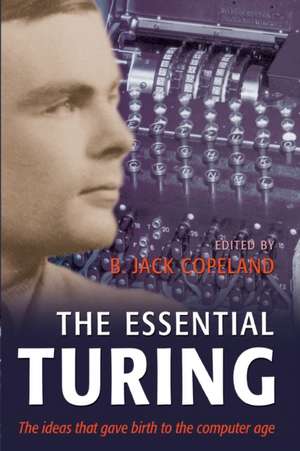
The Essential Turing
Editat de B. Jack. Copelanden Limba Engleză Paperback – 9 sep 2004
Preț: 255.91 lei
Preț vechi: 280.24 lei
-9%
Puncte Express: 384
Carte tipărită la comandă
Livrare economică 27 noiembrie-08 decembrie
Livrare prin curier în România Termenul estimat este afișat lângă disponibilitate.
Transport gratuit de la 400.00 lei Plată online sau ramburs, în funcție de opțiunile comenzii.
Retur gratuit în 14 zile Comandă securizată și suport în română.
Specificații
ISBN-13: 9780198250807
ISBN-10: 0198250800
Pagini: 624
Ilustrații: numerous line drawings and halftones
Dimensiuni: 166 x 242 x 32 mm
Greutate: 0.93 kg
Ediția:New.
Editura: OUP OXFORD
Colecția OUP Oxford
Locul publicării:Oxford, United Kingdom
ISBN-10: 0198250800
Pagini: 624
Ilustrații: numerous line drawings and halftones
Dimensiuni: 166 x 242 x 32 mm
Greutate: 0.93 kg
Ediția:New.
Editura: OUP OXFORD
Colecția OUP Oxford
Locul publicării:Oxford, United Kingdom
V-ar putea interesa
-
 Alan Turing: His Work and ImpactS. Barry Cooper-20%Preț: 405.62 lei508.35 lei
 -
 American Diplomacy: Sixtieth-Anniversary Expanded EditionGeorge F. KennanPreț: 208.61 lei
 -
 Preț: 303.91 lei
 -
 -23%Preț: 444.91 lei577.81 lei
 -
 Realities of American Foreign PolicyGeorge F. KennanPreț: 98.12 lei
 -
 Soviet-American Relations, 1917-1920, Volume IGeorge Frost KennanPreț: 522.80 lei
 -
 Soviet-American Relations, 1917-1920, Volume IIGeorge Frost KennanPreț: 520.67 lei
 -
 Strategic Intelligence for American World PolicySherman KentPreț: 298.76 lei
 -
 Preț: 202.03 lei
 -
 The Interest of America in International ConditionsAlfred Thayer MahanPreț: 454.78 lei
 -
 Sherman Kent and the Board of National EstimatesEditor Donald P. SteuryPreț: 115.44 lei
 -
 America's Strategy in World Politics: The United States and the Balance of PowerNicholas J. Spykman-8%Preț: 448.06 lei487.02 lei
Recenzii
The editor not only presents the Turing seminal papers and ingenious contributions to fields he was far ahead his time, he also gives easy access for non-specialists by his comprehensive introductions and comments.
Cuprins
- Alan Turing 1912-1954
- Computable Numbers: A Guide
- 1: On Computable Numbers, with an Application to the Entscheidensproblem (1936)
- 2: Alan Turing, Emil Post, and Donald W. Davies: On Computable Numbers: Corrections and Critiques
- 3: Systems of Logic Based on Ordinals (1938)
- 4: Letters on Logic to Max Newman (c. 1940)
- Enigma
- 5.: Patrick Mahon: History of Hut 8 to December 1941 (1845)
- 6: Bombe and Spider (1940)
- 7: Letter to Winston Churchill (1941)
- 8: Memorandum to OP-20-G on Naval Enigma (c. 1941)
- Artificial Intelligence
- 9: Lecture on the Automatic Computing Machine (1947)
- 10: Intelligent Machinery (1948)
- 11: Computing Machinery and Intelligence (1950)
- 12: Intelligent Machinery, A Heretical Theory (c. 1951)
- 13: Can Digital Computers Think?
- 14: Alan Turing, Richard Braithwaite, Geoffrey Jefferson, and Max Newman: Can Automatic Calculating Machines Be Said to Think? (1952)
- Artificial Life
- 15: The Chemical Basis of Morphogenesis (1952)
- 16: Chess (1953)
- 17: Solvable and Unsolvable Problems (1954)