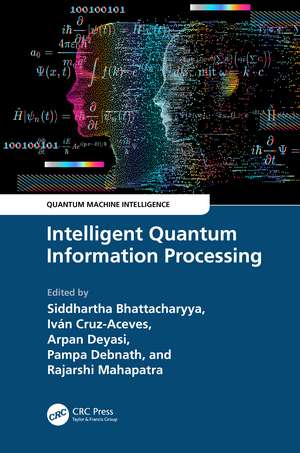
Intelligent Quantum Information Processing: Quantum Machine Intelligence
Editat de Siddhartha Bhattacharyya, Ivan Cruz-Aceves, Arpan Deyasi, Pampa Debnath, Rajarshi Mahapatraen Limba Engleză Paperback – 21 mai 2026
This book:
• Showcases a detailed overview of different quantum machine learning algorithmic frameworks.
• Presents real-life case studies and applications.
• Provides an in-depth analysis of quantum mechanical principles.
• Provides a step-by-step guide in the build-up of quantum inspired/quantum intelligent information processing systems.
• Provides a video demonstration on each chapter for better understanding.
It will serve as an ideal reference text for graduate students and academic researchers in fields such as electrical engineering, electronics and communication engineering, computer engineering, and information technology.

Preț: 443.91 lei
Preț vechi: 554.89 lei
-20%
Puncte Express: 666
Carte tipărită la comandă
Livrare economică 25 noiembrie-09 decembrie
Livrare prin curier în România Termenul estimat este afișat lângă disponibilitate.
Transport gratuit pentru acest produs Plată online sau ramburs, în funcție de opțiunile comenzii.
Retur gratuit în 14 zile Comandă securizată și suport în română.
Specificații
ISBN-13: 9781032446325
ISBN-10: 1032446323
Pagini: 254
Ilustrații: 220
Dimensiuni: 156 x 234 mm
Greutate: 0.47 kg
Ediția:1
Editura: CRC Press
Colecția CRC Press
Seria Quantum Machine Intelligence
ISBN-10: 1032446323
Pagini: 254
Ilustrații: 220
Dimensiuni: 156 x 234 mm
Greutate: 0.47 kg
Ediția:1
Editura: CRC Press
Colecția CRC Press
Seria Quantum Machine Intelligence
V-ar putea interesa
-
 Quantum Information ScienceRiccardo Manenti-19%Preț: 442.57 lei545.32 lei
 -
 Quantum 2.0Paul DaviesPreț: 144.29 lei
 -
 Quantum Computing for EveryoneChris Bernhardt-20%Preț: 94.74 lei118.43 lei
 -
 Theoretical Foundations of Quantum ComputingDaowen Qiu-32%Preț: 479.34 lei707.65 lei
 -
 Quantum InformationAsma Al-QasimiPreț: 445.38 lei
 -
 Quantum Mechanics: Volume 3David TongPreț: 362.56 lei
 -
 The Quantum EvolutionAlex Khang-20%Preț: 1180.60 lei1475.75 lei
 -
 Systematic Security: A CISO’s PlaybookTimur Qader-20%Preț: 367.98 lei459.97 leiRecomandat
 -
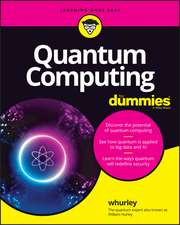 Quantum Computing For DummiesWhurley-20%Preț: 142.20 lei177.76 lei
 -
 Preț: 364.39 lei
 -
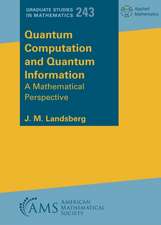 Quantum Computation and Quantum InformationJ. M. Landsberg-9%Preț: 637.48 lei700.53 lei
 -
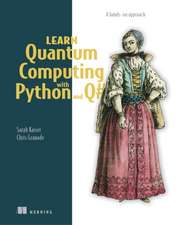 Learn Quantum Computing with Python and QChris Granade-20%Preț: 391.90 lei489.88 lei
 -
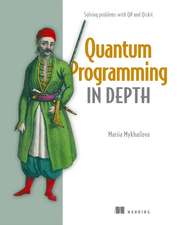 Quantum Programming in DepthMariia Mykhailova-20%Preț: 378.22 lei472.78 lei
 -
 Quantum Computing: From Concepts to CodeAndrew Glassner-35%Preț: 241.67 lei371.43 lei
 -
 Quantum Computing: An Applied ApproachJack D. Hidary-20%Preț: 243.90 lei304.87 lei
 -
 Quantum Image ProcessingFei Yan-20%Preț: 926.07 lei1157.60 lei
 -
 -20%Preț: 1082.87 lei1353.59 lei
 -
 -20%Preț: 1128.76 lei1410.94 lei
Public țintă
Postgraduate and Undergraduate AdvancedNotă biografică
Dr. Siddhartha Bhattacharyya did his Bachelor in Physics, Bachelor in Optics and Optoelectronics, and Master in Optics and Optoelectronics from the University of Calcutta, India in 1995, 1998, and 2000 respectively. He completed his PhD in Computer Science and Engineering from Jadavpur University, India, in 2008. He completed a habilitation thesis from VSB Technical University of Ostrava, Ostrava, Czech Republic in 2023. He is the recipient of the University Gold Medal from the University of Calcutta for his Master. He is the recipient of several coveted awards, including the Distinguished HoD Award and Distinguished Professor Award conferred by the Computer Society of India, Mumbai Chapter, India in 2017, the Honorary Doctorate Award (D. Litt.) from The University of South America, and the South East Asian Regional Computing Confederation (SEARCC) International Digital Award ICT Educator of the Year in 2017. He has been appointed as the ACM Distinguished Speaker for the tenure of 2018-2020. He was inducted into the People of ACM Hall of Fame by ACM, the USA in 2020. He has been appointed as the IEEE Computer Society Distinguished Visitor for the tenure of 2021-2023. He has been elected as a full foreign member of the Russian Academy of Natural Sciences (RANS) and the Russian Academy of Engineering (REA). He has been elected a full fellow of The Royal Society for Arts, Manufacturers and Commerce (RSA), London, UK. He is currently serving as the Principal of Rajnagar Mahavidyalaya, Rajnagar, Birbhum. He is also serving as the Scientific Advisor of Algebra University College, Zagreb, Croatia. He served as a Professor in the Department of Computer Science and Engineering of Christ University, Bangalore. He was the Principal of RCC Institute of Information Technology, Kolkata, India, from 2017-2019. He has also served as a Senior Research Scientist in the Faculty of Electrical Engineering and Computer Science of VSB Technical University of Ostrava, Czech Republic (2018-2019). Prior to this, he was a Professor of Information Technology at RCC Institute of Information Technology, Kolkata, India. He served as the Head of the Department from March 2014 to December 2016. Prior to this, he was an Associate Professor of Information Technology at RCC Institute of Information Technology, Kolkata, India, from 2011-2014. Before that, he served as an Assistant Professor in Computer Science and Information Technology at the University Institute of Technology, The University of Burdwan, India, from 2005-2011. He was a Lecturer in Information Technology at Kalyani Government Engineering College, India, during 2001-2005. He is a co-author of 6 books and the co-editor of 98 books and has more than 400 research publications in international journals and conference proceedings to his credit. He has two PCTs and 19 patents to his credit. He has been a member of the organizing and technical program committees of several national and international conferences. He is the founding Chair of ICCICN 2014, ICRCICN (2015, 2016, 2017, 2018), and ISSIP (2017, 2018) (Kolkata, India). He was the General Chair of several international conferences like WCNSSP 2016 (Chiang Mai, Thailand), ICACCP (2017, 2019) (Sikkim, India), ICICC 2018 (New Delhi, India), and ICICC 2019 (Ostrava, Czech Republic). He is the Associate Editor of several reputed journals, including Applied Soft Computing, IEEE Access, Evolutionary Intelligence, and IET Quantum Communications. He is the editor of the International Journal of Pattern Recognition Research and the founding Editor-in-chief of the International Journal of Hybrid Intelligence, Inderscience. He has guest-edited several issues with several international journals. He is serving as the Series Editor of IGI Global Book Series Advances in Information Quality and Management (AIQM), De Gruyter Book Series Frontiers in Computational Intelligence (FCI), CRC Press Book Series(s) Computational Intelligence and Applications & Quantum Machine Intelligence, Wiley Book Series Intelligent Signal and Data Processing, Elsevier Book Series Hybrid Computational Intelligence for Pattern Analysis and Understanding and Springer Tracts on Human Centered Computing. His research interests include hybrid intelligence, pattern recognition, multimedia data processing, social networks, and quantum computing. He is a life fellow of the Optical Society of India (OSI), India, a life fellow of the International Society of Research and Development (ISRD), UK, a fellow of the Institution of Engineering and Technology (IET), UK, a fellow of Institute of Electronics and Telecommunication Engineers (IETE), India and a fellow of Institution of Engineers (IEI), India. He is also a senior member of the Institute of Electrical and Electronics Engineers (IEEE), USA, the International Institute of Engineering and Technology (IETI), Hong Kong, and the Association for Computing Machinery (ACM), USA. He is the founding President of the Asia-Pacific Artificial Intelligence Association (AAIA), Kolkata, and the Chairman of the IEEE Computational Intelligence Society, Kolkata Chapter. He is a life member of the Cryptology Research Society of India (CRSI), Computer Society of India (CSI), Indian Society for Technical Education (ISTE), Indian Unit for Pattern Recognition and Artificial Intelligence (IUPRAI), Center for Education Growth and Research (CEGR), Integrated Chambers of Commerce and Industry (ICCI), and Association of Leaders and Industries (ALI). He is a member of the Institution of Engineering and Technology (IET), UK, International Rough Set Society, International Association for Engineers (IAENG), Hong Kong, Computer Science Teachers Association (CSTA), USA, International Association of Academicians, Scholars, Scientists and Engineers (IAASSE), USA, Institute of Doctors Engineers and Scientists (IDES), India, The International Society of Service Innovation Professionals (ISSIP) and The Society of Digital Information and Wireless Communications (SDIWC). He is also a certified Chartered Engineer of the Institution of Engineers (IEI), India. He is on the Board of Directors of the International Institute of Engineering and Technology (IETI), Hong Kong.
Ivan Cruz-Aceves received an M.S. degree in Computer Science in 2009 from the Leon Institute of Technology, and a Ph.D. in Electrical Engineering from the University of Guanajuato with Summa Cum Laude distinction in 2014. He joined the Department of Computer Science at the Centre for Research in Mathematics (CIMAT) in 2014 as part of the program "Investigadores por México" at the National Council for Science and Technology (CONACYT). He is currently a full-time researcher of Computer Science, and He is the author of more than 30 international conference papers, 35 papers in journals (JCR), international book chapters, and 10 transfer technologies to the medical area involving medical image processing and analysis. His areas of interest are Artificial Intelligence focused on stochastic and Evolutionary Computation with applications to medical image and video processing and analysis.
Dr. Arpan Deyasi is presently working as an Associate Professor in the Department of Electronics and Communication Engineering in RCC Institute of Information Technology, Kolkata, INDIA. He has more than 17 years of professional experience in academia and industry. His work spans around in the field of semiconductor nanostructure and semiconductor photonics. He has published more than 200 peer-reviewed research papers and edited 8 books. He is associated with different International and National Conferences in various aspects and is also Guest Editor of a few renowned journals. He is a senior member of IEEE, Vice-Chair of IEEE Electron Device Society (Kolkata Chapter), and member of IE(I), Optical Society of India, IETE, ISTE, ISVE, etc.
Ms. Pampa Debnath is presently working as an Assistant Professor in the Department of Electronics and Communication Engineering at RCC Institute of Information Technology, Kolkata, INDIA. She has more than 16 years of professional teaching experience in academics. Her research interest covers the area of Microwave devices, High-frequency antennas, SIW, and RGW-based circuits. She has already served as the technical chair and session chairs of several IEEE, Springer, and other International Conferences and coordinated several Faculty Development Programmes, Workshops, Laboratory and Industrial visits, seminars, and technical events under the banner of IEEE and The Institution of Engineers (INDIA) Kolkata section. She is a reviewer of a few journals of repute and some IEEE, Springer, and other national and international conferences. She is a member of The Institute of Engineers (IE), The Institution of Electronics and Telecommunication Engineers (IETE), the Indian Society for Technical Education (ISTE), International Association for Engineers (IAENG).
Rajarshi Mahapatra received a Ph.D. degree in electronics and electrical communication engineering from the Indian Institute of Technology Kharagpur, Kharagpur, India, and a postdoctoral degree from the CEA-LETI, Grenoble, France. In his postdoctoral research, he was engaged in FP7 Call4 BeFEMTO and Greentouch projects. He is presently serving as an Associate Professor with the Department of Electronics and Communication Engineering, Dr. SPM IIIT Naya Raipur. He also served as Dean (Academics) of IIITNR. Earlier, he had worked for Collins Aerospace, Hyderabad, on software-defined radio and electronic warfare.
Dr. Rajarshi Mahapatra has worked extensively in the domain of physical layer design and analysis of a wireless communication system. He worked in the fields of cognitive radio, 5G and 6G communication, heterogeneous wireless communication, molecular communication, and energy-efficient communication. His team designed and developed software-defined radio and direction-finding systems for EW applications in Collins Aerospace. industry. He has about 18 years of teaching, research, and industry experience. He has guided PhD scholars in the area of wireless communication. He has published several research papers in various refereed Journals and IEEE Journals. He is a regular reviewer of premier IEEE Transactions and other peer-reviewed Journals and IEEE conferences. He has been organizing many workshops on 5G in recent years. He has also developed several high-value research labs, including the 5G test bed. He has successfully completed and undertaken high-value sponsored projects in the field of communication systems.
He has been awarded a National scholarship, an MHRD scholarship for research, and an EU-FP7 fellowship for a European project. He is a senior member of IEEE and a member of the Communication Society. His research interests include 5G & and beyond communication, machine learning for communication, molecular communication, intelligent reflecting surfaces, and optical access networks.
Ivan Cruz-Aceves received an M.S. degree in Computer Science in 2009 from the Leon Institute of Technology, and a Ph.D. in Electrical Engineering from the University of Guanajuato with Summa Cum Laude distinction in 2014. He joined the Department of Computer Science at the Centre for Research in Mathematics (CIMAT) in 2014 as part of the program "Investigadores por México" at the National Council for Science and Technology (CONACYT). He is currently a full-time researcher of Computer Science, and He is the author of more than 30 international conference papers, 35 papers in journals (JCR), international book chapters, and 10 transfer technologies to the medical area involving medical image processing and analysis. His areas of interest are Artificial Intelligence focused on stochastic and Evolutionary Computation with applications to medical image and video processing and analysis.
Dr. Arpan Deyasi is presently working as an Associate Professor in the Department of Electronics and Communication Engineering in RCC Institute of Information Technology, Kolkata, INDIA. He has more than 17 years of professional experience in academia and industry. His work spans around in the field of semiconductor nanostructure and semiconductor photonics. He has published more than 200 peer-reviewed research papers and edited 8 books. He is associated with different International and National Conferences in various aspects and is also Guest Editor of a few renowned journals. He is a senior member of IEEE, Vice-Chair of IEEE Electron Device Society (Kolkata Chapter), and member of IE(I), Optical Society of India, IETE, ISTE, ISVE, etc.
Ms. Pampa Debnath is presently working as an Assistant Professor in the Department of Electronics and Communication Engineering at RCC Institute of Information Technology, Kolkata, INDIA. She has more than 16 years of professional teaching experience in academics. Her research interest covers the area of Microwave devices, High-frequency antennas, SIW, and RGW-based circuits. She has already served as the technical chair and session chairs of several IEEE, Springer, and other International Conferences and coordinated several Faculty Development Programmes, Workshops, Laboratory and Industrial visits, seminars, and technical events under the banner of IEEE and The Institution of Engineers (INDIA) Kolkata section. She is a reviewer of a few journals of repute and some IEEE, Springer, and other national and international conferences. She is a member of The Institute of Engineers (IE), The Institution of Electronics and Telecommunication Engineers (IETE), the Indian Society for Technical Education (ISTE), International Association for Engineers (IAENG).
Rajarshi Mahapatra received a Ph.D. degree in electronics and electrical communication engineering from the Indian Institute of Technology Kharagpur, Kharagpur, India, and a postdoctoral degree from the CEA-LETI, Grenoble, France. In his postdoctoral research, he was engaged in FP7 Call4 BeFEMTO and Greentouch projects. He is presently serving as an Associate Professor with the Department of Electronics and Communication Engineering, Dr. SPM IIIT Naya Raipur. He also served as Dean (Academics) of IIITNR. Earlier, he had worked for Collins Aerospace, Hyderabad, on software-defined radio and electronic warfare.
Dr. Rajarshi Mahapatra has worked extensively in the domain of physical layer design and analysis of a wireless communication system. He worked in the fields of cognitive radio, 5G and 6G communication, heterogeneous wireless communication, molecular communication, and energy-efficient communication. His team designed and developed software-defined radio and direction-finding systems for EW applications in Collins Aerospace. industry. He has about 18 years of teaching, research, and industry experience. He has guided PhD scholars in the area of wireless communication. He has published several research papers in various refereed Journals and IEEE Journals. He is a regular reviewer of premier IEEE Transactions and other peer-reviewed Journals and IEEE conferences. He has been organizing many workshops on 5G in recent years. He has also developed several high-value research labs, including the 5G test bed. He has successfully completed and undertaken high-value sponsored projects in the field of communication systems.
He has been awarded a National scholarship, an MHRD scholarship for research, and an EU-FP7 fellowship for a European project. He is a senior member of IEEE and a member of the Communication Society. His research interests include 5G & and beyond communication, machine learning for communication, molecular communication, intelligent reflecting surfaces, and optical access networks.
Cuprins
Preface
About the Editors
List of Contributors
1 The Role of Quantum Entanglement in Information Processing for Secured Data Transmission
ARPAN DEYASI, PAMPA DEBNATH, AND SIDDHARTHA BHATTACHARYYA
1.1 Introduction
1.2 Quantum Interference
1.3 Quantum Superposition
1.4 Quantum Entanglement
1.5 Quantum Communication
1.6 Quantum Information Processing
1.7 Qubit
1.8 Secured Data Communication
1.9 Quantum Key Distribution
1.10 Quantum Internet
References
2 Quantum Information Processing for Next-Generation Communication System Design
SWETA SHARMA, SOUMEN SANTRA, AND ARPAN DEYASI
2.1 Introduction
2.1.1 Historical Development of Quantum Information Science
2.2 Quantum Algorithm
2.2.1 Algorithms Based on the Quantum Fourier Transform
2.2.2 Algorithms Based on Amplitude Amplification
2.2.3 Algorithms Based on Quantum Walks
2.2.4 BQP-Complete Problems
2.2.5 Hybrid Quantum/Classical Algorithms
2.3 Recent Advances and Current Prospects in Quantum Information Processing
2.3.1 Quantum Computation
2.3.2 Theory of Quantum Computation
2.3.3 Quantum Communication
2.3.4 Quantum Sensing and Metrology
2.4 Conceptual and Technical Challenges
2.4.1 Challenges for Quantum Computing
2.4.2 Challenges for Quantum Communications
2.4.3 Challenges for Quantum Sensing and Metrology
2.5 Conclusion
References
3 Automatic Classification of Tables Using Hybrid Quantum Convolutional Neural Networks
ERICK FRANCO-GAONA, IVÁN CRUZ-ACEVES, AND MARIA-SUSANA AVILA-GARCIA
3.1 Introduction
3.2 Background
3.2.1 Database of Information Elements
3.2.2 Convolutional Neural Networks
3.2.3 Quantum Convolutional Neural Networks
3.3 Proposed Method for Classifying Tables
3.3.1 Hybrid Quantum Convolutional Neural Networks
3.3.2 Convolutional Neural Networks
3.3.3 Transfer Learning
3.3.4 Data Augmentation
3.3.5 Hyperparameters
3.3.6 Evaluation Metrics
3.4 Computational Experiments
3.4.1 CNN Experiments
3.4.2 HQCNN Experiments
3.5 Conclusion and Future Work
3.6 Appendix
References
4 Transformation Optics: Subwavelength Control of Light Leads to Novel Phased Array Antenna System Design
DIPANKAR MITRA, ERIC JAHNS, SHUVASHIS DEY, AND SAYAN ROY
4.1 Introduction
4.2 Form-Invariance of Maxwell’s Equations and Its Relevance to TO
4.3 Design of Phased Array Antenna Elements Using TO
4.4 Future Directions of the TO-Based Design: Can Deep Learning Be a Solution?
4.5 Conclusion
Acknowledgment
References
5 Programming Quantum Hardware via Levenberg-Marquardt Machine Learning
JAMES E. STECK, NATHAN L. THOMPSON, AND ELIZABETH C. BEHRMAN
5.1 Introduction
5.2 Machine Learning for Deep Time Quantum Networks
5.2.1 Machine Learning in Simulation
5.2.2 A Hardware-Compatible Model for IBM Qiskit
5.3 Finite Difference Gradient Descent Learning on Quantum Hardware
5.3.1 Fourier Quantum Parameters for Simulations
5.3.2 Parameter Variation Finite Difference Gradients’ Learning Results
5.3.3 Finite Difference Gradient Descent Learning on IBM Qiskit
5.4 Levenberg-Marquardt Learning for Quantum Hardware
5.4.1 Levenberg-Marquardt Algorithm Applied to Quantum Computing
5.4.2 Levenberg-Marquardt Training: MATLAB Simulation Results
5.4.3 Levenberg-Marquardt Qiskit Training Results
5.5 Conclusion
Acknowledgment
References
6 Numerical Modeling of the Major Temporal Arcade Using a Quantum Genetic Algorithm
JOSÉ ALFREDO SOTO-ÁLVAREZ, IVÁN CRUZ-ACEVES, ARTURO HERNÁNDEZ-AGUIRRE, MARTHA ALICIA HERNÁNDEZ-GONZÁLEZ, AND LUIS MIGUEL LÓPEZ-MONTERO
6.1 Introduction
6.2 Background
6.2.1 Database of Major Temporal Arcade Images
6.2.2 Polynomial Fitting
6.2.3 Genetic Algorithms
6.2.4 Quantum Genetic Algorithm
6.2.5 Proposed Method
6.2.6 Evaluation Measures
6.3 Computational Experiments
6.4 Conclusion
6.5 Appendix: Matlab Code
References
7 Quantum Logic Gate–Based Circuit Design for Computing Applications
JOY BHATTACHARJEE AND ARPAN DEYASI
7.1 Introduction
7.2 Quantum Computing
7.2.1 Superposition
7.2.2 Quantum Entanglement
7.2.3 Quantum Tunneling
7.3 Quantum Bit (Qubit)
7.3.1 What Is Qubit?
7.3.2 Formulation of a Qubit
7.4 Logic Gates
7.4.1 Pauli X, Y and Z Gates
7.4.2 Hadamard (H) Gate
7.4.3 R f Gate or RZ Gate
7.5 Multiplexer Using Quantum Bits
7.5.1 Fredkin Gate
7.5.2 Multiplexer
7.6 Conclusion
References
8 Recent Trends and Challenges in Quantum Computing Based on Artificial Intelligence
KRISHNANJAN MUKHERJEE, RATNESWAR GHOSH, AND SOUMEN SANTRA
8.1 Introduction
8.1.1 Literature Survey
8.1.2 Historical Development of Quantum Computing
8.2 Essential Hardware Components of a Quantum Computer
8.2.1 Data Plane of Quantum
8.2.2 Parameters of Plane of Control and Measurement
8.2.3 Processor Plane and Host Control
8.2.4 Qubit Technologies
8.3 Types of Quantum Computer
8.3.1 Quantum Annealer
8.3.2 Analogue Quantum Annealer
8.3.3 Universal Quantum Computer
8.4 Quantum Bits
8.5 Types of Qubits
8.5.1 Qubit: Superconductor
8.5.2 Qubit: Quantum Dot
8.5.3 Qubit: Trapped Ion
8.5.4 Qubit: Photonic
8.5.5 Qubit: Defect-Based
8.5.6 Qubit: Topological
8.5.7 NMR Qubit
8.6 Applications
8.6.1 Artificial Intelligence and Machine Learning
8.6.2 Computation Chemistry
8.6.3 Cybersecurity and Cryptography
8.6.4 Weather Forecasting
8.7 Comparisons of Quantum Computing Applications
8.7.1 Margolus and Toffoli Gates
8.7.2 Deutsch-Jozsa Algorithm
8.7.3 Bernstein-Vazirani Algorithm
8.8 Recent Works
8.8.1 Case Study 1
8.8.2 Case Study 2
8.8.3 Case Study 3
8.8.4 Some of the Recent Works on Quantum Computing
8.9 Future Works and Conclusion
References
9 Quantum Microwave Engineering: A New Application Area of Quantum Computing
PAMPA DEBNATH, ARPAN DEYASI, AND SIDDHARTHA BHATTACHARYYA
9.1 Introduction
9.2 Quantum Microwave Propagation
9.2.1 Guided Propagation
9.2.2 Non-Guided Propagation
9.3 Quantum Computing with Qubits
9.3.1 Qubit Basics
9.3.2 Qubits Operated as Resonators
9.4 Physical Realization of Qubit
9.4.1 Qubit Trapped Ion
9.4.2 Spin Qubits for Semiconductors
9.4.3 Superconducting Qubits
9.5 Conclusion
References
10 Intelligent Quantum Information Processing: Future Directions of Research
PAMPA DEBNATH, ARPAN DEYASI, AND SIDDHARTHA BHATTACHARYYA
10.1 Conclusion
10.2 Future Research Initiatives
References
Index
About the Editors
List of Contributors
1 The Role of Quantum Entanglement in Information Processing for Secured Data Transmission
ARPAN DEYASI, PAMPA DEBNATH, AND SIDDHARTHA BHATTACHARYYA
1.1 Introduction
1.2 Quantum Interference
1.3 Quantum Superposition
1.4 Quantum Entanglement
1.5 Quantum Communication
1.6 Quantum Information Processing
1.7 Qubit
1.8 Secured Data Communication
1.9 Quantum Key Distribution
1.10 Quantum Internet
References
2 Quantum Information Processing for Next-Generation Communication System Design
SWETA SHARMA, SOUMEN SANTRA, AND ARPAN DEYASI
2.1 Introduction
2.1.1 Historical Development of Quantum Information Science
2.2 Quantum Algorithm
2.2.1 Algorithms Based on the Quantum Fourier Transform
2.2.2 Algorithms Based on Amplitude Amplification
2.2.3 Algorithms Based on Quantum Walks
2.2.4 BQP-Complete Problems
2.2.5 Hybrid Quantum/Classical Algorithms
2.3 Recent Advances and Current Prospects in Quantum Information Processing
2.3.1 Quantum Computation
2.3.2 Theory of Quantum Computation
2.3.3 Quantum Communication
2.3.4 Quantum Sensing and Metrology
2.4 Conceptual and Technical Challenges
2.4.1 Challenges for Quantum Computing
2.4.2 Challenges for Quantum Communications
2.4.3 Challenges for Quantum Sensing and Metrology
2.5 Conclusion
References
3 Automatic Classification of Tables Using Hybrid Quantum Convolutional Neural Networks
ERICK FRANCO-GAONA, IVÁN CRUZ-ACEVES, AND MARIA-SUSANA AVILA-GARCIA
3.1 Introduction
3.2 Background
3.2.1 Database of Information Elements
3.2.2 Convolutional Neural Networks
3.2.3 Quantum Convolutional Neural Networks
3.3 Proposed Method for Classifying Tables
3.3.1 Hybrid Quantum Convolutional Neural Networks
3.3.2 Convolutional Neural Networks
3.3.3 Transfer Learning
3.3.4 Data Augmentation
3.3.5 Hyperparameters
3.3.6 Evaluation Metrics
3.4 Computational Experiments
3.4.1 CNN Experiments
3.4.2 HQCNN Experiments
3.5 Conclusion and Future Work
3.6 Appendix
References
4 Transformation Optics: Subwavelength Control of Light Leads to Novel Phased Array Antenna System Design
DIPANKAR MITRA, ERIC JAHNS, SHUVASHIS DEY, AND SAYAN ROY
4.1 Introduction
4.2 Form-Invariance of Maxwell’s Equations and Its Relevance to TO
4.3 Design of Phased Array Antenna Elements Using TO
4.4 Future Directions of the TO-Based Design: Can Deep Learning Be a Solution?
4.5 Conclusion
Acknowledgment
References
5 Programming Quantum Hardware via Levenberg-Marquardt Machine Learning
JAMES E. STECK, NATHAN L. THOMPSON, AND ELIZABETH C. BEHRMAN
5.1 Introduction
5.2 Machine Learning for Deep Time Quantum Networks
5.2.1 Machine Learning in Simulation
5.2.2 A Hardware-Compatible Model for IBM Qiskit
5.3 Finite Difference Gradient Descent Learning on Quantum Hardware
5.3.1 Fourier Quantum Parameters for Simulations
5.3.2 Parameter Variation Finite Difference Gradients’ Learning Results
5.3.3 Finite Difference Gradient Descent Learning on IBM Qiskit
5.4 Levenberg-Marquardt Learning for Quantum Hardware
5.4.1 Levenberg-Marquardt Algorithm Applied to Quantum Computing
5.4.2 Levenberg-Marquardt Training: MATLAB Simulation Results
5.4.3 Levenberg-Marquardt Qiskit Training Results
5.5 Conclusion
Acknowledgment
References
6 Numerical Modeling of the Major Temporal Arcade Using a Quantum Genetic Algorithm
JOSÉ ALFREDO SOTO-ÁLVAREZ, IVÁN CRUZ-ACEVES, ARTURO HERNÁNDEZ-AGUIRRE, MARTHA ALICIA HERNÁNDEZ-GONZÁLEZ, AND LUIS MIGUEL LÓPEZ-MONTERO
6.1 Introduction
6.2 Background
6.2.1 Database of Major Temporal Arcade Images
6.2.2 Polynomial Fitting
6.2.3 Genetic Algorithms
6.2.4 Quantum Genetic Algorithm
6.2.5 Proposed Method
6.2.6 Evaluation Measures
6.3 Computational Experiments
6.4 Conclusion
6.5 Appendix: Matlab Code
References
7 Quantum Logic Gate–Based Circuit Design for Computing Applications
JOY BHATTACHARJEE AND ARPAN DEYASI
7.1 Introduction
7.2 Quantum Computing
7.2.1 Superposition
7.2.2 Quantum Entanglement
7.2.3 Quantum Tunneling
7.3 Quantum Bit (Qubit)
7.3.1 What Is Qubit?
7.3.2 Formulation of a Qubit
7.4 Logic Gates
7.4.1 Pauli X, Y and Z Gates
7.4.2 Hadamard (H) Gate
7.4.3 R f Gate or RZ Gate
7.5 Multiplexer Using Quantum Bits
7.5.1 Fredkin Gate
7.5.2 Multiplexer
7.6 Conclusion
References
8 Recent Trends and Challenges in Quantum Computing Based on Artificial Intelligence
KRISHNANJAN MUKHERJEE, RATNESWAR GHOSH, AND SOUMEN SANTRA
8.1 Introduction
8.1.1 Literature Survey
8.1.2 Historical Development of Quantum Computing
8.2 Essential Hardware Components of a Quantum Computer
8.2.1 Data Plane of Quantum
8.2.2 Parameters of Plane of Control and Measurement
8.2.3 Processor Plane and Host Control
8.2.4 Qubit Technologies
8.3 Types of Quantum Computer
8.3.1 Quantum Annealer
8.3.2 Analogue Quantum Annealer
8.3.3 Universal Quantum Computer
8.4 Quantum Bits
8.5 Types of Qubits
8.5.1 Qubit: Superconductor
8.5.2 Qubit: Quantum Dot
8.5.3 Qubit: Trapped Ion
8.5.4 Qubit: Photonic
8.5.5 Qubit: Defect-Based
8.5.6 Qubit: Topological
8.5.7 NMR Qubit
8.6 Applications
8.6.1 Artificial Intelligence and Machine Learning
8.6.2 Computation Chemistry
8.6.3 Cybersecurity and Cryptography
8.6.4 Weather Forecasting
8.7 Comparisons of Quantum Computing Applications
8.7.1 Margolus and Toffoli Gates
8.7.2 Deutsch-Jozsa Algorithm
8.7.3 Bernstein-Vazirani Algorithm
8.8 Recent Works
8.8.1 Case Study 1
8.8.2 Case Study 2
8.8.3 Case Study 3
8.8.4 Some of the Recent Works on Quantum Computing
8.9 Future Works and Conclusion
References
9 Quantum Microwave Engineering: A New Application Area of Quantum Computing
PAMPA DEBNATH, ARPAN DEYASI, AND SIDDHARTHA BHATTACHARYYA
9.1 Introduction
9.2 Quantum Microwave Propagation
9.2.1 Guided Propagation
9.2.2 Non-Guided Propagation
9.3 Quantum Computing with Qubits
9.3.1 Qubit Basics
9.3.2 Qubits Operated as Resonators
9.4 Physical Realization of Qubit
9.4.1 Qubit Trapped Ion
9.4.2 Spin Qubits for Semiconductors
9.4.3 Superconducting Qubits
9.5 Conclusion
References
10 Intelligent Quantum Information Processing: Future Directions of Research
PAMPA DEBNATH, ARPAN DEYASI, AND SIDDHARTHA BHATTACHARYYA
10.1 Conclusion
10.2 Future Research Initiatives
References
Index
Descriere
The text presents the latest innovations on intelligent quantum information processing involving quantum machine learning for solving real life problems. It will serve as an ideal reference text for graduate students, and academic researchers in diverse engineering domains including electrical, electronics and communication, and computer.