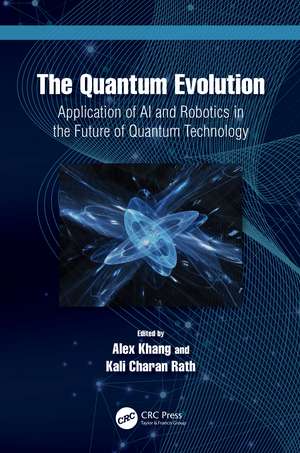
The Quantum Evolution
Editat de Alex Khang, Kali Charan Rathen Limba Engleză Hardback – 27 aug 2024
Ecosistemul descris în The Quantum Evolution se fundamentează pe convergența a trei piloni tehnologici: calculul cuantic, inteligența artificială și robotica industrială. Ne-a atras atenția modul în care editorii Alex Khang și Kali Charan Rath structurează lucrarea pentru a trece dincolo de teoria pură, punând accent pe framework-uri de lucru precum rețelele neuronale inspirate de cuantică și algoritmi capabili să proceseze seturi de date masive. Putem afirma că volumul funcționează ca o punte între cercetarea academică și implementarea industrială, oferind 280 de ilustrații care clarifică mecanismele de superpoziție și entanglement aplicate în sisteme inteligente. Structura cărții este progresivă: primele capitole definesc „schimbarea cuantică” și roboții adaptivi, evoluând spre studii de caz granulare în capitolul 6 despre metrologie și senzori, respectiv capitolul 11 dedicat descoperirii de noi medicamente. În contextul operei editorului Alex Khang, acest titlu reprezintă o evoluție naturală de la lucrările sale anterioare, precum Machine Vision and Industrial Robotics in Manufacturing sau Synergy of AI and Fintech in the Digital Gig Economy, extinzând aplicabilitatea automatizării către regimul subatomic. Complementar lui Quantum Artificial Intelligence de Deepika Ghai, care se concentrează pe fundamentele matematice, volumul de față acoperă zona aplicată a roboticii medicale și a producției 3D, oferind o perspectivă tehnică asupra modului în care hardware-ul cuantic va interacționa cu Internet of Things (IoT).
Preț: 1180.60 lei
Preț vechi: 1475.75 lei
-20%
Carte disponibilă
Livrare economică 04-18 noiembrie
Specificații
ISBN-10: 103264205X
Pagini: 520
Ilustrații: 280
Dimensiuni: 156 x 234 x 30 mm
Greutate: 0.95 kg
Ediția:1
Editura: Taylor & Francis Ltd (Sales)
Locul publicării:Boca Raton, United States
V-ar putea interesa
-
 Quantum 2.0Paul DaviesPreț: 144.29 lei
 -
 Theoretical Foundations of Quantum ComputingDaowen Qiu-32%Preț: 479.34 lei707.65 lei
 -
 -20%Preț: 1371.39 lei1714.24 lei
 -
 Systematic Security: A CISO’s PlaybookTimur Qader-20%Preț: 367.98 lei459.97 leiRecomandat
 -
 Preț: 172.68 lei
 -
 Quantum Computing For DummiesWhurley-20%Preț: 142.20 lei177.76 lei
 -
 -20%Preț: 163.64 lei204.55 lei
 -
 The Essential Book of AIAnne Rooney-20%Preț: 76.61 lei95.77 lei
 -
 -41%Preț: 57.96 lei99.07 lei
 -
 Quantum TechnologyKevin Chen-20%Preț: 127.02 lei158.77 lei
 -
 Learn Quantum Computing with Python and QChris Granade-20%Preț: 391.90 lei489.88 lei
 -
 Quantum Computing: From Concepts to CodeAndrew Glassner-35%Preț: 241.67 lei371.43 lei
 -
 Advances in AI for Cloud, Edge, and Mobile Computing ApplicationsShrikaant Kulkarni-20%Preț: 1296.62 lei1620.78 lei
 -
 Quantum ComputingBrian CleggPreț: 76.85 lei
 -
 -19%Preț: 111.19 lei137.01 lei
 -
 Introduction to Quantum ComputingAhmed Banafa-20%Preț: 232.71 lei290.89 lei
 -
 Introduction to Quantum Computing for BusinessKoen Groenland-20%Preț: 101.34 lei126.68 lei
 -
 -20%Preț: 1082.87 lei1353.59 lei
 -
 -20%Preț: 1128.76 lei1410.94 lei
Public țintă
Professional Reference and Undergraduate AdvancedDe ce să citești această carte
Această lucrare este esențială pentru inginerii și cercetătorii care doresc să înțeleagă viitorul sistemelor autonome. Cititorul câștigă o viziune clară asupra modului în care algoritmii cuantici accelerează analiza datelor față de computerele clasice. Este un ghid practic pentru implementarea tehnologiilor emergente în industrii critice, precum sănătatea și știința materialelor, oferind soluții concrete pentru provocările actuale de securitate cibernetică.
Despre autor
Alex Khang este un specialist recunoscut în domeniul inteligenței artificiale și al tehnologiilor emergente, având un portofoliu vast de lucrări ce explorează intersecția dintre AI, robotică și economie digitală. Expertiza sa acoperă atât managementul talentelor prin cadre de competențe AI, cât și aplicații practice în Fintech și producție industrială. În The Quantum Evolution, el colaborează cu Kali Charan Rath pentru a coordona o viziune multidisciplinară asupra impactului calculului cuantic în cercetarea avansată și dezvoltarea de sisteme inteligente pentru industria 4.0.
Cuprins
Chapter 2. A Revolutionary Approach of Quantum Computing with its Future Applications
Chapter 3. Quantum Robotics: Towards Intelligent and Adaptive Robotic Systems
Chapter 4. Driving Transformative Technology Trends with Quantum-Based Artificial Intelligence (AI) Applications
Chapter 5. Merging Artificial Intelligence (AI) and Machine Learning (ML) with Quantum Technology
Chapter 6. Quantum Sensing and Metrology- Revolutionizing Measurement Science (Case Study on Industrial Application)
Chapter 7. Revolutionizing Healthcare Industry with Quantum Artificial Intelligence (AI) and Machine Learning (ML) Techniques
Chapter 8. Quantum Computing in Materials Science and Discovery
Chapter 9. Quantum Robotics in Healthcare: Innovations and Applications
Chapter 10. Innovations in Medical Manufacturing: A Review of 3D Printing, Robotics, and Internet of Things (IoT)
Chapter 11. Quantum Computing in Drug Discovery
Chapter 12. Quantum Precision in Medical Imaging: Deep Learning for Image Segmentation
Chapter 13. Quantum Computing of Computational Chemistry: Applications of Molecular Quantum Dynamics
Chapter 14. The Quantum Internet of Things: Revolutionizing the Financial Sector
Chapter 15. Quantum Computing in Medical Laboratory Science: From Ancient Methodologies to the Present Applications and Future Prospects
Chapter 16. Quantum Robotics in Space Exploration and Astrobiology
Chapter 17. Unraveling the Quantum Robotics Influence: Transforming Social Interaction for the Future
Chapter 18. Quantum Computing in Oil and Gas Exploration Industry
Chapter 19. Quantum-Powered Hate Speech Detection: Enhancing Recurrent Neural Networks (RNNs) for Safer Online Spaces
Chapter 20. Revolutionizing Quantum Robotics Applications for Enhancing Language Learning and Technology Self-Efficacy
Chapter 21. Quantum Robotics Ethics: Navigating the Ethical Implications of Artificial Intelligence (AI)-Enhanced Robots
Chapter 22. Quantum Computing and Big Data Analytics: Insights and Challenges
Chapter 23. Quantum Computing Cybersecurity - Exploring the Potential of Quantum Machine Learning Techniques in Intrusion Detection
Chapter 24. A Survey on Quantum Information Processing in Next Generation Digital Economy
Notă biografică
Dr. Kali Charan Rath, is an Associate Professor in the Department of Mechanical Engineering at GIET University, Odisha, India, with more than 18 years of experience in academia and research. He holds a Ph.D. degree in CAD/CAM from the National Institute of Technology, Jamshedpur, India. He has guided over 20 M. Tech students as a project supervisor. He has received recognition and awards for his contributions to knowledge dissemination. His research interests include Robotics and Automation, Smart Manufacturing Systems, IoT applications, Product design, Modeling and Simulation, CAD/CAM/CIM, Finite Element Analysis, and Design thinking and Innovation.
Descriere scurtă
The Quantum Evolution: Application of AI and Robotics in the Future of Quantum Technology uncovers the potential of quantum algorithms to tackle complex computational problems exponentially faster than classical counterparts. Readers are introduced to quantum machine learning and its potential to revolutionize AI by enabling more efficient data analysis, pattern recognition, and decision-making. The book explores the potential applications of quantum-inspired neural networks and how they can enhance the capabilities of AI systems, ushering in a new era of intelligent machines. It also delves into the potential risks and challenges associated with quantum technology integration, such as quantum security and privacy concerns. The book showcases numerous real-world applications and examples of how quantum technology, AI, and robotics are being utilized today, giving readers concrete insights into how these advancements are shaping industries, health care, communication, and more.
This book targets a mixed audience of specialists, analysts, engineers, scholars, researchers, academics, professionals, and students from different communities to share and contribute new ideas, methodologies, technologies, models, frameworks, theories, and practices in quantum technology.