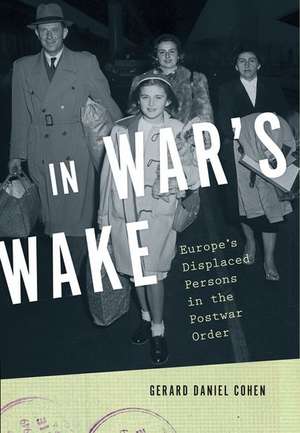
In War's Wake: Europe's Displaced Persons in the Postwar Order: Oxford Studies in International History
Autor Gerard Daniel Cohenen Limba Engleză Paperback – 14 sep 2017
Lucrarea In War's Wake aduce o perspectivă proaspătă asupra istoriei europene postbelice, argumentând că figura „refugiatului” nu a fost doar o consecință pasivă a conflictului, ci un element central în construcția legală și politică a noii ordini internaționale. Față de literatura existentă care se concentrează adesea pe logistica repatrierii, Gerard Daniel Cohen analizează modul în care prezența celor 1,5 milioane de persoane strămutate (DPs) în zonele de ocupație a forțat apariția unor instituții noi și a unui sistem global de drepturi ale omului. Reținem utilizarea riguroasă a arhivelor Organizației Internaționale pentru Refugiați, care îi permite autorului să demonstreze cum gestionarea acestor „populații excedentare” a modelat intervențiile umanitare moderne.
Această monografie, publicată de Oxford University Press în seria Oxford Studies in International History, acoperă aceeași arie tematică precum The Long Road Home de Ben Shephard, dar cu o abordare mult mai axată pe implicațiile geopolitice și juridice pe termen lung, spre deosebire de accentul pus de Shephard pe eforturile de ajutorare de urgență. În timp ce Refugees in Europe, 1919-1959 de Matthew Frank oferă o perspectivă largă asupra unei crize de patru decenii, lucrarea lui Cohen este mai specifică, concentrându-se pe momentul critic 1945-1951 ca punct de inflexiune pentru identitatea politică a Occidentului. Ne-a atras atenția modul în care autorul integrează chestiunea naționalismului evreiesc și a epurărilor politice în contextul mai larg al Războiului Rece, oferind o analiză superioară prin profunzimea documentării.
În contextul operei sale, In War's Wake completează preocupările autorului din Good Jews, extinzând analiza de la atitudinile culturale față de iudaism la impactul structural al refugiaților asupra instituțiilor internaționale. Este un volum esențial pentru înțelegerea modului în care crizele umanitare pot rescrie normele diplomatice globale.
Din seria Oxford Studies in International History
- 15%
 Preț: 171.23 lei
 - 14%
 Preț: 177.90 lei
 - 28%
 Preț: 446.29 lei
 - 20%
 Preț: 278.54 lei
 - 20%
 Preț: 296.65 lei
 - 28%
 Preț: 485.04 lei
 - 21%
 Preț: 302.35 lei
 - 28%
 Preț: 371.06 lei
 - 22%
 Preț: 346.78 lei
 - 19%
 Preț: 291.95 lei
 - 23%
 Preț: 233.10 lei
 - 34%
 Preț: 584.57 lei
 - 11%
 Preț: 380.14 lei
 - 15%
 Preț: 223.80 lei
 - 19%
 Preț: 167.90 lei
Preț: 283.17 lei
Preț vechi: 342.27 lei
-17%
Carte tipărită la comandă
Livrare economică 03-08 decembrie
Livrare express 23-29 octombrie pentru 91.29 lei
Specificații
ISBN-10: 0190840803
Pagini: 250
Ilustrații: 1 halftone
Dimensiuni: 155 x 234 x 18 mm
Greutate: 0.38 kg
Editura: Oxford University Press
Colecția OUP USA
Seria Oxford Studies in International History
Locul publicării:New York, United States
V-ar putea interesa
-
 Embracing DefeatJohn W. Dower-25%Preț: 103.31 lei137.67 lei
 -
 The World Since 1945: A Concise HistoryKeith Robbins-17%Preț: 197.48 lei238.51 lei
 -
 -11%Preț: 385.74 lei433.21 lei
 -
 -17%Preț: 286.34 lei344.71 lei
 -
 Europe Since 1945Mary Fulbrook-11%Preț: 359.75 lei405.90 lei
 -
 The Road to Monetary Union in Europe: The Emperor, the Kings, and the GeniesTommaso Padoa-Schioppa-29%Preț: 449.66 lei629.98 lei
 -
 -15%Preț: 250.63 lei296.59 lei
 -
 -28%Preț: 392.40 lei547.56 lei
 -
 -21%Preț: 400.78 lei508.22 lei
 -
 -11%Preț: 370.95 lei416.32 lei
 -
 -21%Preț: 414.35 lei525.35 lei
 -
 The Road To StalingradProf John Erickson-25%Preț: 93.48 lei124.19 lei
 -
 The FamilyKitty KelleyPreț: 138.68 lei
 -
 The Dark ValleyPiers BrendonPreț: 196.77 lei
 -
 Eminent ChurchilliansAndrew Roberts-27%Preț: 88.56 lei121.30 lei
 -
 The Meaning Of HitlerSebastian Haffner-27%Preț: 57.10 lei78.35 lei
De ce să citești această carte
Recomandăm această carte cercetătorilor și studenților la istorie sau relații internaționale care doresc să înțeleagă rădăcinile sistemului modern de azil. Cititorul câștigă o perspectivă clară asupra modului în care blocajul birocratic al taberelor de refugiați din 1945 a dus la nașterea ONG-urilor contemporane și a legislației internaționale privind drepturile omului, oferind un context istoric crucial pentru crizele migrației de astăzi.
Despre autor
Gerard Daniel Cohen este un istoric specializat în istoria modernă a Europei și a relațiilor internaționale, cu un interes academic profund pentru soarta populațiilor evreiești și a refugiaților post-Holocaust. Lucrările sale, precum Good Jews, explorează adesea intersecția dintre politică, memorie istorică și identitate. În In War's Wake, el își folosește expertiza pentru a plasa experiența persoanelor strămutate în centrul marii strategii diplomatice, consolidându-și reputația de analist al structurilor umanitare care au definit secolul XX.
Descriere
Recenzii
An insightful study of the European refugee problem created by WW II and then nurtured by the Cold War...Recommended.
“In War's Wake brilliantly demonstrates…that refugee flows possess a logic of their own and are by their very nature complementary.”- Holly Case, The Nation
As Gerard Daniel Cohen persuasively argues, Allied recognition of the DPs' objections to returning, and the prevailing sense of a profound difference between the 'democratic' Allies and the Soviet bloc, were important factors in the development of the Cold War.” - Sheila Fitzpatrick, London Review of Books
Written in spare prose, and on the basis of extraordinary research, In War's Wake shows how fruitful it is to blend international and social history, by bringing back into view the forgotten crucible of mass statelessness in which crucial legacies were made for contemporary humanitarianism and human rights alike."-Samuel Moyn, Columbia University, author of The Last Utopia: Human Rights in History
In War's Wake tells the story of the unprecedented humanitarian effort on behalf of millions of Europeans displaced by the Second World War. The postwar refugee crisis, Cohen demonstrates, gave rise to new conceptions of human rights, asylum and refugee policies, population policies, Cold War conflicts, and the emergence of the State of Israel. This provocative, well-written study is a landmark contribution to the history of human rights and to the political history of twentieth-century Europe."-Tara Zahra, author of The Lost Children: Reconstructing Europe's Families after World War II
“Based on thorough research in the archives of numerous institutions, Cohen's study of the millions of individuals left without a country after the Second World War shows how the European refugee problem was addressed by the leaders of the emerging free world, members of international organizations, legal scholars, and human rights activists. As Cohen demonstrates, the DP crisis facilitated a shift from minority rights to individual human rights and brought the issue of statelessness to the center of international politics. Enmeshed with the Cold War, this episode crucially secured the rights of individuals to a nationality and to a safe place of refuge, but also shaped new patterns of humanitarianism and international migration in the postwar era. In War's Wake is a masterpiece”-Patrick Weil, Université de Paris 1
“On the basis of meticulous research, Daniel Cohen makes important connections between the policies that emerged to manage Europe's displaced persons in 'war's wake' and the development of international humanitarian aid and population control programs, the onset of the Cold War, and the origins of the state of Israel. In the process, he shows that the very category of 'DP' shifted in response to the practical and political dimensions of resettlement.”-Mary D. Lewis, author of The Boundaries of the Republic: Migrant Rights and the Limits of Universalism in France, 1918-1940
[A] detailed and challenging study of post-war displaced persons and the development of the human-rights era.”-Susan Cohen, International History Review
“This well-crafted book demonstrates the far-reaching and lasting impact of the displaced persons on international affairs, humanitarianism, and human rights. It also provides a unique perspective on the attitudes and interests that led to the creation of a Jewish state. Although this is an international history with an interest in organizations, it does not lose sight of the individuals whose plight drew the attention of policymakers….Cohen is to be commended for his ability to balance a discussion of concepts and institutions with the dignity of the individual.”-Margarete Myers Feinstein, H-Judaic
“The strength of Cohen's book lies in his nuanced analysis and the connections he draws among various political agents, their arguments, and the policies that eventually evolved. His careful research places the European refugee problem at the center of events, and shows how the DP experience exerted considerable influence on the development of international humanitarian aid, population management, and the origins of the modern state of Israel.”-Lynn Rapaport, Holocaust and Genocide Studies
“In a now quite crowded field Cohen is a distinctive and signicant voice.>
“A model of the genre of international history: a thoroughly researched, transnationally focused, clearly presented study that amalgamates political, social and intellectual approaches into a convincing and far-ranging analysis that is relevant to many key aspects of the post-1945 period, in Europe and beyond....An excellent book that will undoubtedly become a standard work in the field.”-Pertti Ahonen, German History
“In War's Wake is a cogent argument for the centrality of the 'refugee' in the legal, political, and moral construction of the postwar international order and its humanitarian mission….[It] engages and illuminates an impressive range of historiographies: on postwar reconstruction and the start of the Cold War, on migration and immigration, on international aid organizations and evolving modes of humanitarianism, on postwar American influence abroad, on the foundation of the state of Israel, and on legal conceptions of human rights. It deserves a wide readership.”-Heidi Fehrenbach, Central European History