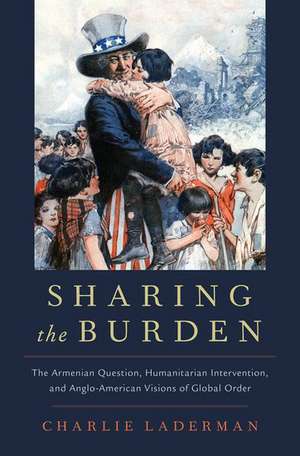
Sharing the Burden: The Armenian Question, Humanitarian Intervention, and Anglo-American Visions of Global Order: Oxford Studies in International History
Autor Charlie Ladermanen Limba Engleză Hardback – 5 noi 2019
Analiza propusă de Charlie Laderman debutează prin examinarea studiilor de caz asupra atrocităților din Imperiul Otoman și a modului în care acestea au forțat o recalibrare a responsabilității internaționale. Notăm cu interes cum autorul nu se limitează la o cronică a victimizării, ci folosește „Chestiunea Armeană” ca prismă pentru a înțelege nașterea ordinii mondiale moderne. Subliniem faptul că supraviețuirea comunității armene a devenit indisolubil legată de dezbaterea privind mandatul global al Statelor Unite, transformând o tragedie regională într-un pilon al diplomației anglo-americane.
Sharing the Burden oferă o perspectivă proaspătă asupra modului în care lideri precum Theodore Roosevelt și Woodrow Wilson au integrat imperativul moral în realismul politic. Această lucrare reprezintă o alternativă necesară la Dismantling the Ottoman Empire de Nevzat Uyanık pentru cursurile de istorie a relațiilor internaționale, cu avantajul că pune accentul pe viziunile ideologice concurente ale Londrei și Washingtonului, mai degrabă decât doar pe interesele comerciale sau misionare. În contextul operei autorului, volumul completează cercetările din Hitler's American Gamble, unde Charlie Laderman a explorat momentele de criză care au definit hegemonia americană, menținând aceeași rigoare în analiza arhivelor diplomatice.
Structura narativă evidențiază tensiunea dintre dorința publicului de a interveni și limitările sistemului Ligii Națiunilor. Credem că această ediție, publicată de Oxford University Press, este esențială pentru înțelegerea rădăcinilor intervenționismului umanitar contemporan, oferind un context istoric solid pentru dilemele politice actuale.
Din seria Oxford Studies in International History
- 15%
 Preț: 171.23 lei
 - 14%
 Preț: 177.90 lei
 - 28%
 Preț: 446.29 lei
 - 20%
 Preț: 278.54 lei
 - 17%
 Preț: 283.17 lei
 - 20%
 Preț: 296.65 lei
 - 28%
 Preț: 485.04 lei
 - 21%
 Preț: 302.35 lei
 - 28%
 Preț: 371.06 lei
 - 22%
 Preț: 346.78 lei
 - 19%
 Preț: 291.95 lei
 - 23%
 Preț: 233.10 lei
 - 11%
 Preț: 380.14 lei
 - 15%
 Preț: 223.80 lei
 - 19%
 Preț: 167.90 lei
Preț: 584.57 lei
Preț vechi: 892.18 lei
-34%
Carte tipărită la comandă
Livrare economică 03-08 decembrie
Specificații
ISBN-10: 0190618604
Pagini: 300
Ilustrații: 15 halftones
Dimensiuni: 163 x 236 x 28 mm
Greutate: 0.59 kg
Editura: Oxford University Press
Colecția OUP USA
Seria Oxford Studies in International History
Locul publicării:New York, United States
De ce să citești această carte
Această carte se adresează studenților și cercetătorilor în istorie diplomatică și științe politice. Cititorul câștigă o înțelegere profundă a modului în care genocidul armean a modelat conceptul de „responsabilitate de a proteja”. Este un studiu esențial despre cum valorile morale și interesele strategice se ciocnesc în formarea unei noi ordini globale, oferind perspective critice asupra relației speciale dintre Marea Britanie și Statele Unite.
Despre autor
Charlie Laderman este un istoric recunoscut, specializat în istoria relațiilor internaționale și politica externă a Statelor Unite. Este coautor al volumului Hitler's American Gamble, o lucrare apreciată pentru profunzimea cercetării arhivelor. În prezent, contribuie la dezvoltarea programelor de istorie în cadrul Oxford Studies in International History. Expertiza sa se concentrează pe momentele de cotitură ale secolului XX, analizând intersecția dintre ideologie, moralitate și putere în configurarea sistemului internațional, cu un accent deosebit pe parteneriatul transatlantic și intervenționismul umanitar.
Descriere
Recenzii
A tremendous volume. The sheer amount of research that went into the book is staggering, and Laderman's interpretations of the data are fresh and provocative. Readers will learn much about the Armenian question. They will also discover broader revelations about U.S. foreign relations in the book, challenging not just the history they know, but how history can be told.
Laderman makes a persuasive case that the Armenian question weighed heavily on the minds of official and non-governmental actors within the British and American empires. Going forward, historians of Gilded Age and Progressive Era Anglo-American relations, imperialism, and humanitarianism will need to grapple with the Armenian question with Sharing the Burden as the new starting point.
A thoroughly researched and highly compelling account of how the Armenian question acted as a catalyst for an emerging American-British geopolitical alliance and the United States' rise as a predominant actor in the international arena....[A] truly visionary presentation of the Armenian question as a precursor for the future dilemmas of humanitarian intervention in general and of American global leadership in particular....The book will remain an essential read for current and future American policymakers as they reflect on their personal leadership's potential and limitations, the factors driving their nation's willingness to engage the world, and the risks that come with 'sharing the burden' of international leadership and humanitarian intervention.
A fascinating and thoroughly assured work of international political history....With immense skill, Laderman weaves together numerous strands, including transatlantic relations, the politics of intervention, the role of missionaries, the rise of the US as a global power, various international and historical contexts, and World War I. Sharing the Burden is highly topical and immensely stimulating.
By analysing a series of episodes many today have forgotten about, Laderman...reminds us that the dilemmas of humanitarian intervention that have bedevilled policymakers in recent decades are, in fact, not new problems at all....He persuasively argues that the 'Armenian question' is intimately tied up with the rise of the United States as a world power....The next time American leaders consider such an intervention, they would be wise to read Laderman's impressive book.
Laderman's persuasive and readable history has implications for the present day. The congressional resolutions last fall were, largely, a rebuke of Turkey for its current invasion of northern SyriaCongressional resolutions are very welcome, but history suggests that these Christians should not expect much more from America. Just as in the last century, despite the best intentions, America's commitment to Christians in the Middle East today is limited: well wishes, exhortations for equality and tolerance, some humanitarian assistance-though nothing like the massive humanitarian campaign that took place in the last century and saved so many lives....The sad lesson of Laderman's book is this: if Christians in Syria expect the American government to do more to help them, they will find themselves on their own
When -- if ever -- should liberal democratic States intervene abroad to stop atrocities and abuses of basic human rights, even when they have the power to do so? The problem of humanitarian intervention is no recent one, as Charlie Laderman shows in his incisive and empathetic study of the widely-covered Turkish atrocities against the Armenians. Again and again, leading US statesmen and opinion-makers considered the tempting possibility of 'sharing the burden,' of joint Anglo-American actions to rescue the desperate Armenians. Yet it was not to be. This is superb political and diplomatic history, with a sobering message for policy-makers and pundits today.
In the early twentieth century, Theodore Roosevelt and Woodrow Wilson believed it their duty as statesmen to prevent further killings of Armenian Christians, eventually reckoned at 1.5 million. Sharing the Burden is an invaluable account of reactions by missionaries, as well as the US and British governments, to genocide.
A compelling and beautifully-written history of the centrality of the Armenian question in trans-Atlantic politics before and after the Great War. No other book gives humanitarianism in foreign policy making its due in this period using extensive archival research placed in the context of global history.
Anyone interested in US foreign relations during the Gilded Age and Progressive Era should read this important book. Focusing on the international politics of humanitarian intervention in the Ottoman Empire to aid the Armenians, Laderman provides new insights into the promise and failure of the League of Nations and its mandate system to create a new world order after World War I.
Charlie Laderman does an outstanding job showing how humanitarian and religious outrage at the Armenian massacres set the stage for American intervention in the Cuban war for independence from Spain and presaged America shaping the international order in the twentieth century. Sharing the Burden is an essential read for understanding the importance of shared values in American and British foreign policy.