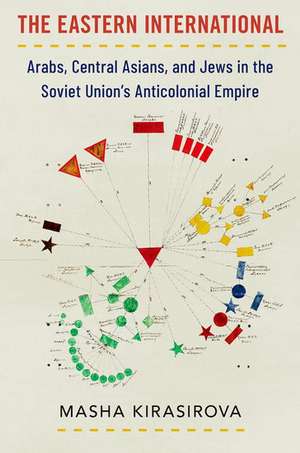
The Eastern International: Arabs, Central Asians, and Jews in the Soviet Union's Anticolonial Empire: Oxford Studies in International History
Autor Masha Kirasirovaen Limba Engleză Paperback – 19 iun 2024
Din seria Oxford Studies in International History
- 15%
 Preț: 171.23 lei
 - 14%
 Preț: 177.90 lei
 - 28%
 Preț: 446.29 lei
 - 20%
 Preț: 278.54 lei
 - 17%
 Preț: 283.17 lei
 - 20%
 Preț: 296.65 lei
 - 28%
 Preț: 485.04 lei
 - 21%
 Preț: 302.35 lei
 - 28%
 Preț: 371.06 lei
 - 22%
 Preț: 346.78 lei
 - 19%
 Preț: 291.95 lei
 - 23%
 Preț: 233.10 lei
 - 34%
 Preț: 584.57 lei
 - 11%
 Preț: 380.14 lei
 - 15%
 Preț: 223.80 lei
Preț: 167.90 lei
Preț vechi: 207.27 lei
-19%
Puncte Express: 252
Carte tipărită la comandă
Livrare economică 03-08 decembrie
Livrare express 23-29 octombrie pentru 75.13 lei
Livrare prin curier în România Termenul estimat este afișat lângă disponibilitate.
Transport gratuit de la 400.00 lei Plată online sau ramburs, în funcție de opțiunile comenzii.
Retur gratuit în 14 zile Comandă securizată și suport în română.
Specificații
ISBN-13: 9780197685709
ISBN-10: 0197685706
Pagini: 412
Ilustrații: 20 black and white halftones
Dimensiuni: 160 x 226 x 38 mm
Greutate: 0.59 kg
Editura: Oxford University Press
Colecția OUP USA
Seria Oxford Studies in International History
Locul publicării:New York, United States
ISBN-10: 0197685706
Pagini: 412
Ilustrații: 20 black and white halftones
Dimensiuni: 160 x 226 x 38 mm
Greutate: 0.59 kg
Editura: Oxford University Press
Colecția OUP USA
Seria Oxford Studies in International History
Locul publicării:New York, United States
Recenzii
In The Eastern International Masha Kirasirova tells a fascinating history of individuals, states, and empires. This important and well-argued book will inspire new debates in Middle Eastern Studies, Central Asian Studies, Soviet Studies, and Jewish History. Through its careful reconstruction of Soviet-Middle Eastern relations, it convincingly argues that we should not treat each of these scholarly subfields as separate. Rather, by combining archives, networks, and the movements of ideas, peoples, and policies across Soviet Russia, the Middle East, and Central Asia, The Eastern International considers these fields as a whole. It suggests new imaginings of the concept of the East in ways that move beyond the Eurocentric significations of the term, and it offers exciting intellectual imaginings in their stead.
Kirasirova's long-awaited book fills in a critical blank spot in Western coverage of relations between metropolitan Soviet Russia, Central Asia, and the Global South (especially the Arab world). She has tapped a trove of archival material largely untouched by scholars to date and applied her impressive analytical skills in processing it. The result is a highly original study that challenges many of the current clichés about metropolitan-colonial interrelations in the Afro-Asian and Soviet worlds.
This is a fascinating study of the relationship between the domestic and foreign 'Easts' across the Soviet period. It exposes new ways to understand the USSR as a state set on global influence and also replete with contradictions in the way it treated non-European peoples. Masha Kirasirova shows how authors, filmmakers, and party members could use the ambivalences of Soviet rule to their advantage but also that there were always limits on their ability to act. The focus on Jewish-Arab tensions and on cultural diplomacy and the central role of Central Asia in Soviet Cold War transnational relationships are unique contributions.
With The Eastern International, Masha Kirasirova has authored an important contribution to a growing historiography of books that connect Soviet history and Central Asian history with the study of the Middle East.
Highly original and engaging throughout, The Eastern International will be enlightening for anyone interested in the history of the USSR and the Middle East, the Cold War, anticolonialism and internationalism.
Her thorough research draws from an array of evidence, including rich archival materials, interviews, newspapers, published documents, and films, with different source combinations anchoring each chapter.
Kirasirova offers a detailed account of the Soviet Union's global anticolonial efforts and the role of Central Asian figures within the "Eastern International." She provides valuable insights into the complexities of Soviet statecraft and its impact on global and regional politics.
The Eastern International advances conversations about the Soviet Union and decolonization. Among its many valuable contributions, Kirasirova's work pushes readers to think broadly about the Bolsheviks' interconnected attempts to address questions of empire at home and abroad.
Masha Kirasirova's The Eastern International is a milestone in the histories of the Global South, decolonisation and the postcolonial experience that pushes readers to think broadly about the Soviet Union's attempts to address questions of empire and imperialism as revolutionaries of all stripes reimagined the world. It is an invaluable text for anyone who teaches the Cold War, Soviet history or decolonisation, highlighting the under-studied, and certainly under-taught, nuances of Soviet interventions around the globe.
Kirasirova's long-awaited book fills in a critical blank spot in Western coverage of relations between metropolitan Soviet Russia, Central Asia, and the Global South (especially the Arab world). She has tapped a trove of archival material largely untouched by scholars to date and applied her impressive analytical skills in processing it. The result is a highly original study that challenges many of the current clichés about metropolitan-colonial interrelations in the Afro-Asian and Soviet worlds.
This is a fascinating study of the relationship between the domestic and foreign 'Easts' across the Soviet period. It exposes new ways to understand the USSR as a state set on global influence and also replete with contradictions in the way it treated non-European peoples. Masha Kirasirova shows how authors, filmmakers, and party members could use the ambivalences of Soviet rule to their advantage but also that there were always limits on their ability to act. The focus on Jewish-Arab tensions and on cultural diplomacy and the central role of Central Asia in Soviet Cold War transnational relationships are unique contributions.
With The Eastern International, Masha Kirasirova has authored an important contribution to a growing historiography of books that connect Soviet history and Central Asian history with the study of the Middle East.
Highly original and engaging throughout, The Eastern International will be enlightening for anyone interested in the history of the USSR and the Middle East, the Cold War, anticolonialism and internationalism.
Her thorough research draws from an array of evidence, including rich archival materials, interviews, newspapers, published documents, and films, with different source combinations anchoring each chapter.
Kirasirova offers a detailed account of the Soviet Union's global anticolonial efforts and the role of Central Asian figures within the "Eastern International." She provides valuable insights into the complexities of Soviet statecraft and its impact on global and regional politics.
The Eastern International advances conversations about the Soviet Union and decolonization. Among its many valuable contributions, Kirasirova's work pushes readers to think broadly about the Bolsheviks' interconnected attempts to address questions of empire at home and abroad.
Masha Kirasirova's The Eastern International is a milestone in the histories of the Global South, decolonisation and the postcolonial experience that pushes readers to think broadly about the Soviet Union's attempts to address questions of empire and imperialism as revolutionaries of all stripes reimagined the world. It is an invaluable text for anyone who teaches the Cold War, Soviet history or decolonisation, highlighting the under-studied, and certainly under-taught, nuances of Soviet interventions around the globe.
Notă biografică
Masha Kirasirova is Assistant Professor of History at New York University Abu Dhabi. She is an editor of Russian-Arab Worlds: A Documentary History (OUP, 2023) and The Routledge Handbook of the Global Sixties Between Protest and Nation-Building.