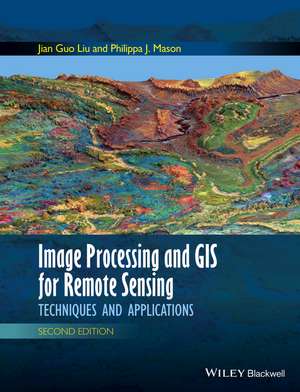
Image Processing and GIS for Remote Sensing
Autor Jian Guo Liu, Philippa J Masonen Limba Engleză Hardback – 21 mar 2016
În cadrul programelor de studii superioare dedicate științelor pământului și mediului, integrarea fluxurilor de lucru între analiza de date satelitare și sistemele informatice geografice reprezintă o competență critică. Remarcăm faptul că ediția a doua a lucrării Image Processing and GIS for Remote Sensing de Jian Guo Liu și Philippa J Mason consolidează această legătură printr-o structură inovatoare de tip „3 în 1”. Volumul nu se limitează la prezentarea teoretică a teledetecției, ci construiește o punte metodologică între procesarea digitală a imaginilor și analizele spațiale complexe realizate în GIS. Descoperim aici o abordare ancorată în cercetarea originală a autorilor, un aspect distinctiv fiind includerea tehnicii SFIM (Smoothing Filter-based Intensity Modulation). Această metodă, devenită standard industrial prin adoptarea de către ASTRIUM pentru procesarea imaginilor de tip „Pan-sharpen”, oferă studenților și profesioniștilor acces la instrumente validate la cel mai înalt nivel tehnologic. Față de volumul anterior, Essential Image Processing and GIS for Remote Sensing, această ediție extinde cadrul teoretic cu date noi și studii de caz actualizate, facilitând o înțelegere profundă fără a impune cerințe matematice excesive. De asemenea, lucrarea extinde cadrul propus de Subpixel Mapping for Remote Sensing Images prin introducerea unui capitol nou dedicat tehnologiei subpixel, oferind perspective proaspete asupra rezoluției și clasificării land-cover. Tonul este unul tehnic dar accesibil, axat pe aplicabilitate. Deși rămâne un text fundamental pentru cursurile de Master și Doctorat, relevanța sa pentru sectorul industrial — în special în explorarea resurselor de petrol și gaze — transformă acest manual într-un ghid de referință pentru echipele geospațiale din corporații multinaționale.
Preț: 692.11 lei
Preț vechi: 760.56 lei
-9%
Carte tipărită la comandă
Livrare economică 18 august-01 septembrie
Specificații
ISBN-10: 1118724208
Pagini: 480
Dimensiuni: 197 x 254 x 27 mm
Greutate: 1.18 kg
Ediția:2nd edition
Editura: Wiley
Locul publicării:Chichester, United Kingdom
V-ar putea interesa
-
 Comprehensive Remote SensingShunlin Liang-28%Preț: 17350.14 lei24066.04 lei
 -
 Remote Sensing and GISBasudeb Bhatta-23%Preț: 648.92 lei842.76 lei
 -
 -9%Preț: 550.87 lei605.35 lei
 -
 Preț: 427.93 lei
 -
 Preț: 339.64 lei
 -
 -20%Preț: 1327.38 lei1659.23 lei
 -
 Remote Sensing and Image InterpretationThomas Lillesand-18%Preț: 1328.74 lei1620.41 lei
 -
 Seismic Data Interpretation Using Digital Image ProcessingAbdullatif A Al-Shuhail-23%Preț: 608.18 lei789.84 lei
 -
 Fundamentals of Geographic Information Systems (GIS) AnalysisTao - Buffalo State University Tang-23%Preț: 716.99 lei931.16 lei
 -
 GIS For DummiesJami DennisPreț: 165.83 lei
 -
 Introduction to Remote Sensing, Sixth EditionJames B. Campbell-15%Preț: 671.95 lei790.53 lei
 -
 Imagery and GISKass Green-15%Preț: 641.49 lei754.69 lei
 -
 The ArcGIS Imagery BookClint BrownPreț: 160.13 lei
 -
 Preț: 323.68 lei
 -
 Web and Wireless Geographical Information SystemsMiguel Félix Mata-Rivera-20%Preț: 758.24 lei947.80 lei
 -
 Image Analysis in Earth SciencesRenée Heilbronner-18%Preț: 942.03 lei1148.83 lei
 -
 Hyperspectral Image ProcessingLiguo Wang-15%Preț: 631.51 lei742.96 lei
 -
 Geoinformatics in Theory and PracticeNorbert De Lange-15%Preț: 516.64 lei607.81 lei
 -
 -15%Preț: 693.71 lei816.13 lei
 -
 Preț: 259.38 lei
Public țintă
The first edition was aimed largely at the academic community: teaching staff and students (from Masters to PhD level); the authors feel this should continue as a target audience for the 2nd edition. However, since the current edition published the authors have realized that there is more industry potential for this book that hasn t been fully exploited– for example there are applications for the oil and gas industry where this book would be a useful reference. The authors have learned from other colleagues that the book has been bought and used by technical staff in numerous commercial organisations and has been found to be useful. Such industrial organisations, who have in–house remote sensing/geospatial teams needing instruction, but who do not have access to academic texts. They may find it a useful recipe book for themselves and their junior staff.The book′s audience could be widened to include larger corporate bodies with in–house geospatial teams which may also be spread across multi–national offices (e.g. Anglo–American, Rio–Tinto, BP, Shell etc).
In summary, the book is a textbook for advanced undergraduates and Master degree students, a teaching book for teaching staff, a reference book for PhD students and researchers, and a handbook for industry staff using remote sensing and GIS. Typical industry focused courses are as follows (according to Reviewer A of the new edition proposal)
Introduction to Remote Sensing offering to National Oil Company, Libya (currently being planned with African Shield Petroleum Consulting ltd.
Remote Sensing and GIS related lectures at the United Arab Emirates University (http://www.uaeu.ac.ae/study—opportunity/graduate/documents/remote—sensing—gis.pdf). Massdar Institute (UAE), Environmental Remote Sensing and Image Processing Laboratory (
http://www.masdar.ac.ae/) Remote sensing education courses at Chiba University, Centre for Environmental Remote Sensing (Japan) (
http://www.chiba–u.ac.jp/e/education/centers/remote.html).
Primary Market: This book is aimed primarily at 3rd/4th year university undergraduate (based on the course taught at Imperial) and MSc courses within the Earth and Environmental Sciences including Geography. It will also be useful to lower level undergraduate students as a reference book.
Typical courses are entitled;
Earth Sciences, Image Processing, Remote Sensing for Geoscience, Remote Sensing and Image Processing, Geoscience and Remote Sensing, Digital Image Processing for Environmental Remote Sensing, Geogrpahical Methods, Geographical Practices, Environmental cryospheric remote sensing, Environmental GIS, Geodata Sources, Digital Image Analysis, GIS, Introdution to GIS and Remote Sensing, Environmental Remote Sensing
Secondary Market: An invaluable reference for researchers within the earth sciences and a useful overview for professionals within the medical sciences and physics who use image and data manipulation techniques and require an accessible overview.
De ce să citești această carte
Această ediție a doua este esențială pentru studenții avansați și inginerii geodezi care doresc să stăpânească intersecția dintre GIS și teledetecție. Cititorul câștigă acces la tehnici de procesare brevetate și studii de caz reale, trecând de la simpla vizualizare a datelor la analiza subpixel de precizie. Este o resursă rară care echilibrează rigoarea academică a editurii Wiley cu nevoile practice ale specialiștilor din industrie.