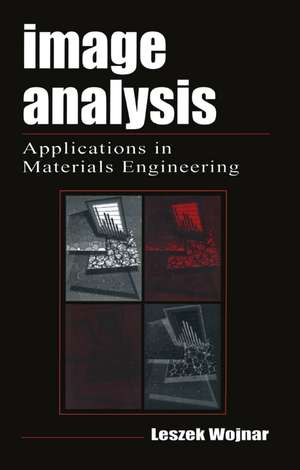
Image Analysis: Applications in Materials Engineering: Materials Science & Technology
Autor Leszek Wojnaren Limba Engleză Hardback – 28 oct 1998
Preț: 1418.98 lei
Preț vechi: 1730.47 lei
-18%
Puncte Express: 2128
Carte tipărită la comandă
Livrare economică 27 noiembrie-11 decembrie
Livrare prin curier în România Termenul estimat este afișat lângă disponibilitate.
Transport gratuit pentru acest produs Plată online sau ramburs, în funcție de opțiunile comenzii.
Retur gratuit în 14 zile Comandă securizată și suport în română.
Specificații
ISBN-13: 9780849382260
ISBN-10: 0849382262
Pagini: 256
Ilustrații: 1 table and 12 equations
Dimensiuni: 156 x 234 x 19 mm
Greutate: 0.63 kg
Ediția:1
Editura: CRC Press
Colecția CRC Press
Seria Materials Science & Technology
ISBN-10: 0849382262
Pagini: 256
Ilustrații: 1 table and 12 equations
Dimensiuni: 156 x 234 x 19 mm
Greutate: 0.63 kg
Ediția:1
Editura: CRC Press
Colecția CRC Press
Seria Materials Science & Technology
V-ar putea interesa
-
 Essentials of Light MicroscopyJeremy Sanderson-10%Preț: 316.81 lei353.69 lei
 -
 Specialty Imaging: HRCT of the LungSantiago Martínez-Jiménez-28%Preț: 1453.50 lei2014.17 leiRecomandat
 -
 -20%Preț: 1092.60 lei1365.74 lei
 -
 XAFS for EveryoneScott Calvin-9%Preț: 818.20 lei899.12 lei
 -
 Remote Sensing and Image InterpretationThomas Lillesand-18%Preț: 1373.23 lei1674.67 lei
 -
 Seismic Data Interpretation using Digital Image ProcessingAbdullatif A. Al-Shuhail-23%Preț: 618.01 lei802.62 lei
 -
 The Image Processing HandbookJohn C. Russ-20%Preț: 755.93 lei944.91 lei
 -
 Principles and Applications of Electrical Engineering ISEGiorgio Rizzoni-25%Preț: 395.45 lei527.08 lei
 -
 Fundamentals Image Processing and AnalysisStan Birchfield-23%Preț: 1255.93 lei1631.08 lei
 -
 Digital Image Processing, Global EditionRafael Gonzalez-11%Preț: 663.18 lei745.14 lei
 -
 Digital Image ProcessingWilhelm Burger-20%Preț: 695.42 lei869.26 lei
 -
 Materials Data ScienceStefan Sandfeld-15%Preț: 591.20 lei695.53 lei
 -
 Techniques for Analysis of Mineral Raw MaterialsCarlos Pérez Bergmann-18%Preț: 1070.21 lei1305.13 lei
 -
 Computer Analysis of Images and PatternsModesto Castrillón-Santana-20%Preț: 327.69 lei409.62 lei
 -
 Image Analysis in Earth SciencesRenée Heilbronner-18%Preț: 1010.39 lei1232.18 lei
 -
 -20%Preț: 613.19 lei766.48 lei
 -
 Intelligent Analysis of Optical ImagesZhengjun Liu-18%Preț: 905.73 lei1104.55 lei
Public țintă
ProfessionalNotă biografică
Leszek Wojnar, D.Sc., is an Associate Professor at Cracow University of Technology, Poland. His research interests are in image analysis, stereology and materials engineering. He is affiliated with the Polish Society for Materials Engineering, the International Society for Stereology and the Polish Society for Stereology. His Ph.D. thesis obtained at the Institute of Materials Science, Cracow University of Technology (1985) was dedicated to the role of nodular graphite in the fracture process of cast iron. Dr. Wojnar is known for his innovative methods in teaching oriented towards problem solving. In recent years (1990-1997) he has worked on various aspects of the application of computer technology in materials science, including image analysis and development of the software for weldability assessment. Dr. Wojnar has participated as a member to various advisory boards of the congresses in stereology (Freiburg, 1989, Irvine, California, 1991, Prague, 1993 and Warsaw, 1997). He was an invited lecturer in Freiburg and Warsaw and worked as editor for many conference proceedings. Dr. Wojnar has published more than 50 articles in periodicals and conference proceedings and has published two books (in Polish): Computerized Image Analysis with M. Majorek (1994) and Application of Computational Methods in Weldability Assessment with J. Mikula (1995). His work Principles of Quantitative Fractography (1990) issued at the Cracow University of Technology was the first such complete monograph in Poland and gave him the D.Sc. position. An unusual accomplishment and one which stems from the existing financial climate surrounding Cracow University is that he developed his own private laboratory on image analysis which now works in conjunction with universities throughout Poland. Recent works of this small laboratory are devoted mainly to applications in medicine.
Cuprins
IntroductionDigital Images and Their Analysis versus the Human Vision SystemGeneral Concept of the BookMain Tools for Image TreatmentAbout This ChapterBasic EnhancementFiltersBinarizationMathematical MorphologyFourier TransformationEdge DetectionCombining Two ImagesMouse EtchingImage Acquisition and Its QualitySpecimen PreparationImage AcquisitionShade CorrectionRemoving ArtifactsBasic TipsDetection of Basic FeaturesGrain BoundariesOther Features Detected Like GrainsPores and Isolated ParticlesChains and ColoniesFibersTreatment of Complex StructuresTextured and Oriented StructuresVery Fine StructuresFracture SurfacesAnalysis and InterpretationImage Processing and Image AnalysisMeasurements of Single ParticlesFirst Measurements - NumbersShapeGrains SizeGray-Scale MeasurementsOther MeasurementsApplicationsQuality ControlSimulationsResearch and Case HistoriesConcluding RemarksReferences
Descriere
Minimizing theoretical background and mathematical formalism, Image Analysis sets forth the basic principles of image acquisition, enhancement, measurements, and interpretation in a very simple form, focused on applications and the properties of available tools. The author lists different tasks and offers complete solutions to these tasks based on his extensive experience with the procedures described. The book provides a multitude of illustrations, drawings, and bitmaps and serves as an outstanding resource for specialists using image analysis equipment, including technicians and students.