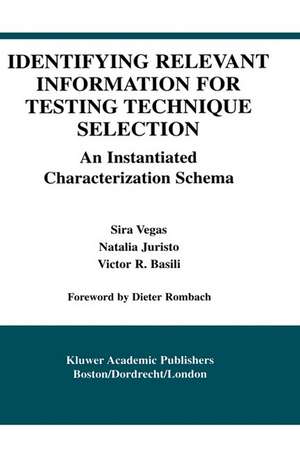
Identifying Relevant Information for Testing Technique Selection: An Instantiated Characterization Schema: International Series in Software Engineering, cartea 8
Autor Sira Vegas, Natalia Juristo, Victor R. Basilien Limba Engleză Hardback – 30 apr 2003


Preț: 628.63 lei
Preț vechi: 785.78 lei
-20%
Puncte Express: 943
Carte tipărită la comandă
Livrare economică 09-23 noiembrie
Livrare prin curier în România Termenul estimat este afișat lângă disponibilitate.
Transport gratuit pentru acest produs Plată online sau ramburs, în funcție de opțiunile comenzii.
Retur gratuit în 14 zile Comandă securizată și suport în română.
Specificații
ISBN-13: 9781402074356
ISBN-10: 1402074352
Pagini: 308
Ilustrații: XXIII, 281 p.
Dimensiuni: 155 x 235 x 22 mm
Greutate: 0.65 kg
Ediția:2003
Editura: Springer Us
Colecția Springer
Seria International Series in Software Engineering
Locul publicării:New York, NY, United States
ISBN-10: 1402074352
Pagini: 308
Ilustrații: XXIII, 281 p.
Dimensiuni: 155 x 235 x 22 mm
Greutate: 0.65 kg
Ediția:2003
Editura: Springer Us
Colecția Springer
Seria International Series in Software Engineering
Locul publicării:New York, NY, United States
V-ar putea interesa
-
 Mathematical Modeling in Nutrition and the Health SciencesJanet A. Novotny-20%Preț: 1242.29 lei1552.86 lei
 -
 Software Process ModelingSilvia T. Acuna-20%Preț: 623.89 lei779.85 lei
 -
 -20%Preț: 960.53 lei1200.65 lei
 -
 Object-Oriented Software in C++Michael A. Smith-20%Preț: 329.46 lei411.82 lei
 -
 -27%Preț: 676.09 lei926.15 lei
 -
 Software Modeling and DesignHassan Gomaa-20%Preț: 665.25 lei831.56 lei
 -
 Basics of Software Engineering ExperimentationNatalia Juristo-20%Preț: 1234.14 lei1542.68 lei
 -
 KanbanDavid J. Anderson-20%Preț: 264.19 lei330.24 lei
 -
 The Human Side of AgileGil BrozaPreț: 271.68 lei
 -
 Software EngineeringRuneson-20%Preț: 455.66 lei569.57 lei
 -
 Professional GitBrent Laster-20%Preț: 255.81 lei319.77 lei
 -
 Python AlgorithmsMagnus Lie Hetland-20%Preț: 468.00 lei584.99 lei
 -
 The Definitive Guide to HTML5 WebSocketVanessa Wang-20%Preț: 372.28 lei465.36 lei
 -
 Preț: 398.58 lei
 -
 Visual Languages and ApplicationsTadeo Ichikawa-20%Preț: 325.04 lei406.30 lei
 -
 A Knowledge-Based Approach to Program UnderstandingSalwa K. Abd-El-Hafiz-20%Preț: 613.08 lei766.34 lei
 -
 Software Reuse: Guidelines and MethodsJames W. Hooper-20%Preț: 615.45 lei769.31 lei
 -
 Innovation TogetherLolan Song-20%Preț: 620.83 lei776.05 lei
 -
 Empirical Foundations of Information and Software Science IVJagdish C. Agrawal-20%Preț: 337.66 lei422.08 lei
 -
 High-Integrity SoftwareC.T. Sennett-20%Preț: 328.29 lei410.37 lei
 -
 Continuous Delivery with Visual Studio ALM 2015Mathias Olausson-20%Preț: 299.70 lei374.63 lei
 -
 Specification and Verification of Multi-agent SystemsMehdi Dastani-40%Preț: 788.83 lei1320.37 lei
 -
 Design It! : Pragmatic ProgrammersMicahel Keeling-20%Preț: 253.99 lei317.48 lei
 -
 Mastering ServiceNow - Second EditionMartin Wood-20%Preț: 368.74 lei460.93 lei
 -
 Experimental Software Engineering Issues:H. Dieter Rombach-20%Preț: 321.74 lei402.18 lei
Public țintă
Professional/practitionerCuprins
1. Introduction.- 1 Basics on Software Testing.- 2 The Problem of Selecting Testing Techniques.- 3 Getting a Characterisation Schema for Testing Techniques.- 4 Organisation of the Book.- 2. State of the Practice.- 1 Areas Surveyed.- 2 Testing Area.- 3 Area of Characterisation.- 4 Conclusions on the State of the Practice.- 3. Research Goals.- 1 Description of the Problem.- 2 Problem-Solving Approach.- 3 Hypotheses.- 4. Problem Solving Process.- 1 Research Methods.- 2 Objectives of Technological Research.- 3 Applying the Scientific Method to Technological Research.- 4 Expert Peer Review versus Experimental Testing.- 5 The Problem-Solving Process Used in this Book.- 5. First Generative Iteration: Deductive Theoretical Schema.- 1 Description of the Research Stage: Generation of a Theoretical Schema.- 2 Testing Process.- 3 Stratification of Testing-Related Information.- 4 Testing Process Elements.- 5 Attributes of the Theoretical Schema.- 6 Result of the Construction of the Theoretical Schema.- 7 Use and Evolution of the Characterisation Schema.- 6. Second Generative Iteration: Inductive Empirical Schema.- 1 Description of the Research Stage: Generation of an Empirical Schema.- 2 Data Collection.- 3 Data Analysis.- 4 Result of Building the Empirical Schema.- 5 Study of the Evolution of the Empirical Schema.- 7. Synthesis of Perspectives: Proposal of the Preliminary Schema.- 1 Description of the Research Stage: Synthesis of Schemas.- 2 Rules of Synthesis.- 3 Synthesis of the Theoretical and Empirical Schemas.- 4 Result of Schema Synthesis.- 5 Study of Schema Synthesis.- 8. Improvement of the Schema: Expert Peer Review.- 1 Description of the Research Stage: Improvement.- 2 Questionnaire for Experts.- 3 Questionnaire Analysis Method.- 4 Analysis of Responses.- 5 Improved Schema.- 9. Empirical Evaluation.- 1 Objective of the Empirical Evaluation.- 2 Choice of the Workload.- 3 Analysis of the Results.- 4 Conclusions on the Empirical Evaluation.- 10. Experimental Evaluation.- 1 Objective of the Experiment.- 2 Experiment Planning.- 3 Experimental Design.- 4 Data Analysis.- 5 Conclusions on Experimental Evaluation.- 6 Characterisation Schema Improvement.- 11. Conclusions.- Appendices.- Forms Used to Obtain the Empirical Schema.- Questionnaires Used in Expert Peer Review.- Schema Instantiation.- Experiment Forms.