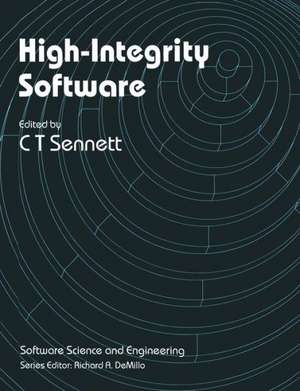
High-Integrity Software: Software Science and Engineering
Editat de C.T. Sennetten Limba Engleză Paperback – iul 2013
Preț: 328.29 lei
Preț vechi: 410.37 lei
-20%
Puncte Express: 492
Carte tipărită la comandă
Livrare economică 28 noiembrie-12 decembrie
Livrare prin curier în România Termenul estimat este afișat lângă disponibilitate.
Transport gratuit de la 400.00 lei Plată online sau ramburs, în funcție de opțiunile comenzii.
Retur gratuit în 14 zile Comandă securizată și suport în română.
Specificații
ISBN-13: 9781468457773
ISBN-10: 1468457772
Pagini: 372
Ilustrații: VIII, 360 p.
Dimensiuni: 189 x 246 x 20 mm
Greutate: 0.66 kg
Ediția:1989
Editura: Springer Us
Colecția Springer
Seria Software Science and Engineering
Locul publicării:New York, NY, United States
ISBN-10: 1468457772
Pagini: 372
Ilustrații: VIII, 360 p.
Dimensiuni: 189 x 246 x 20 mm
Greutate: 0.66 kg
Ediția:1989
Editura: Springer Us
Colecția Springer
Seria Software Science and Engineering
Locul publicării:New York, NY, United States
V-ar putea interesa
-
 -27%Preț: 676.09 lei926.15 lei
 -
 Software Modeling and DesignHassan Gomaa-20%Preț: 665.25 lei831.56 lei
 -
 KanbanDavid J. Anderson-20%Preț: 264.20 lei330.25 lei
 -
 The Human Side of AgileGil BrozaPreț: 271.68 lei
 -
 Software EngineeringRuneson-20%Preț: 471.15 lei588.94 lei
 -
 Professional GitBrent Laster-20%Preț: 256.78 lei320.97 lei
 -
 Mobile Computation with FunctionsZeliha Dilsun Kirli-20%Preț: 663.76 lei829.70 lei
 -
 Software Engineering with Computational IntelligenceTaghi M Khoshgoftaar-20%Preț: 1001.19 lei1251.48 lei
 -
 Embedded Software for SoCAhmed Amine Jerraya-20%Preț: 1508.10 lei1885.12 lei
 -
 Python AlgorithmsMagnus Lie Hetland-20%Preț: 468.00 lei584.99 lei
 -
 The Definitive Guide to HTML5 WebSocketVanessa Wang-20%Preț: 372.28 lei465.36 lei
 -
 Large-scale OptimizationVladimir Tsurkov-20%Preț: 941.87 lei1177.33 lei
 -
 Head First AgileAndrew Stellman-20%Preț: 343.20 lei429.00 lei
 -
 -20%Preț: 325.29 lei406.60 lei
 -
 Functional Integration: Theory and ApplicationsJean-Pierre Antoine-20%Preț: 327.36 lei409.20 lei
 -
 Intersensory Perception and Sensory IntegrationRichard D. Walk-20%Preț: 325.61 lei407.00 lei
 -
 -20%Preț: 332.74 lei415.93 lei
 -
 Continuous Delivery with Visual Studio ALM 2015Mathias Olausson-20%Preț: 299.70 lei374.63 lei
 -
 Design It! : Pragmatic ProgrammersMicahel Keeling-20%Preț: 257.50 lei321.87 lei
 -
 Mastering ServiceNow - Second EditionMartin Wood-20%Preț: 368.74 lei460.93 lei
Public țintă
ResearchCuprins
1 Introduction.- 2 Formal specification and implementation.- 2.1 Introduction to formal methods.- 2.2 Formal specification using Z.- 2.3 Formal implementation from Z.- 2.4 Conclusion.- 3 Designing for high integrity: The software fault tolerance approach.- 3.1 Introduction.- 3.2 Overview of software fault tolerance.- 3.3 Towards an implementation framework for software fault tolerance.- 3.4 Robust software using Ada’s exception handling facilities.- 3.5 N-version programming.- 3.6 Recovery blocks.- 3.7 Comparison of N-version programming and recovery blocks.- 3.8 Practical application of N-version programming and recovery blocks.- 3.9 Summary.- 4 Practical experience with a formal verification system.- 4.1 Introduction.- 4.2 Background.- 4.3 The Gypsy language.- 4.4 The Gypsy Verification Environment.- 4.5 A simple example.- 4.6 Specification data types.- 4.7 Future directions.- 4.8 Conclusions.- 5 Reliable programming in standard languages.- 5.1 Introduction.- 5.2 Language requirements for high-integrity programming.- 5.3 The use of standard languages.- 5.4 Programming in Pascal and Ada.- 5.5 Practical experiences.- 6 NewSpeak: a reliable programming language.- 6.1 Introduction.- 6.2 Types and values.- 6.3 Declarations and variables.- 6.4 Guarded declarations.- 6.5 Cases and conditionals.- 6.6 Loops.- 6.7 Procedures.- 6.8 Assertions.- 6.9 Timing.- 6.10 Conclusion.- 6.11 Appendix 1: summary of syntax.- 6.12 Appendix 2: type lattice and widening.- 7 Program analysis and systematic testing.- 7.1 Introduction.- 7.2 The basic requirement.- 7.3 The Liverpool experience.- 7.4 The Liverpool experiments.- 7.5 The LDRA Testbeds.- 7.6 Interpretation.- 7.7 Applicability and benefits.- 7.8 Safety-critical systems.- 8 Program analysis and verification.- 8.1 Introduction.- 8.2Program modelling.- 8.3 Flow analysis.- 8.4 Formal verification.- 8.5 Conclusions.- 9 The algebraic specification of a target machine: Ten15.- 9.1 Introduction.- 9.2 Types and operation.- 9.3 Features of the Ten15 machine.- 9.4 The formal method.- 9.5 Formal definition of Ten15.- 9.6 Conclusions.- 10 Assurance in high-integrity software.- 10.1 Introduction.- 10.2 Requirements and technical basis for assurance measures.- 10.3 Development.- 10.4 Requirements.- 10.5 Architecture.- 10.6 Evaluation.- 10.7 Configuration control.- 10.8 Complexity.- 10.9 Human computer interaction.- 10.10 Staff issues.- 10.11 Tools.- 10.12 Towards assurance measures.- 10.13 Conclusions.- 11 Modelling real-world issues for dependable software.- 11.1 Introduction.- 11.2 The importance of policies.- 11.3 Multiple levels of representation.- 11.4 Models for a communication system.- 11.5 Dependability breaches.- 11.6 Outline of the ATM system.- 11.7 Axegrinder rules.- 11.8 Views of the system.- 11.9 Composite view of the system.- 11.10 Behavioural model of the system.- 11.11 Vulnerability analysis.- 11.12 Analysis of communication.- 11.13 Analysis of system conformation.- 11.14 Message analysis.- 11.15 Behavioural analysis.- 11.16 What enforces the rules?.- 11.17 Final summary: The analytical method in outline.- 12 Contractual specification of reliable software.- 12.1 The procurement process for high-integrity software.- 12.2 Procurement issues at the feasibility study stage.- 12.3 High-integrity considerations during project definition.- 12.4 The development environment for trusted software.- 12.5 The formal specification of access control policies.