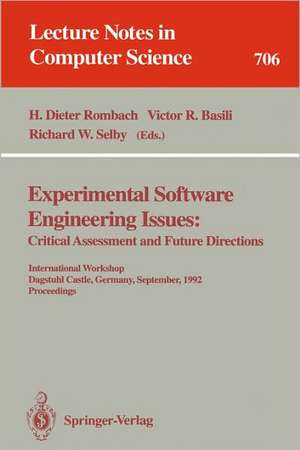
Experimental Software Engineering Issues:
Editat de H. Dieter Rombach, Victor R. Basili, Richard W. Selbyen Limba Engleză Paperback – 30 aug 1993
Preț: 321.74 lei
Preț vechi: 402.18 lei
-20%
Puncte Express: 483
Carte tipărită la comandă
Livrare economică 25 noiembrie-09 decembrie
Livrare prin curier în România Termenul estimat este afișat lângă disponibilitate.
Transport gratuit de la 400.00 lei Plată online sau ramburs, în funcție de opțiunile comenzii.
Retur gratuit în 14 zile Comandă securizată și suport în română.
Specificații
ISBN-13: 9783540570929
ISBN-10: 3540570926
Pagini: 292
Ilustrații: XIX, 265 p.
Dimensiuni: 155 x 235 x 16 mm
Greutate: 0.45 kg
Ediția:1993
Editura: Springer
Locul publicării:Berlin, Heidelberg, Germany
ISBN-10: 3540570926
Pagini: 292
Ilustrații: XIX, 265 p.
Dimensiuni: 155 x 235 x 16 mm
Greutate: 0.45 kg
Ediția:1993
Editura: Springer
Locul publicării:Berlin, Heidelberg, Germany
V-ar putea interesa
-
 -27%Preț: 676.09 lei926.15 lei
 -
 Software Modeling and DesignHassan Gomaa-20%Preț: 665.25 lei831.56 lei
 -
 Microsoft SecretsMichael A. CusumanoPreț: 207.53 lei
 -
 KanbanDavid J. Anderson-20%Preț: 264.20 lei330.25 lei
 -
 The Human Side of AgileGil BrozaPreț: 271.68 lei
 -
 Software EngineeringRuneson-20%Preț: 457.31 lei571.64 lei
 -
 Professional GitBrent Laster-20%Preț: 256.78 lei320.97 lei
 -
 -20%Preț: 672.15 lei840.18 lei
 -
 Python AlgorithmsMagnus Lie Hetland-20%Preț: 468.00 lei584.99 lei
 -
 The Definitive Guide to HTML5 WebSocketVanessa Wang-20%Preț: 372.28 lei465.36 lei
 -
 Pro Team Foundation ServiceMathias Olausson-20%Preț: 255.64 lei319.56 lei
 -
 Head First AgileAndrew Stellman-20%Preț: 343.20 lei429.00 lei
 -
 A Knowledge-Based Approach to Program UnderstandingSalwa K. Abd-El-Hafiz-20%Preț: 613.08 lei766.34 lei
 -
 Case TechnologyRaymond T. Yeh-20%Preț: 945.70 lei1182.12 lei
 -
 Continuous Delivery with Visual Studio ALM 2015Mathias Olausson-20%Preț: 299.70 lei374.63 lei
 -
 Design It! : Pragmatic ProgrammersMicahel Keeling-20%Preț: 257.50 lei321.87 lei
 -
 Mastering ServiceNow - Second EditionMartin Wood-20%Preț: 368.74 lei460.93 lei
 -
 CORBA KomponentenBertram Neubauer-20%Preț: 426.00 lei532.49 lei
 -
 SoftwareentwicklungStefan Berndes-20%Preț: 237.03 lei296.29 lei
 -
 SSADM & GRAPESA. Aue-20%Preț: 334.15 lei417.69 lei
 -
 Domain EngineeringIris Reinhartz-Berger-63%Preț: 309.58 lei845.30 lei
 -
 -20%Preț: 341.41 lei426.76 lei
 -
 Early Software Reliability PredictionAjeet Kumar Pandey-20%Preț: 668.29 lei835.35 lei
Public țintă
ResearchCuprins
The experimental paradigm in software engineering.- Profile of an artifact assessment capability.- Experiments and measurements for systems integration.- Software engineering still on the way to an engineering discipline.- Problems in modeling the software development process as an adventure game.- Qualitative techniques and tools for measuring, analyzing, and simulating software processes.- On experimental Computer Science.- Session 1 summary the experimental paradigm in software engineering.- Objectives and context of software measurement, analysis and control.- Position paper.- Software Engineering as an organisational challenge.- Quantitative measurements based on process and context models.- Selecting, implementing, and measuring methods to improve the software development process.- Rethinking measurement to support incremental process improvement.- Session 2 summary objectives and context of measurement/experimentation.- Software measurement and experimentation frameworks, mechanisms, and infrastructure.- Towards well-defined, shareable product data.- A view on the use of three research philosophies to address empirically determined weaknesses of the software engineering process.- Bridging the gap between research and practice in software engineering management: Reflections on the staffing factors paradox.- A methodology for evaluating software engineering methods and tools.- Experimental software engineering should concentrate on software evolution.- Yet another laboratory for software engineering.- An axiomatic model for program complexity.- Support of experimentation by measurement theory.- Session 3 summary procedures and mechanisms for measurement/experimentation.- Task-specific utility assessment models and their role in the development of software engineering handbooks.- Quantitative empirical modeling for managing software development: Constraints, needs and solutions.- Software business, concurrent engineering and experience factory relationships.- Establishing the fundamentals of software engineering.- Measurement-based modelling issues — the problem of assuring ultra-high dependability.- The role of simulation in software engineering experimentation.- Multiple viewpoints of software models.- Session 4 summary [Measurement-based] modeling.- Software engineering models, using and reusing.- Model reuse and technology transfer.- Packaging for reuse and reuse of models.- A reuse culture for software construction.- Experimental software engineering; Packaging for reuse.- Experimental designs for validating metrics and applying them across multiple projects.- Session 5 summary packaging for reuse.- Position paper.- Technology transfer.- Systematic software technology transfer.- Effective use of measurement and experimentation in computing curricula.- Session 6 summary technology transfer, teaching and training.