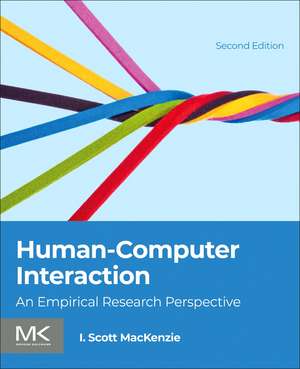
Human-Computer Interaction: An Empirical Research Perspective
Autor I. Scott MacKenzieen Limba Engleză Paperback – 17 ian 2024
Metodologia propusă de I. Scott MacKenzie în Human-Computer Interaction transformă designul de interfață dintr-un proces intuitiv într-o disciplină riguros științifică. Reținem accentul pus pe cercetarea empirică, unde arhitectura sistemelor este validată prin experimente controlate și analize statistice. Volumul este structurat logic pentru a ghida cititorul de la contextul istoric și factorul uman către fundamentarea științifică a ipotezelor și modelarea interacțiunii. Credem că forța acestui text rezidă în capacitatea de a descompune elementele de interacțiune — cum ar fi inputul prin gesturi sau selecția — în variabile măsurabile.
Pe linia practică a lucrării Research Methods for Human-Computer Interaction de Paul Cairns, dar cu un focus mai pronunțat pe modelele predictive și descriptive, acest volum oferă instrumentele necesare pentru a evalua performanța utilizatorului. Notăm că I. Scott MacKenzie își extinde expertiza din lucrarea anterioară, Text Entry Systems, unde analiza în detaliu mecanismele de introducere a datelor, aplicând aici aceleași rigori metodologice asupra întregului spectru de interacțiune om-calculator.
Structura cărții facilitează o progresie naturală, culminând cu un ghid esențial despre redactarea și publicarea rezultatelor cercetării. Ilustrațiile numeroase și studiile de caz ancorează conceptele teoretice în realitatea laboratorului de testare. Este o resursă care nu se rezumă la teoria designului, ci oferă un set complet de instrumente pentru testarea ipotezelor, esențial pentru oricine dorește să producă dovezi cuantificabile în domeniul UX sau al sistemelor interactive.
Preț: 372.83 lei
Preț vechi: 604.74 lei
-38%
Carte tipărită la comandă
Livrare economică 20 noiembrie-04 decembrie
Specificații
ISBN-10: 0443140960
Pagini: 466
Dimensiuni: 191 x 235 x 26 mm
Greutate: 0.9 kg
Ediția:2
Editura: ELSEVIER SCIENCE
V-ar putea interesa
-
 Sketching User Experiences: The WorkbookSaul Greenberg-17%Preț: 123.24 lei149.00 lei
 -
 -40%Preț: 270.35 lei450.73 lei
 -
 Human-Computer Interaction: Comprhnsv LooselfJanet E. Finlay-15%Preț: 667.03 lei784.75 lei
 -
 3D User InterfacesDoug Bowman-15%Preț: 408.38 lei480.44 lei
 -
 Introduction to Human-Computer InteractionKasper Hornbæk-27%Preț: 423.05 lei579.30 lei
 -
 -40%Preț: 481.94 lei797.76 lei
 -
 -23%Preț: 163.71 lei212.75 lei
 -
 The Pocket Universal Principles of UXIrene Pereyra-20%Preț: 79.13 lei98.81 lei
 -
 -20%Preț: 321.52 lei401.91 lei
 -
 About FaceAlan Cooper-20%Preț: 310.92 lei388.66 lei
 -
 Interaction DesignHelen Sharp-20%Preț: 528.38 lei660.47 lei
 -
 -9%Preț: 516.76 lei567.86 lei
 -
 Agentic AI For DummiesPam Baker-20%Preț: 145.95 lei182.44 lei
 -
 Research Methods in InformationAlison Jane Pickard-19%Preț: 558.33 lei689.30 lei
 -
 Human-Computer InteractionMasaaki Kurosu-20%Preț: 403.85 lei504.82 lei
 -
 HCI International 2024 PostersConstantine Stephanidis-20%Preț: 573.09 lei716.37 lei
 -
 Human Computer Interaction in HealthcareAndre W. Kushniruk-5%Preț: 482.57 lei507.97 lei
 -
 Statistics for ScientistsUmberto Michelucci-20%Preț: 275.88 lei344.84 lei
 -
 -20%Preț: 315.48 lei394.35 lei
De ce să citești această carte
Pentru cercetătorii și profesioniștii UX care doresc să treacă de la design bazat pe intuiție la validare prin date concrete. Veți câștiga o metodologie clară pentru proiectarea experimentelor și testarea ipotezelor, beneficiind de expertiza unui autor consacrat în modelarea interacțiunii. Este un ghid practic care vă învață nu doar cum să construiți un experiment, ci și cum să publicați rezultatele în comunitatea științifică.
Descriere scurtă
Throughout the book, readers will find hands-on exercises, checklists, and real-world examples. This is a must-have, comprehensive guide to empirical and experimental research in HCI – an essential addition to your HCI library.
- Provides a master, A-to-Z guide in a concise, hands-on reference
- Presents the practical and theoretical ins-and-outs of user studies
- Includes exercises, takeaway points, and case studies throughout
- Updated to incorporate developments in HCI, including Human performance outliers, Interaction elements: pointing and selecting; text input; gesture input
Cuprins
Recenzii
"Human-computer interactions (HCI) is an ever more important subject for study as computers become ever faster, smaller, and more integrated into daily life. MacKenzie …emphasizes the performance of research into HCI in this work intended for the working scientist…Each chapter concludes with student exercises and there is a supplementary website that contains software source code, several statistical applications, and packages for experiments in HCI." --Reference & Research Book News, December 2013
"This is intended to be a textbook specifically for use in teaching the topic at a degree level, and it achieves that aim in no small measure…The text is clear, slightly conversational and offers a refreshing look at the field of study…The book contains a number of interesting case studies designed to illustrate the various issues, and it also contains some questionnaires and other example material, all designed to make the reader query how and why they do things." --BCS.org, November 2013
"Scott McKenzie is one of the most thoughtful, thorough, authoritative, and careful HCI researchers I know. This book puts his experience, insights, and wisdom into a highly accessible, practical, and user-friendly form. It ties general notions in user interface design to solid scientific concepts and experimental procedures, and it teaches readers how to perform them for themselves. And it even concludes with a chapter on how to write a research paper -- useful advice, but rarely found in such a book." --Robert J.K. Jacob, Department of Computer Science, Tufts University