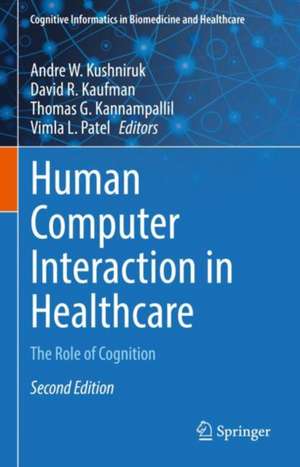
Human Computer Interaction in Healthcare: Cognitive Informatics in Biomedicine and Healthcare
Editat de Andre W. Kushniruk, David R. Kaufman, Thomas G. Kannampallil, Vimla L. Patelen Limba Engleză Hardback – 14 noi 2024
Considerăm acest volum un instrument esențial pentru cercetătorii în informatică medicală, dezvoltatorii de tehnologii de sănătate, rezidenții în specialități tehnice și medicii interesați de optimizarea fluxurilor de lucru digitale. Ediția a doua a Human Computer Interaction in Healthcare, publicată în 2024, vine într-un moment critic în care adoptarea tehnologiilor digitale în medicină depășește adesea capacitatea de adaptare a utilizatorului uman. Notăm cu interes modul în care editorii, sub coordonarea lui Andre W. Kushniruk, abordează nu doar interfața grafică, ci fundamentul cognitiv al interacțiunii om-calculator.
Structura cărții urmărește o progresie logică, de la bazele teoretice ale cogniției și comunicării, către aplicații practice precum dispozitivele purtabile și implementarea inteligenței artificiale în mediul clinic. Comparativ cu HCI and Usability for Medicine and Health Care de Andreas Holzinger, care se concentrează pe ingineria utilizabilității ca disciplină de software, lucrarea de față aprofundează modelarea cognitivă și distribuția muncii clinice, oferind un cadru mai larg de înțelegere a erorii umane. De asemenea, dacă Advances in Human Aspects of Healthcare pune accent pe ergonomia mediului de lucru, volumul editat de Vimla L. Patel și echipa sa prioritizează fluxul de informație și procesele de decizie asistate de calculator.
Această lucrare se ancorează solid în opera anterioară a autorilor, continuând explorarea dimensiunilor umane și sociale începută în Human, Social, and Organizational Aspects of Health Information Systems. Credem că rigoarea cu care sunt tratate metodele de evaluare și designul iterativ oferă soluții concrete pentru depășirea barierelor de adoptare a sistemelor informatice, transformându-le din simple baze de date în parteneri cognitivi pentru clinician.

Preț: 482.57 lei
Preț vechi: 507.97 lei
-5%
Carte disponibilă
Livrare economică 02-16 noiembrie
Livrare express 16-22 octombrie pentru 59.50 lei
Specificații
ISBN-10: 3031699467
Pagini: 488
Ilustrații: Approx. 480 p.
Dimensiuni: 160 x 241 x 30 mm
Greutate: 0.98 kg
Ediția:Second Edition 2024
Editura: Springer
Colecția Cognitive Informatics in Biomedicine and Healthcare
Seria Cognitive Informatics in Biomedicine and Healthcare
Locul publicării:Cham, Switzerland
V-ar putea interesa
-
 Human-Computer Interaction: Comprhnsv LooselfJanet E. Finlay-15%Preț: 667.03 lei784.75 lei
 -
 Introduction to Human-Computer InteractionKasper Hornbæk-27%Preț: 419.91 lei578.43 lei
 -
 Human Factors in Healthcare Level 1 and Level 2 PackDebbie Rosenorn-Lanng-5%Preț: 602.97 lei634.71 lei
 -
 Human Factors in Healthcare: Level OneDebbie Rosenorn-Lanng-22%Preț: 406.47 lei519.02 lei
 -
 Health Design ThinkingBon Ku-18%Preț: 103.91 lei126.75 lei
 -
 Handbook of Perioperative and Procedural Patient SafetyJuan A. Sanchez-5%Preț: 727.75 lei766.06 lei
 -
 Sabiston Textbook of Surgery: The Biological Basis of Modern Surgical PracticeDouglas Scott Tyler-29%Preț: 1167.99 lei1644.95 leiRecomandat
 -
 Intelligent Semantic Analysis for HealthcareSonali Vyas-27%Preț: 951.18 lei1310.91 leiNou
 -
 -32%Preț: 251.67 lei367.54 lei
 -
 Stories in Health CommunicationGjyn O'Toole-33%Preț: 251.89 lei374.56 lei
 -
 -14%Preț: 738.12 lei858.27 lei
 -
 The Design of CareCraig Bremner-9%Preț: 1329.26 lei1460.73 lei
 -
 About FaceAlan Cooper-20%Preț: 310.92 lei388.66 lei
 -
 -9%Preț: 717.80 lei788.80 lei
 -
 -12%Preț: 131.30 lei148.57 lei
 -
 -5%Preț: 1510.63 lei1590.14 leiRecomandat
 -
 Informatics and Nursing: Opportunities and ChallengesKRISTI SANBORN MILLER Ph.D.-27%Preț: 524.48 lei721.20 lei
 -
 Biomedical Informatics: Computer Applications in Health Care and BiomedicineEdward H. Shortliffe-5%Preț: 893.00 lei939.99 lei
 -
 Coproducing CareJohn M. Carroll-5%Preț: 203.69 lei214.41 lei
 -
 -24%Preț: 168.01 lei221.52 lei
De ce să citești această carte
Această carte este recomandată profesioniștilor care doresc să înțeleagă de ce unele tehnologii medicale eșuează în practică în ciuda complexității lor tehnice. Cititorul va câștiga o perspectivă clinică asupra designului de interfețe, învățând cum să evalueze și să implementeze sisteme informatice care reduc oboseala cognitivă și cresc siguranța pacientului. Este un ghid metodologic indispensabil pentru oricine proiectează viitorul asistenței medicale digitale.
Despre autor
Echipa de editori este formată din lideri recunoscuți în informatica biomedicală. Andre W. Kushniruk este cunoscut pentru cercetările sale asupra factorului uman și evaluării utilizabilității în sănătate. Vimla L. Patel este o figură centrală în informatica cognitivă, cu o carieră dedicată înțelegerii proceselor de luare a deciziilor medicale. Împreună cu David R. Kaufman și Thomas G. Kannampallil, aceștia au publicat lucrări de referință despre provocările Big Data și aspectele organizaționale ale sistemelor informatice, consolidând seria Cognitive Informatics in Biomedicine and Healthcare ca un pilon academic în domeniu.
Descriere scurtă
There is a general consensus that health IT has not realized its potential as a tool to facilitate clinical decision-making, the coordination of care and improvements in patient safety. Embracing sound principles of iterative design can yield significant dividends. It can also enhance practitioner’s abilities to meet “meaningful use” requirements. The purpose of the book is two-fold: to address key gaps on the applicability of theories, models and evaluation frameworks of HCI and human factors for research in biomedical informatics. It highlights the state of the art, drawing from the current research in HCI. It also serves as a graduate level textbook highlighting key topics in HCI relevant for biomedical informatics, computer science and social science students working in the healthcare domain.
Cognitive Informatics for Biomedicine: Human Computer Interaction in Healthcare is indispensable to those who want to ensure that the systems they build, and the interactive environments that they promote, will reflect the rigor and dedication to human-computer interaction principles that will ultimately enhance both the user’s experience and the quality and safety of the care that is offered to patients. It is an essential reference to all who are interested in the application of these new techniques within healthcare, from students of informatics through to clinicians, informatics researchers and developers of health IT looking to incorporate them into their day-to-day workflow.
Cuprins
Notă biografică
Thomas G. Kannampallil, PhD, FAMIA is an Associate Professor in the Washington University School of Medicine’s (WUSM) Department of Anesthesiology and at the Institute for Informatics, Data Science and Biostatistics. He also holds joint appointments in the Department of Computer Science and Engineering, and the Division of Biology and Biomedical Sciences. His research interests lie at the intersection of computer science, cognitive science, and clinical informatics, focusing on developing and evaluating intelligent computational tools for improving clinical decision making and patient safety. More recently, Dr. Kannampallil’s research has focused on developing artificial intelligence (AI)-based tools for improving postoperative and mental health outcomes. He is currently the Associate Editor for the Journal of Biomedical Informatics and serve on ONC and PCORI technical expert panels on health information technology. He was elected as a Fellow of the American Medical Informatics Association (FAMIA) in 2021. His research is supported by funding from the Agency for Healthcare Research and Quality (AHRQ), National Institute of Aging and National Library of Medicine.
David R. Kaufman, Ph.D., FACMI, is an Associate Professor in Health Informatics at SUNY Downstate Health Sciences University. Previously, he was an Associate Professor of Biomedical informatics and the Director of the Graduate Training Program at Arizona State University (ASU). With an undergraduate degree in psychology, he received his masters and doctorate in educational psychology, both from McGill University. In 2017, he was elected a Fellow of the American College of Medical Informatics. Dr. Kaufman worked in human-computer interaction (HCI) and human factors for about 25 years. He has extensive experience conducting cognitive research concerning informatics initiatives and evaluating various health information technologies (HIT) developed for clinicians, patients, and health consumers. Since 1994, his involvement in HCI projects on the evaluation of electronic health records, computer-provider order entry systems, and a large-scale telemedicine system for patients with diabetes has transitioned to a recent NIH-funded telehealth clinical trial for stroke disparity patients. Dr. Kaufman was the principal investigator on a Mayo Clinic-ASU ROOT project, which characterized the EHR workflows during the transition to another EHR. He is currently leading an AHRQ-funded effort to characterize pandemic workflow at a Brooklyn safety-net hospital, with the objective to fashion technology-mediated solutions that will enhance data collection, aggregation, synthesis, and visualization to support decision-making.
Vimla L. Patel, PhD, DSc, FRSC, FACMI, FIAHSI is the Director and Senior Research Scientist in Cognitive Studies in Medicine and Public Health at the New York Academy of Medicine. She has adjunct professorial appointments at Columbia University, , and Weill Cornell Medical College in New York. Trained as a cognitive scientist at McGill University, Dr. Patel subsequently served as a Professor of Medicine and Psychology. She has expertise in using cognitive methods to capture and analyze data to model clinical decision-making and explore ways to augment human intelligence. Her recent research addresses the nature of complexity in the healthcare environment and the use of appropriate methods of investigation for health information technology intervention and patient safety. She is an elected fellow of the Royal Society of Canada (Academy of Social Sciences), the American College of Medical Informatics, and the New York Academy of Medicine. As a founding member of the International Academy of Health Sciences Informatics, she is the past Associate Editor of the Journal of Biomedical Informatics, and Assistant Editor of AI in Medicine and currently, on the editorial board of the Journal of Intelligence-based Medicine and Healthcare. She is an editor or co-editor of eight books and the series editor of the Springer book series in Cognitive Informatics in Biomedicine and Healthcare.