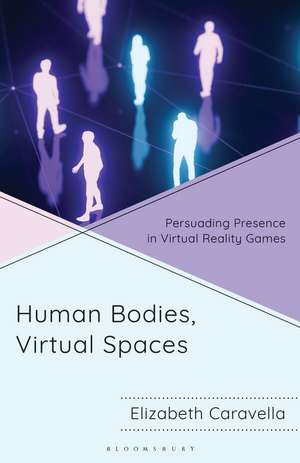
Human Bodies, Virtual Spaces: Persuading Presence in Virtual Reality Games
Autor Elizabeth Caravellaen Limba Engleză Paperback – 24 iun 2027
Preț: 214.33 lei
Preț vechi: 284.88 lei
-25% Precomandă
Puncte Express: 321
Carte nepublicată încă
Livrare prin curier în România Precomanda se expediază când titlul devine disponibil.
Transport gratuit de la 400.00 lei Plată online sau ramburs, în funcție de opțiunile comenzii.
Retur gratuit în 14 zile Comandă securizată și suport în română.
Doresc să fiu notificat când acest titlu va fi disponibil:
Se trimite...
Specificații
ISBN-13: 9798765158227
Pagini: 178
Ilustrații: 3 tables
Dimensiuni: 152 x 229 x 25 mm
Greutate: 0.45 kg
Editura: Bloomsbury Publishing
Colecția Bloomsbury Academic
Locul publicării:New York, United States
Pagini: 178
Ilustrații: 3 tables
Dimensiuni: 152 x 229 x 25 mm
Greutate: 0.45 kg
Editura: Bloomsbury Publishing
Colecția Bloomsbury Academic
Locul publicării:New York, United States
V-ar putea interesa
-
 How a Game LivesJacob Geller-20%Preț: 191.62 lei239.53 lei
 -
 -20%Preț: 79.08 lei98.85 lei
 -
 Bodies In TechnologyDon IhdePreț: 183.29 lei
 -
 Every Version of YouGrace Chan-19%Preț: 69.46 lei85.81 lei
 -
 Virtual Reality: Architecture, Culture, and the BodyTatjana Crossley-9%Preț: 1351.13 lei1484.76 lei
 -
 Site-Reliant Immersive Experiences: Sensing Affective Spaces in Art and ArchitectureDr Liana Psarologaki-33%Preț: 544.85 lei816.94 lei
 -
 -14%Preț: 566.12 lei658.29 lei
 -
 Immaterial BodiesLisa Blackman-8%Preț: 489.98 lei532.58 lei
 -
 -19%Preț: 87.10 lei107.49 lei
 -
 -24%Preț: 203.65 lei267.72 lei
 -
 Digital Embodiment and the ArtsDenise DoylePreț: 230.59 lei
 -
 -23%Preț: 705.58 lei916.34 lei
 -
 Virtual Reality NarrativesKath Dooley-15%Preț: 723.09 lei850.69 lei
 -
 Theorising and Designing Immersive EnvironmentsÁgnes-Karolina Bakk-18%Preț: 756.56 lei922.64 lei
 -
 Art and Culture in the Multiverse of MetaversesJames Hutson-20%Preț: 1202.29 lei1502.86 lei
 -
 -19%Preț: 309.20 lei379.54 lei
 -
 States of Immersion Across Media: Bodies, Techniques, PracticesPhilippe Bédard-14%Preț: 1444.89 lei1680.11 lei
 -
 Games That Haunt Us: Gothic Game Space as a Living NightmareStephanie Farnsworth-32%Preț: 596.25 lei878.53 lei
Cuprins
List of Tables
About the Author
Introduction: Why Study Presence in Virtual Reality Games?
1. Virtual Reality Through Time and Space
2. Dimensionality & Embodiment in Virtual Reality Games
3. Immersion & Presence in Rhythm Games
4. Interactivity & Procedural Rhetoric
5. Imagination, Affect, & Emotional Engagement
Conclusion: Persuading Presence as a Recursive Process
About the Author
Introduction: Why Study Presence in Virtual Reality Games?
1. Virtual Reality Through Time and Space
2. Dimensionality & Embodiment in Virtual Reality Games
3. Immersion & Presence in Rhythm Games
4. Interactivity & Procedural Rhetoric
5. Imagination, Affect, & Emotional Engagement
Conclusion: Persuading Presence as a Recursive Process
Recenzii
This book offers a much-needed corrective to the technology-obsessed discourse surrounding virtual reality. Elizabeth Caravella demonstrates how our sense of "presence" emerges from the complex interplay between our embodied movements, spatial awareness, and the procedural design of virtual experiences themselves. Her framework examining immersion, interactivity, and imagination offers both scholars and VR designers practical insights for creating more meaningful and accessible virtual experiences.
Elizabeth Caravella provides an important contribution to digital rhetoric by showing that presence in VR can be enacted through the persuasive power of procedural rhetorics; in doing so, she also advances our understanding of the critical intersections of the physical and the embodied that moves us beyond a simplified tech-centric understanding of presence.
Elizabeth Caravella provides an important contribution to digital rhetoric by showing that presence in VR can be enacted through the persuasive power of procedural rhetorics; in doing so, she also advances our understanding of the critical intersections of the physical and the embodied that moves us beyond a simplified tech-centric understanding of presence.