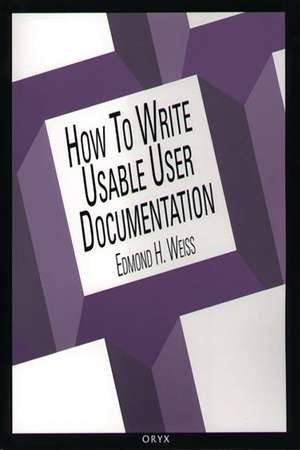
How To Write Usable User Documentation
Autor Edmond H. Weissen Limba Engleză Paperback – 26 iun 1991
Preț: 152.16 lei
Preț vechi: 284.27 lei
-46%
Puncte Express: 228
Carte tipărită la comandă
Livrare economică 18 noiembrie-02 decembrie
Livrare prin curier în România Termenul estimat este afișat lângă disponibilitate.
Transport gratuit de la 400.00 lei Plată online sau ramburs, în funcție de opțiunile comenzii.
Retur gratuit în 14 zile Comandă securizată și suport în română.
Specificații
ISBN-13: 9780897746397
ISBN-10: 0897746392
Pagini: 280
Dimensiuni: 216 x 279 x 18 mm
Greutate: 0.79 kg
Ediția:Revised
Editura: Bloomsbury Publishing
Colecția Greenwood
Locul publicării:New York, United States
ISBN-10: 0897746392
Pagini: 280
Dimensiuni: 216 x 279 x 18 mm
Greutate: 0.79 kg
Ediția:Revised
Editura: Bloomsbury Publishing
Colecția Greenwood
Locul publicării:New York, United States
V-ar putea interesa
-
 Sketching User Experiences: The WorkbookSaul Greenberg-18%Preț: 120.36 lei146.40 lei
 -
 Developing Quality Technical InformationMichelle CareyPreț: 355.87 lei
 -
 The Penguin Writer's ManualMartin Manser-19%Preț: 74.33 lei92.26 lei
 -
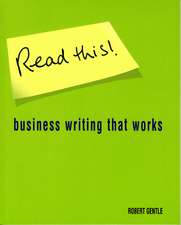 Read This!Robert GentlePreț: 107.23 lei
 -
 Persuasive WritingPeter FrederickPreț: 90.39 lei
 -
 -20%Preț: 213.53 lei266.91 lei
 -
 -40%Preț: 471.55 lei787.42 lei
 -
 Swallowed by a WhaleHuw Lewis-JonesPreț: 91.50 leiNou
 -
 The Complete Guide to Medical WritingMark C. Stuart-8%Preț: 220.19 lei240.32 lei
 -
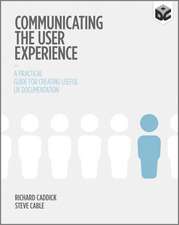 Communicating the User ExperienceRichard Caddick-20%Preț: 195.64 lei244.54 lei
 -
 Writing Graphic Novels For DummiesKensuke OkabayashiPreț: 115.21 lei
 -
 iPhone For Dummies, 2026 EditionHart-DavisPreț: 138.17 lei
 -
 -24%Preț: 915.68 lei1204.85 lei
 -
 Preț: 95.24 lei
 -
 -25%Preț: 468.46 lei624.34 lei
 -
 English Paper Piecing Handy Pocket GuideBecky GoldsmithPreț: 51.69 lei
 -
 -17%Preț: 91.92 lei110.49 lei
 -
 -19%Preț: 280.25 lei347.67 lei
 -
 The Crime Writers Casebook: Third EditionStuart Gibbon-17%Preț: 72.32 lei87.45 lei
 -
 The Writers' HandybookDorothy NelsonPreț: 77.18 lei
Recenzii
A readable, thought-provoking volume.
Weiss leads technical writers and documentors through the process of clearly explaining a product, system or procedure.
There may be guidance that pre-dates Weiss' book, but for me this represents the beginnings of user-friendly documentation. Anyone who has struggled through a manufacturer's manuals..needs to know that there is a better way to serve the customer. . . . Effective documentation must factor in motivation. . . . Wiess shows us how. . . . The other problem with conventional documentation, is its internal organization. Instead of self-contained answers, one is forced to leaf from one partial explanation to the next. . . . Weiss gets directly to the point. His answer is modularization. Each section must be short, focused, self-contained, and conceptually autonomous. It must be able to stand on its own, so that if the reader stops right there (wherever that is), he can resume reading without loss at a later point. YES!
Weiss leads technical writers and documentors through the process of clearly explaining a product, system or procedure.
There may be guidance that pre-dates Weiss' book, but for me this represents the beginnings of user-friendly documentation. Anyone who has struggled through a manufacturer's manuals..needs to know that there is a better way to serve the customer. . . . Effective documentation must factor in motivation. . . . Wiess shows us how. . . . The other problem with conventional documentation, is its internal organization. Instead of self-contained answers, one is forced to leaf from one partial explanation to the next. . . . Weiss gets directly to the point. His answer is modularization. Each section must be short, focused, self-contained, and conceptually autonomous. It must be able to stand on its own, so that if the reader stops right there (wherever that is), he can resume reading without loss at a later point. YES!