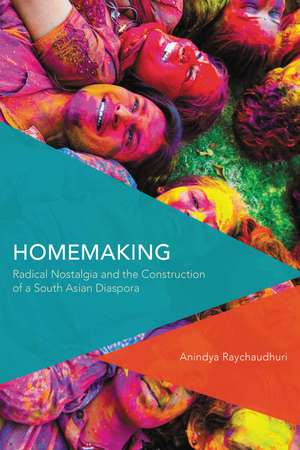
Homemaking: Radical Nostalgia and the Construction of a South Asian Diaspora: Critical Perspectives on Theory, Culture and Politics
Autor Anindya Raychaudhurien Limba Engleză Paperback – 4 iun 2020
Homemaking: Radical Nostalgia and the Construction of a South Asian Diaspora examines diasporic life in south Asian communities in Europe, North America and Australia, to map the ways in which members of these communities use nostalgia to construct distinctive identities.
Using a series of examples from literature, cinema, visual art, music, computer games, mainstream media, physical and virtual spaces and many other cultural objects, this book argues that it is possible, and necessary, to read this nostalgia as helping to create a powerful notion of home that can help to transcend international relations of empire and capital, and create instead a pan-national space of belonging.
This homemaking represents the persistent search for somewhere to belong on one's own terms. Constructed through word, image and music, preserved through dreams and imagination, the home provides sustenance in the continuing struggle to change the present and the future for the better.
Din seria Critical Perspectives on Theory, Culture and Politics
- 23%
 Preț: 329.49 lei
 - 23%
 Preț: 327.44 lei
 -
 Preț: 262.53 lei
 - 29%
 Preț: 341.10 lei
 - 15%
 Preț: 368.05 lei
 - 29%
 Preț: 343.17 lei
 - 19%
 Preț: 316.09 lei
 - 23%
 Preț: 327.95 lei
 - 23%
 Preț: 327.54 lei
 - 23%
 Preț: 313.67 lei
 - 23%
 Preț: 330.20 lei
 - 14%
 Preț: 313.80 lei
 - 30%
 Preț: 829.60 lei
 - 30%
 Preț: 828.22 lei
 - 25%
 Preț: 219.46 lei
 - 17%
 Preț: 259.28 lei
 - 29%
 Preț: 219.09 lei
 - 13%
 Preț: 330.49 lei
 - 25%
 Preț: 212.59 lei
Preț: 256.12 lei
Preț vechi: 350.26 lei
-27%
Puncte Express: 384
Carte tipărită la comandă
Livrare economică 28 noiembrie-12 decembrie
Livrare prin curier în România Termenul estimat este afișat lângă disponibilitate.
Transport gratuit de la 400.00 lei Plată online sau ramburs, în funcție de opțiunile comenzii.
Retur gratuit în 14 zile Comandă securizată și suport în română.
Specificații
ISBN-13: 9781783482634
ISBN-10: 178348263X
Pagini: 216
Dimensiuni: 153 x 220 x 16 mm
Greutate: 0.33 kg
Editura: Bloomsbury Publishing
Colecția Rowman & Littlefield
Seria Critical Perspectives on Theory, Culture and Politics
Locul publicării:New York, United States
ISBN-10: 178348263X
Pagini: 216
Dimensiuni: 153 x 220 x 16 mm
Greutate: 0.33 kg
Editura: Bloomsbury Publishing
Colecția Rowman & Littlefield
Seria Critical Perspectives on Theory, Culture and Politics
Locul publicării:New York, United States
Cuprins
Acknowledgments / Preface / Introduction - "Ich Will Heim": Nostalgia and the Radical Possibilities of Homemaking / Chapter 1 - "Doubly Expatriated": Duleep Singh and the Politics of Nostalgia / Chapter 2 - A Teacher, a Factory-Worker, and a "Battered" Housewife: Rebellious Nostalgias, Nostalgias of Rebellion / Chapter 3 - Aloo-gobi, Mangoes and a Small Aubergine: Food, Foodscapes and Nostalgia / Chapter 4 - "Straight from the Village": Diasporic Public Spaces and the Heterotopias of Nostalgia / Chapter 5 - Salaam, London: Bollywood, Wish Fulfilment, and the Fictive Geographies of the Diaspora / Chapter 6 - Making Yourself at Home: Homemaking and Diasporic Asian Broadcasting / Conclusion - Going Back Home: Looking Backwards, Looking Forwards. / Bibliography
Recenzii
Raychaudhuri's work on South Asian diasporic nostalgia is an invaluable contribution to memory studies that deals with topics as diverse as Brexit, BBC Asian broadcasting, and diasporic literature. Moving from experiences of the everyday - like food - to historical figures, Raychaudhuri offers a sophisticated portrait of nostalgia's radical potential to transform and challenge the idea of home.
Anindya Raychaudhuri's theoretic scaffolding of the argument is unique, and promises to open new avenues for reading South Asian diasporic subjects and spaces. The stunning clarity of the argument is highlighted by a contextualized reading of diaspora in a contemporary, heightened, political climate of rising populist nationalism. And, it proves the validity of making such an argument across a range of cultural spaces spanning literature to print, visual, and digital media. Arguing against a well-rehearsed trend in South Asian diaspora studies to signal loss, nostalgia, or anti imperial struggles as inherently conservative, the book proposes a radical idea of progressive presence by re-reading the spatial and experiential vectors of home and not-home. Furthermore, by interrupting the customary practice of locating the analysis outside the "I," it turns the lens on authorial presence as subjective, and as fully capable of theorizing while experiencing the complexities of being a diasporic herself. This adds an elegant, feminist anthropological element. While focusing mainly on England and Brexit to read diaspora in the 21st century, the book offers literary analyses of diasporic novelists whose characters return fleetingly to homelands while pivoting smoothly to the nativist point of view and the clamoring of nationalists against unwelcome others in the press and on social media. To a lesser degree, the book's analytical arc also explores Trump's America and other European nations faced with the reality of global flows of peoples across borders and cultures. The final gesture of nuancing the randomness of immigrant lives located in the crosshairs of ephemeral and agentive, diasporic presence, is, indeed remarkable.
The idea of nostalgia is interrogated and offered in terms of a critical hermeneutics across actual and imagined places where fiction, cinema, foodscapes, cultural geographies and other popular cultures across Britain and South Asia interact. In doing so, a rich set of examples are offered to illuminate the diasporic condition as transformative, complex and one that we can all learn from.
Anindya Raychaudhuri's theoretic scaffolding of the argument is unique, and promises to open new avenues for reading South Asian diasporic subjects and spaces. The stunning clarity of the argument is highlighted by a contextualized reading of diaspora in a contemporary, heightened, political climate of rising populist nationalism. And, it proves the validity of making such an argument across a range of cultural spaces spanning literature to print, visual, and digital media. Arguing against a well-rehearsed trend in South Asian diaspora studies to signal loss, nostalgia, or anti imperial struggles as inherently conservative, the book proposes a radical idea of progressive presence by re-reading the spatial and experiential vectors of home and not-home. Furthermore, by interrupting the customary practice of locating the analysis outside the "I," it turns the lens on authorial presence as subjective, and as fully capable of theorizing while experiencing the complexities of being a diasporic herself. This adds an elegant, feminist anthropological element. While focusing mainly on England and Brexit to read diaspora in the 21st century, the book offers literary analyses of diasporic novelists whose characters return fleetingly to homelands while pivoting smoothly to the nativist point of view and the clamoring of nationalists against unwelcome others in the press and on social media. To a lesser degree, the book's analytical arc also explores Trump's America and other European nations faced with the reality of global flows of peoples across borders and cultures. The final gesture of nuancing the randomness of immigrant lives located in the crosshairs of ephemeral and agentive, diasporic presence, is, indeed remarkable.
The idea of nostalgia is interrogated and offered in terms of a critical hermeneutics across actual and imagined places where fiction, cinema, foodscapes, cultural geographies and other popular cultures across Britain and South Asia interact. In doing so, a rich set of examples are offered to illuminate the diasporic condition as transformative, complex and one that we can all learn from.
Notă biografică
Anindya Raychaudhuri is a Lecturer in English at the University of St Andrews. His research interests include postcolonial and diasporic identities and cultures, cultural representation and collective memory of war and conflict, critical theory and Marxism. In 2016, he was named one of the BBC/AHRC New Generation Thinkers.