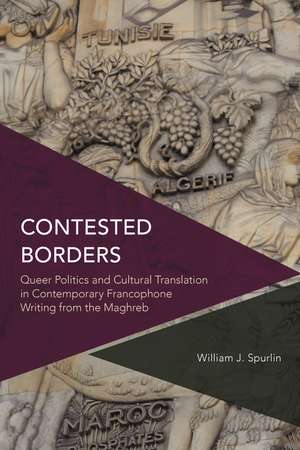
Contested Borders: Queer Politics and Cultural Translation in Contemporary Francophone Writing from the Maghreb: Critical Perspectives on Theory, Culture and Politics
Autor William J. Spurlinen Limba Engleză Hardback – 22 iun 2022
Din seria Critical Perspectives on Theory, Culture and Politics
- 23%
 Preț: 329.49 lei
 - 23%
 Preț: 327.44 lei
 - 27%
 Preț: 256.12 lei
 -
 Preț: 262.53 lei
 - 29%
 Preț: 341.10 lei
 - 15%
 Preț: 368.05 lei
 - 29%
 Preț: 343.17 lei
 - 19%
 Preț: 316.09 lei
 - 23%
 Preț: 327.95 lei
 - 23%
 Preț: 327.54 lei
 - 23%
 Preț: 313.67 lei
 - 23%
 Preț: 330.20 lei
 - 14%
 Preț: 313.80 lei
 - 30%
 Preț: 829.60 lei
 - 30%
 Preț: 828.22 lei
 - 25%
 Preț: 219.46 lei
 - 17%
 Preț: 259.28 lei
 - 29%
 Preț: 219.09 lei
 - 14%
 Preț: 319.95 lei
 - 26%
 Preț: 207.60 lei
Preț: 552.27 lei
Preț vechi: 816.98 lei
-32%
Puncte Express: 828
Carte tipărită la comandă
Livrare economică 10-24 noiembrie
Livrare prin curier în România Termenul estimat este afișat lângă disponibilitate.
Transport gratuit pentru acest produs Plată online sau ramburs, în funcție de opțiunile comenzii.
Retur gratuit în 14 zile Comandă securizată și suport în română.
Specificații
ISBN-13: 9781786600813
ISBN-10: 1786600811
Pagini: 262
Dimensiuni: 154 x 230 x 22 mm
Greutate: 0.55 kg
Editura: Bloomsbury Publishing
Colecția Rowman & Littlefield
Seria Critical Perspectives on Theory, Culture and Politics
Locul publicării:New York, United States
ISBN-10: 1786600811
Pagini: 262
Dimensiuni: 154 x 230 x 22 mm
Greutate: 0.55 kg
Editura: Bloomsbury Publishing
Colecția Rowman & Littlefield
Seria Critical Perspectives on Theory, Culture and Politics
Locul publicării:New York, United States
Descriere
This book broadens understandings of dissident sexualities in Africa through examining new representations of same-sex desire emerging in recent francophone autofictional writing from the Maghreb.
Long-established traditions pertaining to gender and sexuality are brought into contact with new forms of gender and sexual dissidence, resulting from the inflection of globally circulating discourses and embodiments of queerness in North Africa, and from the experience of emigration and settlement by the writers concerned in France. The book analyses specifically how Franco-Maghrebi writers Rachid O., Abdellah Taïa, Eyet-Chékib Djaziri, and Nina Bouraoui foreground translation and narrative reflexivity around incommensurable spaces of queerness in order to index their crossings and negotiations of multiple languages, histories and cultures.
By writing in French, Spurlin demonstrates that the writers are not merely mimicking the language of their former coloniser but inflecting a European language with discursive turns of phrase indigenous to North Africa, thus creating new possibilities of meaning and expression to name their lived experiences of gender and sexual alterity-a form of (queer) translational praxis that destabilises received gender/sexual categories both within the Maghreb and in Europe.
Long-established traditions pertaining to gender and sexuality are brought into contact with new forms of gender and sexual dissidence, resulting from the inflection of globally circulating discourses and embodiments of queerness in North Africa, and from the experience of emigration and settlement by the writers concerned in France. The book analyses specifically how Franco-Maghrebi writers Rachid O., Abdellah Taïa, Eyet-Chékib Djaziri, and Nina Bouraoui foreground translation and narrative reflexivity around incommensurable spaces of queerness in order to index their crossings and negotiations of multiple languages, histories and cultures.
By writing in French, Spurlin demonstrates that the writers are not merely mimicking the language of their former coloniser but inflecting a European language with discursive turns of phrase indigenous to North Africa, thus creating new possibilities of meaning and expression to name their lived experiences of gender and sexual alterity-a form of (queer) translational praxis that destabilises received gender/sexual categories both within the Maghreb and in Europe.
Cuprins
Acknowledgements
Introduction
1. Sexual/Textual Crossings: Toward New Representations of Sexual Dissidence in
the Maghreb
2. Historical Antecedents: Imperial Crossings and Same-Sex Desire between Men
in North Africa
3. Disruption, Fragmentation, and Alternative Sites of Memory: Gender and Sexual
Dissidence as Forms of Decolonisation in Francophone Post-Independence
Literature in the Maghreb
4. New Translations of Masculinity and Same-Sex Desire through (Re)Negotiating
Gender/Sexual Borders: Rachid O., Eyet-Chékib Djaziri, and Abdellah Taïa
5. Nina Bouraoui: Further Translations of Sexual Alterity through Embodiment and
Intersectional Crossings of Identic, Geopolitical, Temporal, and Generic Borders
6. Migration and/as Translation: Cultural Mediation and Negotiation as Ongoing
Struggles for the Decolonisation
Introduction
1. Sexual/Textual Crossings: Toward New Representations of Sexual Dissidence in
the Maghreb
2. Historical Antecedents: Imperial Crossings and Same-Sex Desire between Men
in North Africa
3. Disruption, Fragmentation, and Alternative Sites of Memory: Gender and Sexual
Dissidence as Forms of Decolonisation in Francophone Post-Independence
Literature in the Maghreb
4. New Translations of Masculinity and Same-Sex Desire through (Re)Negotiating
Gender/Sexual Borders: Rachid O., Eyet-Chékib Djaziri, and Abdellah Taïa
5. Nina Bouraoui: Further Translations of Sexual Alterity through Embodiment and
Intersectional Crossings of Identic, Geopolitical, Temporal, and Generic Borders
6. Migration and/as Translation: Cultural Mediation and Negotiation as Ongoing
Struggles for the Decolonisation
Recenzii
The book effectively illustrates the prowess of these writers who do not fit into national identities or Western sexual identities as they use their autofiction for self-discovery. In this regard, the book offers a welcome look at queer migrant perspectives from France, which feels incredibly important given the political realities and colonialist history of France.
William Spurlin's Contested Borders: Queer Politics and Cultural Translation in Contemporary Francophone Writing from the Maghreb is a rigorously researched and critically incisive account of Franco-Maghrebi writing. Spurlin's intersectional analysis is equally attentive to geography, race, gender, sexuality, and language. Simultaneously invoking, departing from, and moving beyond the critical and creative archive of works from the region, the author's attention to new spaces of dissident sexualities leads to future directions for research in the area. Contested Borders is a must read for scholars in Postcolonial, Middle Eastern and North African, and Sexuality Studies.
Written in Spurlin's usual deft style, Contested Borders surveys an impressive range of feminist and queer Maghrebian texts, part of the region's long tradition of writing about same-sex desire. The authors of these texts, living in between radically different languages, histories, and cultures, visit upon those uncomfortable with the globe's increasing
fragmentation the truths, triumphs, and fragilities of those living beyond essentialized Western categories and indigenous cultural taboos.
Contested Borders is timely and makes an immense contribution to our understanding of queer sexualities in the Maghreb and by extension in Africa. To date, this is the only monograph in English on the Maghreb that brings to our attention important questions of our time: life writing, sites of memory, translation, globalization, and queer theory.
Spurlin's book is, overall, a welcome contribution to queer studies, particularly at its intersection with postcolonial and translation studies. Indeed, it makes a valuable methodological contribution to thinking queer and postcolonial not merely together, but as fundamentally mutually imbricated.
William Spurlin's Contested Borders: Queer Politics and Cultural Translation in Contemporary Francophone Writing from the Maghreb is a rigorously researched and critically incisive account of Franco-Maghrebi writing. Spurlin's intersectional analysis is equally attentive to geography, race, gender, sexuality, and language. Simultaneously invoking, departing from, and moving beyond the critical and creative archive of works from the region, the author's attention to new spaces of dissident sexualities leads to future directions for research in the area. Contested Borders is a must read for scholars in Postcolonial, Middle Eastern and North African, and Sexuality Studies.
Written in Spurlin's usual deft style, Contested Borders surveys an impressive range of feminist and queer Maghrebian texts, part of the region's long tradition of writing about same-sex desire. The authors of these texts, living in between radically different languages, histories, and cultures, visit upon those uncomfortable with the globe's increasing
fragmentation the truths, triumphs, and fragilities of those living beyond essentialized Western categories and indigenous cultural taboos.
Contested Borders is timely and makes an immense contribution to our understanding of queer sexualities in the Maghreb and by extension in Africa. To date, this is the only monograph in English on the Maghreb that brings to our attention important questions of our time: life writing, sites of memory, translation, globalization, and queer theory.
Spurlin's book is, overall, a welcome contribution to queer studies, particularly at its intersection with postcolonial and translation studies. Indeed, it makes a valuable methodological contribution to thinking queer and postcolonial not merely together, but as fundamentally mutually imbricated.
Notă biografică
William J. Spurlin is Professor of English and Director of Teaching and Learning for Arts & Humanities at Brunel University London. Previously, he was Professor of English at the University of Sussex and directed the Centre for the Study of Sexual Dissidence & Cultural Change from 2006-2011. Professor Spurlin has written extensively on the politics of gender and sexual dissidence in Africa in his book, Imperialism within the Margins: Queer Representation and the Politics of Culture in Southern Africa (2006), which examines the politics of sexuality that emerged in the years following apartheid in South Africa; in numerous articles in academic journals, such as Research in African Literatures (forthcoming), Studies in Ethnicity and Nationalism (2013), Feminist Review (2010), and Études Anglaises (2008); and as chapters in edited collections, most recently in The Future of Postcolonial Studies (2015), The Wiley Companion to Translation Studies (2014), and Gendering Border Studies (2010). His other monograph is Lost Intimacies: Rethinking Homosexuality under National Socialism (2009), and he has co-edited, with Jarrod Hayes and Margaret Higonnet, Comparatively Queer: Interrogating Identities across Time and Cultures (2010). Professor Spurlin chairs the Comparative Gender Studies Committee at the International Comparative Literature Association (ICLA), and he is a Section Editor for the journal Postcolonial Text.