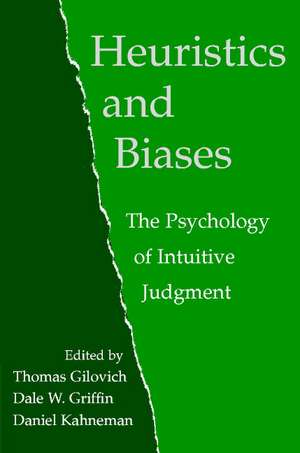
Heuristics and Biases: The Psychology of Intuitive Judgment
Editat de Thomas Gilovich, Dale Griffin, Daniel Kahnemanen Limba Engleză Paperback – 7 iul 2002
Editorii acestui volum, Thomas Gilovich, Dale Griffin și laureatul Premiului Nobel, Daniel Kahneman, sunt figurile centrale care au definit psihologia judecății intuitive. Lucrarea de față, publicată de Cambridge University Press, fundamentează academic tranziția de la modelele raționale stricte la înțelegerea proceselor cognitive reale. Apreciem rigoarea cu care volumul asamblează cele mai relevante cercetări apărute după succesul foundational al anilor '70, oferind o resursă masivă de peste 800 de pagini, susținută de 80 de tabele și date empirice care explică de ce mintea umană recurge la scurtături mentale.
Reținem că această ediție funcționează ca o continuare necesară și o actualizare a volumului de referință Judgment under Uncertainty. Dacă titlul anterior punea bazele teoriei, Heuristics and Biases extinde aplicabilitatea acestor concepte în domenii vitale precum dreptul, medicina și managementul. Considerăm această lucrare o alternativă robustă la Cognitive Biases pentru cursurile avansate de psihologie cognitivă sau economie comportamentală, având avantajul unei perspective integrate, care nu doar inventariază erorile, ci analizează mecanismele lor profunde.
În contextul operei lui Thomas Gilovich, volumul reprezintă fundamentul teoretic pentru lucrările sale mai accesibile publicului larg, precum How We Know What Isn't So sau Why Smart People Make Big Money Mistakes... and How to Correct Them. În timp ce acelea explorează manifestările cotidiene ale iraționalității, Heuristics and Biases oferă arhitectura științifică și datele brute care susțin acele argumente. Este o lectură densă, cu un ton academic precis, esențială pentru înțelegerea modului în care intuiția modelează deciziile sub incertitudine.
Preț: 460.63 lei
Preț vechi: 500.68 lei
-8%
Carte tipărită la comandă
Livrare economică 11-25 iunie
Specificații
ISBN-10: 0521796792
Pagini: 882
Ilustrații: 53 b/w illus. 80 tables
Dimensiuni: 160 x 231 x 46 mm
Greutate: 1.25 kg
Editura: Cambridge University Press
Colecția Cambridge University Press
Locul publicării:New York, United States
V-ar putea interesa
-
 How We Know What Isn't SoThomas Gilovich-13%Preț: 77.24 lei88.97 lei
 -
 -15%Preț: 464.39 lei546.34 lei
 -
 Preț: 448.80 lei
 -
 Measurement in PsychologyJoel MichellPreț: 240.89 lei
 -
 Historical and Philosophical Foundations of PsychologyMartin Farrell-19%Preț: 453.75 lei560.18 lei
 -
 Human Organic Memory DisordersAndrew R. Mayes-11%Preț: 525.67 lei590.64 lei
 -
 Sexual Selection in Primates: New and Comparative PerspectivesPeter M. KappelerPreț: 407.35 lei
 -
 A Handbook of Wisdom: Psychological PerspectivesRobert Sternberg PhDPreț: 371.57 lei
 -
 Choices, Values, and FramesDaniel Kahneman-8%Preț: 573.89 lei623.80 lei
 -
 Preț: 294.06 lei
 -
 Japanese Frames of Mind: Cultural Perspectives on Human DevelopmentHidetada ShimizuPreț: 353.97 lei
 -
 Preț: 271.24 lei
 -
 Personality and Close Relationship ProcessesStanley O. Gaines, Jr-14%Preț: 738.04 lei858.19 lei
 -
 -14%Preț: 697.70 lei811.28 lei
 -
 Preț: 93.48 lei
 -
 AddictionaryMA Msc. D. ChapmanPreț: 94.45 lei
 -
 The Elements of Mental Tests, Second EditionJohn D. Mayer-8%Preț: 377.06 lei409.85 lei
 -
 The Wisest One in the RoomLee Ross-6%Preț: 84.02 lei89.50 lei
 -
 The Psychology of Radicalization and TerrorismWillem Koomen-15%Preț: 459.00 lei539.99 lei
 -
 Schnelles Denken, langsames DenkenDaniel KahnemanPreț: 136.35 lei
 -
 The AdministratorJaroslaw JankowskiPreț: 54.50 lei
 -
 The IdealistJaroslaw JankowskiPreț: 54.40 lei
 -
 Pensar Rápido, Pensar Despacio / Thinking, Fast and SlowDaniel KahnemanPreț: 91.43 lei
Public țintă
Academic/professional/technical: Research and professionalDe ce să citești această carte
Recomandăm această lucrare profesioniștilor și cercetătorilor care doresc să înțeleagă arhitectura erorii umane. Este o resursă academică esențială care explică mecanismele din spatele deciziilor greșite în afaceri, medicină sau politică. Cititorul câștigă acces la decenii de cercetare fundamentală, structurată clar prin tabele și ilustrații, oferind un avantaj teoretic major în orice domeniu bazat pe analiza datelor și judecată intuitivă.
Despre autor
Thomas Gilovich este profesor de psihologie la Universitatea Cornell și un cercetător renumit în domeniul psihologiei sociale și al proceselor de luare a deciziilor. Autor al unor lucrări influente precum The Wisest One in the Room și How We Know What Isn't So, Gilovich s-a specializat în demontarea falaciilor care ne guvernează viața de zi cu zi. Expertiza sa în erori de judecată și comportament economic irațional este dublată de o capacitate rară de a sintetiza date academice complexe, transformându-le în perspective aplicabile în economie și științe sociale.
Descriere scurtă
Cuprins
Recenzii
"...the book should serve well as a reference work for researchers in cognitive science and as a textbook for advanced courses in that difficult topic. Philosophers interested in cognitive science will also wish to consult it." Metapsychology Online Review
"Heuristics and Biases: The Psychology of Intuitive Judgment is a scholarly treat, one that is sure to shape the perspectives of another generation of researchers, teachers, and graduate students. The book will serve as a welcome refresher course for some readers and a strong introduction to an important research perspective for others." Journal of Social and Clinical Psychology