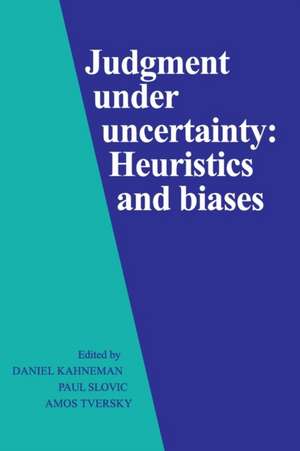
Judgment under Uncertainty
Editat de Daniel Kahneman, Paul Slovic, Amos Tverskyen Limba Engleză Paperback – 22 mar 2019
Descoperim în Judgment under Uncertainty o lucrare fundamentală pentru psihologia cognitivă, organizată riguros pentru a cartografia mecanismele judecății umane. Structura volumului este concepută pentru a ghida cititorul de la fundamentele teoretice ale euristicilor către aplicații complexe în domenii vitale. Metodologia adoptată de editori — Daniel Kahneman, Paul Slovic și Amos Tversky — îmbină treizeci și cinci de capitole ce funcționează ca sinteze ale unor arii extinse de cercetare, depășind simpla descriere a unor experimente izolate. Notăm cu interes progresia logică a materialului, care debutează cu introducerea conceptelor de euristici și erori (biases), continuând cu secțiuni dedicate reprezentativității, cauzalității și atribuirii, precum și disponibilității informaționale. Această ediție de la Cambridge University Press este esențială deoarece recuperează articole clasice, dar aduce și contribuții inedite care analizează modul în care incertitudinea afectează diagnosticul medical, evaluarea riscului și percepția socială. Cartea acoperă aceeași arie tematică precum Heuristics and Biases de Thomas Gilovich, însă Judgment under Uncertainty păstrează un caracter mai academic și sistematic, fiind lucrarea care a pus bazele disciplinei. În contextul operei lui Daniel Kahneman, acest volum reprezintă fundamentul științific pe care s-au construit ulterior succese editoriale precum Thinking, Fast and Slow sau Noise. Dacă lucrările sale mai recente sunt adresate publicului larg, Judgment under Uncertainty rămâne resursa tehnică primară, oferind rigoarea necesară cercetătorilor și studenților care doresc să înțeleagă arhitectura cognitivă din spatele deciziilor economice și sociale, activitate ce i-a adus lui Kahneman Premiul Nobel.
Preț: 443.18 lei
Carte indisponibilă temporar
Specificații
ISBN-10: 0521284147
Pagini: 572
Ilustrații: illustrations, bibliog , index
Dimensiuni: 152 x 229 x 31 mm
Greutate: 0.77 kg
Editura: Cambridge University Press
Locul publicării:New York, United States
V-ar putea interesa
-
 SoonAndrew SantellaPreț: 107.15 lei
 -
 Last Unknowns, TheJohn BrockmanPreț: 117.16 lei
 -
 -13%Preț: 279.48 lei321.05 lei
 -
 The Organisation of MindTim Shallice-24%Preț: 532.26 lei704.37 lei
 -
 Preț: 369.81 lei
 -
 Preference, Belief, and SimilarityAmos Tversky-15%Preț: 518.47 lei609.97 lei
 -
 A Mind So RareMerlin DonaldPreț: 162.29 lei
 -
 Love & WillRollo MayPreț: 101.33 lei
 -
 Barriers to Conflict ResolutionStanford Center on Conflict and NegotiatPreț: 159.35 lei
 -
 Acceptable RiskSarah LichtensteinPreț: 383.15 lei
 -
 Decision MakingDavid E. BellPreț: 382.18 lei
 -
 The Social Amplification of RiskNick PidgeonPreț: 455.90 lei
 -
 The Construction of PreferenceSarah Lichtenstein-14%Preț: 811.32 lei943.40 lei
 -
 The Human MindLord Robert Winston-34%Preț: 90.14 lei136.77 lei
 -
 Preț: 355.76 lei
 -
 Preț: 297.89 lei
 -
 Why We LoveHelen FisherPreț: 116.08 lei
 -
 -12%Preț: 438.49 lei498.29 lei
 -
 Epiphenomenal Mind: An Integrated Outlook on Sensations, Beliefs, and PleasureWilliam S. Robinson-18%Preț: 1111.61 lei1355.62 lei
 -
 The Perception of RiskPaul SlovicPreț: 392.53 lei
 -
 Perceptual OrganizationStephen Handel-15%Preț: 724.65 lei852.54 lei
 -
 Preț: 350.32 lei
Public țintă
Academic/professional/technical: Research and professionalDe ce să citești această carte
Această carte este esențială pentru oricine dorește să înțeleagă de ce mintea umană face erori sistematice în condiții de incertitudine. Spre deosebire de textele de popularizare, volumul oferă fundamentul academic necesar pentru studenții la psihologie, economie sau științe politice. Veți câștiga o înțelegere profundă a euristicilor care guvernează deciziile cotidiene și profesionale, beneficiind de expertiza celor mai influenți cercetători în domeniul comportamental.
Despre autor
Daniel Kahneman este un psiholog israeliano-american, laureat al Premiului Nobel pentru Științe Economice în 2002, recunoscut pentru integrarea cercetării psihologice în știința economică. Împreună cu Amos Tversky, a stabilit bazele cognitive ale erorilor umane comune și a dezvoltat „prospect theory”. Profesor emerit la Princeton University, Kahneman este considerat unul dintre cei mai influenți gânditori globali, opera sa transformând radical înțelegerea raționalității umane prin evidențierea limitărilor intuitive în procesul de luare a deciziilor.
Descriere scurtă
Cuprins
Recenzii
"The examples are lively, the style is engaging, and it is as entertaining as it is enlightening." Times Literary Supplement
"...an important and well-written book." Journal of the American Statistical Association
"...a good collection of papers on an important topic." Quarterly Journal of Experimental Psychology
"Clearly, this is an important book. Anyone who undertakes judgment and decision research should own it." Contemporary Psychology