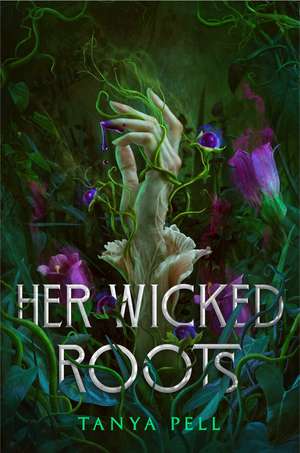
Her Wicked Roots
Autor Tanya Pellen Limba Engleză Hardback – 9 oct 2025
In this queer retelling of Nathaniel Hawthorne classic gothic story, Rappaccini’s Daughter, a young woman is lured to a lush estate owned by a botanist who might be hiding dark secrets.
Cordelia Beecher is on the run. In search of her missing brother Edward, she has fled the oppressive charity school she was raised in, desperate to find the only family she knows. Using clues from his past letters, she sets off for the sleepy town of Farrow but everyone there claims to have never heard of Edward—not even the man he was supposedly working for as an apprentice.
With nowhere to go, Cordi turns to Lady Evangeline, a local botanist who owns the magnificent Edenfield estate. The benevolent lady of the manor has made it her mission to take young, often traumatized, women into her employ and protect them from man’s world of wicked desires and deceits. Hired as a maid and companion to her enigmatic daughters, Prim and Briar, Cordi quickly settles into Edenfield. Even as her relationship with Briar blossoms, Cordi can’t help but suspect that there are secrets in the estate…and when she stumbles across evidence that Edward was once there, she’s determined to find answers.
Atmospheric, eerie, and thoroughly original, Her Wicked Roots will establish Tanya Pell as a “wickedly creepy” (Josh Winning, author of Heads Will Roll) and vital voice in horror.
Preț: 120.58 lei
Preț vechi: 146.21 lei
-18% Recomandat
Carte disponibilă
Livrare economică 06-18 noiembrie
Livrare express 16-22 octombrie pentru 63.19 lei
Specificații
ISBN-10: 1668087294
Pagini: 352
Ilustrații: designed edges; 4-c ends
Dimensiuni: 152 x 229 x 28 mm
Greutate: 0.59 kg
Editura: Gallery Books
Colecția Gallery Books
V-ar putea interesa
-
 This Vicious HungerFrancesca May-25%Preț: 93.61 lei124.53 lei
 -
 -24%Preț: 92.91 lei123.02 lei
 -
 Rollercoasters: The Undying of Obedience WellrestNicholas Bowling-27%Preț: 69.00 lei94.52 lei
 -
 The Hallow HuntMargie FustonPreț: 56.77 lei
 -
 Honeysuckle and BoneTrisha Tobias-5%Preț: 62.23 lei65.29 lei
 -
 Holly: A Belladonna NovellaAdalyn Grace-25%Preț: 88.41 lei117.16 lei
 -
 Preț: 114.17 lei
 -
 Preț: 72.72 lei
 -
 Ruthless DevotionRebecca KenneyPreț: 71.74 lei
 -
 -25%Preț: 92.29 lei123.74 lei
 -
 Preț: 123.51 lei
 -
 Haunting Adeline International Edition: Cat & Mouse DuetH. D. CarltonPreț: 96.98 lei
 -
 House of ThornsIsabel Strychacz-18%Preț: 52.68 lei64.37 leiRecomandat
 -
 Herculine: A NovelGrace Byron-20%Preț: 113.60 lei141.53 leiRecomandat
 -
 It Was Her House FirstCherie PriestPreț: 101.53 leiRecomandat
 -
 A Botanical DaughterNoah Medlock-17%Preț: 60.18 lei72.93 lei
 -
 -26%Preț: 79.92 lei107.30 lei
 -
 RagwortSam K. Horton-19%Preț: 110.73 lei136.11 leiRecomandat
 -
 The Haunting of William ThornBen AldersonPreț: 74.39 lei
 -
 I, in the ShadowsTori BovalinoPreț: 119.99 lei
Notă biografică
Recenzii
"Tanya Pell is a horror horticulturist who has cultivated a manic botanic gothic that grafts Silvia Moreno-Garcia to Daphne du Maurier, and what sprouts out is absolutely beautiful. Her Wicked Roots reaches in and rummages through the reader's subconscious until there's no weeding it out." —Clay McLeod Chapman, author of Wake Up and Open Your Eyes
"Tanya Pell’s Her Wicked Roots is a winding, creeping ivy, a nighttime garden bursting and blossoming with rich texture and dark, sinister bouquets. Beautiful flowers can, however, be deadly. A richly Gothic and lush retelling." —Cynthia Pelayo, Bram Stoker Award-winning author of Vanishing Daughters
"Her Wicked Roots is a true treat, sure to delight and thrill in equal measure; a must-read for fans of queer gothic novels." —Johanna Van Veen, author of Blood on Her Tongue and My Darling Dreadful Thing
“Darkly enchanting, Her Wicked Roots is haunting, propulsive and as hypnotic as the poisonous blooms at the novel’s heart. Truly a bewitching sapphic delight.” —Francesca May, author of Wild and Wicked Things and This Vicious Hunger
“This gorgeous, haunting story coiled tight around my heart and refused to let go. An intoxicating tale of secrets, desire, hurt and bravery, rooted in the fear of losing the ones we love. Tanya Pell is such an exciting voice in horror, and this gothic mystery is truly unforgettable.” —Josh Winning, author of Heads Will Roll
“Tanya Pell skillfully brews a gothic Victorian horror novel that’s equal parts The Secret Garden and Midsommar… Like the belladonna plant that populates Edenfield, Her Wicked Roots is deceptively approachable—but beware of the poison just under the stunning surface.” —BookPage
"Eerie… It’s easy to sink into the spooky atmosphere, and an impressive final twist will catch even the most genre-savvy unaware. For readers seeking fun queer gothic horror, this delivers." —Publisher's Weekly
“Perfect for fans of Silvia Moreno-Garcia's Mexican Gothic (2022) or Kit Mayquist's Tripping Arcadia (2022), the book features a Gone Girl-esque twist that will plant this story’s wicked roots deep into readers' souls.” —Booklist
“Lush and languid… A full-blooded and enchanting gothic, that much like some of the flora it features, is beautiful and lethal in equal measure. Nothing short of spectacular, Pell’s latest is twisted, twisty, full of queer longing and chlorophyllic menace… There’s a quiet dread that Tanya Pell has clearly mastered. Rappaccini’s Daughter meets Silvia Moreno-Garcia in this claustrophobic, botanical beast of a book that is indeed as exquisite on the inside as its cover suggests. Thorny, horny, and full of tension.” —FanFiAddict
Descriere
In this stunning gothic horror—a queer re-telling of Nathaniel Hawthorne's Rappaccini's Daughter—a grieving but tenacious young woman is lured to a lush estate owned by a seemingly benevolent botanist who might be hiding more than her enigmatic daughters.
Extras
CORDELIA’S HEAD BANGED AGAINST THE side of the carriage and she startled awake, fingers clawing reflexively at the small bag in her lap, pulling it closer. For one terrifying moment, she thought the jolt was the carriage being forced to a halt. That at any second the door would open and rough hands would reach in, drag her from her seat, and force her back to the Barrow and the horrors that would await her there.
But it had only been a lurch as the carriage wheel bounced through a pothole. Cordi heard the driver cursing the roads with language that might have made a fainter heart blush but only made her exhale a shaky laugh.
“Are you all right, dear?”
The only other passenger was an elderly woman with a lapful of yarn and knitting needles poised like tiny spears in her hands that had been clicking and clacking since the driver had helped her settle into her seat. Those needles were finally still as she watched Cordi with concern.
Cordi gave a wan smile, trying to keep her features hidden behind the uneven waves of her hair. “Yes, ma’am,” she said meekly, hating the attention she had drawn. “Just startled.”
The old woman clucked and went back to her knitting. “Bad dreams?”
Are there any other kind?
But the woman didn’t seem to need an answer. The door to conversation had been opened and she was apparently happy to fill the quiet while her thin fingers, the skin wrinkled and sagging with age, returned to her nimble knitting and purling. “I sleep like the dead myself. Suppose I’m getting practice in,” she said with a little chuckle. “Not too long till the grave for me. But I simply cannot sleep without a proper bed. Was never able to. And certainly not on a dusty road, jostling about like a package.”
“Yes, ma’am,” Cordi said again, not wanting to be rude.
When she had first boarded in the city, she had imagined the eyes of the other passengers on her, scrutinizing her face even as she tried to keep it turned casually away. Surely they were memorizing her so they might later tell the constables what they knew. She had been certain at each stop that she would be arrested, and so had waited with bated breath and a pounding heart as each passenger disembarked and their luggage was handed down, pressed into a corner of the carriage in an effort to make herself as small as possible. She did not breathe until the wheels had begun moving again.
In these moments of uncertain limbo as she waited for the lurch of the carriage, Cordi’s hand would sink into her pocket and clutch her beloved talisman. The treasured fox, a gift from her brother carved from linden wood, offered her some small measure of comfort. Her thumb would stroke its smooth belly as a penitent’s fingers might slide over prayer beads.
When she had been forced to clamber down herself at the stops in order to make water or burst, she had shuffled through the people milling around the station. Men stood about in dark hats and coats, reading papers, checking watches, and guffawing at bawdy jokes. Ladies attended small children or tried to revive wilting feathers in their hats, noses turned up at the scent of horses and tobacco. Cordi had done her business and kept her head down, her collar turned up, forcing her gait to be steady as she wove through the crowd, her face a mask of casual annoyance. Just another passenger eager to be on her way. Just another poor, wretched girl among thousands. She willed all eyes not to linger upon her, retreating to the safety of the coach and the quiet, dreary passengers within.
No one had spoken to her, nor to each other for that matter. Everyone had kept to their own business. It made her wonder about their own secrets. If they were all running from something, just like her.
No, she scolded herself. No. She was not running from something. She was running toward.
“Dear?”
Cordi reflexively straightened against the carriage seat. Years of harsh school inspections gave her a straight spine and folded hands on cue. “Ma’am?”
The older woman’s lips pinched together, eyes narrowed behind tiny golden spectacles, sweeping over Cordi’s poor clothing, lingering on her hands, dotted with scars from a hard life lived. Upon her seeing these, her lips turned at the corners into a tender smile, something warm and comforting. “I said you were much too young and too pretty to be having bad dreams. That’s all.”
Kindness was a gift Cordi had not known for some time. Something she had almost forgotten how to acknowledge. “Th-thank you,” she stuttered. “Ma’am.”
The woman nodded and resumed her knitting, the sound of her needles tapping together filling the small space.
Cordi allowed herself to look out the window and found her eyes dazzled. Green fields and hillocks stretching into the distance, marred only by the occasional fence or copse of trees. Sheep, their wool stained with fresh mud rather than the muck of the city.
Cordi pressed her nose against the frosty glass, fogging it with her breath as she tried to crane her neck, looking for any glimpse of crowded buildings and the life she’d left behind. A world of black and gray and death, the early morning sun choked behind low clouds and smoke from chimneys coughing out soot, ash, and brick dust to corrupt the recent snow.
There was only the lush pastoral scene passing hastily beyond her window. Days and miles separated her from the cruel city and the crimes committed there, both her own and others’. With each mile traveled, she felt a link in the chain tying her to her old life crack and fall away.
The driver cursed again before pulling up the reins, the carriage rolling to a stop.
“Oh,” Cordelia breathed at the sight of a meadow carpeted in an early spray of bluebells.
The purple and blue flowers dipped their heads lazily, heavy with dew yet to burn away, sparkling and twinkling in the changing light. A field of stars.
The coach swayed as the driver hauled himself out of his seat and down to the ground. He rapped quickly on the door before it swung open on her side. Instinctively, Cordi pressed farther back into the seat, one hand clutching her bag. “Why have we stopped?”
The driver pushed his hat back on his head, revealing clean, pale skin beneath, a clear line separating his scalp from his face, dusty and tanned by years in the sun. “That dip we took. One of the team is pulling to the side. May have picked up a stone or I may need to adjust his straps. But you might as well stretch your legs if you’ve a mind.” The driver was a genial man; though curt, he treated her and the other passengers with nothing but respect. His nose was red from a chill even early spring could not quite vanquish and paired splendidly with his red beard peppered with stiff, gray hairs. More of those same hairs sprouted like weeds from his ears.
He backed away from the door and she heard his thick boots on the road as he went to attend to his horses.
“You go right ahead, dear,” the woman offered. “Will do you some good to see some sun. Too pale. I’m staying right here with my work. If I disembark, I’m likely never to make my way back up again.”
Cordi considered staying put, tucked into her corner. But she was tired of sitting and the air wafting into the carriage from the open door was so sweet. She slung her satchel on her shoulder and climbed out, blinking in the bright sunshine.
As she stepped down, knees adjusting to the feel of solid ground beneath her, she had to choke back happy tears even as she drew a deep breath into her lungs. She shut her eyes, half convinced she would open them to the squat wall covered in black frost that marked the path between the stone steps of her former prison and its iron gate. But when she lifted her lids, the flowers and trees were still there, not muted and leached of all color by soot and sorrow, but dazzling and alive, as far a cry from the frozen wasteland as she might ever find.
Had her brother, Edward, seen it like this? Had he marveled as well?
Cordi walked through the tall grass, sweeping her hand across the stalks, letting them tickle her palm and dampen her skirt and ankles. She was drawn to the blue flowers, some the same color as the pure sky above her—the color of Edward’s eyes. Others were rich indigo, as dark blue as her own. They put her in mind of the last time she had seen her brother, standing at the gates of the Barrow, wearing his school-issue coat, threadbare and black and not at all suitable for the winter days that loomed. Gray fingerless gloves he had found in the charity basket, fraying and riddled with holes she had tried to stitch together, covered his hands for all the warmth they would offer. He had held his hat, and a dingy, stained canvas bag was tossed over his shoulder.
On those steps they had parted for the first time in their lives. Before he disappeared into the city streets, she had reached under her shawl and pulled out a length of knitted wool. The scarf was several different colors, the fibers salvaged from pieces beyond repair and lengths of wool she had scrounged or begged for. Some she had even stolen from Mrs. Clark’s knitting basket when it was her turn to clean the head teacher’s suite of rooms. Those pieces she had used for the tassels, for they were the brightest: pale blue and deepest indigo. A reminder that they were family. A plea not to forget her.
Did you knit this with your eyes closed? She had slapped at him as he had known she would, and he’d ducked before hugging her to his heart, laughing into her hair, the sound bittersweet. I treasure it and you. Now, promise me you’ll learn to knit a straight line by the time I come for you. And I will come for you, Dee.
It was the last she’d seen him before he set off down the walk, scarf tucked beneath his collar, hat pulled down over his head, hiding his curls. Just another young English boy in black and gray on another black-and-gray English morning.
Here, though, was all the color in the world. She gathered some of the flowers, breaking them off along their crisp stalks, the tips of her fingers numbing with the damp chill. She took only a few, enough to chase the darkness of the carriage away, to remind her she was free. Turning back to the road, she glimpsed another splash of color: a taller flute of a plant, dotted with small amethyst flowers, that rose over the bluebells, their heads bowed like supplicants before a god. The pink-purple flowers were thickly clustered together, their trumpets open mouths inviting bees to dine upon the sweet nectar within.
Cordelia approached, intending to add it to her small bouquet, the color striking and alluring. She extended a hand—
“Stop!” the driver shouted.
She snatched her fingers back, nearly strangling the bluebells as her grip tightened.
“Don’t touch that one, missy. That there’s foxglove.”
“Foxglove?” she said dumbly.
Whether he heard her faint reply or not, he carried on. “Poison, it is. Pretty to look at, but best be leaving it alone. Could kill a horse if eaten. Would probably spare your life if we were quick enough, sure, but wouldn’t likely spare you pain.”
Like so many things, Cordi thought, giving the flower one last look before she trudged back to the carriage.
The driver nodded at her good sense to listen, adjusting the strap on one of the horses. “Funny how nature protects itself. How some of the loveliest things are also the deadliest.” His eyebrows plummeted and he turned back to the meadow, shaking his head. “Strange to see foxglove this early. Though I don’t mind telling you I’ve seen queerer things growing this close to Farrow.”
Cordi’s heart pounded in her chest. “Are we so near?”
“That we are, missy. This is the edge of Rutland. Quick stop at the crossroads ahead and then we’ll head on.”
She looked around again, the magic and wonder of the place making sense. This was where she was meant to be. This was where she would put down roots and find her home.
With the horses secure, they could continue on, and Cordi found herself fidgeting, eager, almost giddy. Her companion noticed the change. “The fresh air seems to agree with you,” the woman said with a laugh.
Cordi did smile then. A true smile. Plucking a bluebell from the bouquet, she offered it to the woman, who took it with thanks. “How sweet. I loved gathering flowers when I was young.” The woman clucked again. “And I loved having them gathered for me when I was your age. How the boys brought me flowers! Oh!” She giggled, face crinkling with delight, but the wrinkles were of a life well lived. Different scars than Cordi carried. Lines carved with love by time.
A knock sounded from above—the driver signaling a stop. Obviously for Cordi’s companion. The woman began to gather her knitting, shoving the bundles of yarn and needles into a thick carpetbag, tucking the bluebell into the buttonhole of her own coat. “Where are you off to, love? Will you be departing with me? On the way to Babford, perhaps? I think I heard they’d been advertising for a new schoolteacher. Would that be you, then? A small class you’ll have, to be sure, but, oh, they will keep you on your toes. Especially those Pratt boys, my goodness. But a young thing like you will have the energy for their mischief. The walk isn’t far, blessedly. You gather your things and I’ll—”
“No,” Cordi interrupted, almost laughing at how eager strangers were to talk once the opportunity had arisen. So unlike the city. “I’m bound for Farrow. I’m—”
“Farrow.”
Cordi’s mouth snapped shut. Stupid of her to say where she was going to anyone. Careless.
But the older woman only stared, the eyes behind those tiny spectacles lost as the sun streaming in from one window reflected off the glass, turning her eyes into glowing white moons.
“You’re going to Farrow.” The woman’s voice, previously warm and grandmotherly, had turned cool, chilling the very air.
“Yes, ma’am.”
“I see.” The woman inhaled a slow breath as the wheels slowly rolled to a stop. The carriage swayed as the driver jumped to the ground to assist his passenger. As the door opened, the woman remained in her seat. Though her eyes remained obscured by the golden lenses, Cordi felt the stare behind them, hard and severe.
“I don’t understand,” Cordi said, confused at the sudden change in demeanor, gripping her bag as if the woman might launch herself across the seats toward her.
“Perhaps not.” The woman’s hands shook as she tugged her shawl around her shoulders. “But ignorance won’t keep you safe. Ignorance has never kept a woman safe. If you’ve any brains in your head, child, you’ll not stop at Farrow. There’s nothing there for young girls, no matter what promises serpents make. Nothing.”
Then she was gone, so quick out of the carriage she didn’t even take the hand the coachman offered. Cordi leaned forward before the door could shut to see her shuffling down the road, back bent, head bowed, at a pace that might send her sprawling if she was not careful on the uneven terrain. The bluebell Cordi had given her drifted to the ground and was crushed by the woman’s heel into the dust of the road.
The sun dipped behind a cloud and the world turned bleak. “All right, miss?” the driver said, but he seemed wary himself.
Cordi nodded and he closed her in, the carriage suddenly feeling like a tomb.