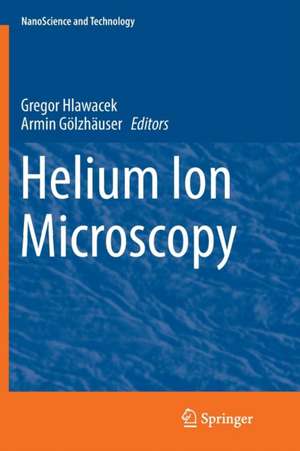
Helium Ion Microscopy
Editat de Gregor Hlawacek, Armin Gölzhäuseren Limba Engleză Paperback – 16 iun 2018
Preț: 1398.46 lei
Preț vechi: 1705.44 lei
-18%
Puncte Express: 2098
Carte tipărită la comandă
Livrare economică 16-30 noiembrie
Livrare prin curier în România Termenul estimat este afișat lângă disponibilitate.
Transport gratuit pentru acest produs Plată online sau ramburs, în funcție de opțiunile comenzii.
Retur gratuit în 14 zile Comandă securizată și suport în română.
Specificații
ISBN-13: 9783319824734
ISBN-10: 3319824732
Pagini: 552
Ilustrații: XXIII, 526 p. 320 illus., 204 illus. in color.
Dimensiuni: 155 x 235 x 30 mm
Greutate: 0.76 kg
Ediția:Softcover reprint of the original 1st edition 2016
Editura: Springer
Locul publicării:Cham, Switzerland
ISBN-10: 3319824732
Pagini: 552
Ilustrații: XXIII, 526 p. 320 illus., 204 illus. in color.
Dimensiuni: 155 x 235 x 30 mm
Greutate: 0.76 kg
Ediția:Softcover reprint of the original 1st edition 2016
Editura: Springer
Locul publicării:Cham, Switzerland
V-ar putea interesa
-
 -30%Preț: 543.01 lei781.08 lei
 -
 Atomic and Laser SpectroscopyAlan Corney-32%Preț: 639.13 lei937.41 lei
 -
 Optical Spectroscopy of Inorganic SolidsBrian Henderson-32%Preț: 671.56 lei988.98 lei
 -
 Mass Spectrometry - Principles and Applications 3eEdmond De Hoffmann-19%Preț: 402.21 lei496.56 lei
 -
 Internal Reflection and ATR SpectroscopyMilan Milosevic-8%Preț: 630.94 lei685.80 lei
 -
 Impedance SpectroscopyLvovich-9%Preț: 746.32 lei820.13 lei
 -
 Mass Spectrometry in Structural Biology and BiophysicsIgor A Kaltashov-9%Preț: 982.74 lei1079.93 lei
 -
 Rotational Spectroscopy of Diatomic MoleculesJohn M. Brown-14%Preț: 1334.16 lei1551.36 lei
 -
 -23%Preț: 1188.17 lei1543.07 lei
 -
 Organic Spectroscopy WorkbookJean-Pierre Rabine-19%Preț: 431.98 lei533.31 lei
 -
 XAFS for EveryoneScott Calvin-28%Preț: 683.02 lei955.22 lei
 -
 Using Commercial Amateur Astronomical SpectrographsJeffrey L. HopkinsPreț: 328.37 lei
 -
 -11%Preț: 524.67 lei589.52 lei
Cuprins
Introduction- Microscopy.- Analytics- Nanoengineering.
Textul de pe ultima copertă
This book covers the fundamentals of Helium Ion Microscopy (HIM) including the Gas Field Ion Source (GFIS), column and contrast formation. It also provides first hand information on nanofabrication and high resolution imaging. Relevant theoretical models and the existing simulation approaches are discussed in an extra section. The structure of the book allows the novice to get acquainted with the specifics of the technique needed to understand the more applied chapters in the second half of the volume. The expert reader will find a complete reference of the technique covering all important applications in several chapters written by the leading experts in the field. This includes imaging of biological samples, resist and precursor based nanofabrication, applications in semiconductor industry, using Helium as well as Neon and many more. The fundamental part allows the regular HIM user to deepen his understanding of the method. A final chapter by Bill Ward, one of the pioneers of HIM,covering the historical developments leading to the existing tool complements the content.
Caracteristici
Written by the leading professionals in the field Highlights the basic physics as well as the technological aspects of the instrument Presents the relevant theoretical models and the corresponding software packages Describes real applications of the technique Includes supplementary material: sn.pub/extras