Hard Times
Autor Charles Dickensen Limba Engleză Paperback – 5 feb 2009
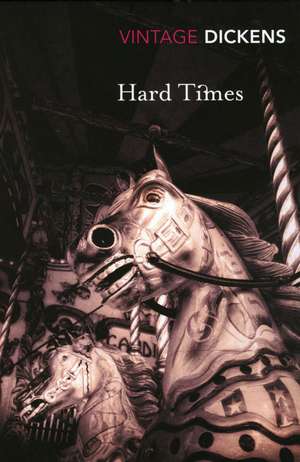
Considerăm imaginea inaugurală a sălii de clasă, unde umbra lui Thomas Gradgrind se proiectează autoritar asupra copiilor, drept una dintre cele mai puternice metafore ale educației victoriene. Mesajul este tăios: „Ceea ce îmi doresc sunt Faptele. Nu predați acestor băieți și fete nimic altceva decât Fapte”. Astfel începe Hard Times, un roman care se distinge în bibliografia lui Charles Dickens prin concizie și o asprime neobișnuită. Spre deosebire de peisajele urbane din Great Expectations sau David Copperfield, aici suntem transportați în Coketown, un oraș industrial dominat de fum, cărămidă roșie și ritmul monoton al mașinăriilor. Observăm că autorul renunță la digresiunile sentimentale extinse pentru a construi o satiră concentrată la adresa utilitarismului. Cei care au parcurs North and South de Elizabeth Gaskell vor fi pregătiți pentru realismul social și tensiunile dintre proprietarii de fabrici și muncitori, însă Dickens adaugă o dimensiune grotescă, aproape simbolică, personajelor sale. Structura acestei ediții Collins Classics este remarcabilă: pe lângă textul integral, cuprinsul ne indică o incursiune profundă în contextul epocii prin apendicele ce includ scrisori ale autorului, recenzii contemporane din 1854 și eseuri de Thomas Carlyle despre industrializare. Reținem că, deși este cea mai scurtă scriere lungă a sa, Hard Times concentrează întreaga revoltă a lui Dickens împotriva dezumanizării, oferind o experiență de lectură densă, lipsită de ilustrațiile clasice, dar încărcată de o relevanță socială perenă.
Preț: 41.90 lei
Preț vechi: 50.70 lei
-17%
Carte disponibilă
Livrare economică 06-17 noiembrie
Livrare express 20-24 octombrie pentru 29.44 lei
Specificații
ISBN-10: 0099518929
Pagini: 304
Ilustrații: b/w integrated
Dimensiuni: 130 x 197 x 20 mm
Greutate: 0.23 kg
Editura: Vintage Publishing
Locul publicării:United Kingdom
V-ar putea interesa
-
 The Jungle BookRudyard KiplingPreț: 28.01 lei
 -
 Great ExpectationsCharles DickensPreț: 28.01 lei
 -
 Tess of the D'UrbervillesThomas HardyPreț: 28.01 lei
 -
 The Picture of Dorian GrayOscar WildePreț: 28.01 lei
 -
 The Wonderful Wizard of OzL. Frank BaumPreț: 28.01 lei
 -
 CLASSICS WATER BABIESCharles KingsleyPreț: 28.01 lei
 -
 CLASSICS AS YOU LIKE ITWilliam ShakespearePreț: 28.01 lei
 -
 The Rime of the Ancient Mariner and Other PoemsSamuel Taylor ColeridgePreț: 28.47 lei
 -
 The TempestWilliam ShakespearePreț: 28.01 lei
 -
 A Christmas Carol and Other Christmas WritingsCharles Dickens-26%Preț: 48.68 lei65.60 lei
 -
 The War of the WorldsH. G. Wells-27%Preț: 47.25 lei64.76 lei
 -
 English Reformations: Religion, Politics, and Society under the TudorsChristopher Haigh-22%Preț: 396.96 lei509.91 lei
 -
 Of Mice and MenJohn Steinbeck-29%Preț: 49.89 lei70.16 lei
 -
 One Flew Over the Cuckoo's NestKen KeseyPreț: 72.45 lei
 -
 A Doll's HouseHenrik IbsenPreț: 24.75 lei
 -
 HamletWilliam Shakespeare-18%Preț: 23.87 lei29.07 lei
 -
 The Bell JarSylvia PlathPreț: 71.58 lei
 -
 Tom FordBridget Foley-9%Preț: 842.19 lei925.48 lei
 -
 The Travelling Cat ChroniclesHiro Arikawa-18%Preț: 59.27 lei72.49 lei
 -
 The Kinfolk Garden: How to Live with NatureJohn Burns-23%Preț: 216.66 lei283.01 lei
 -
 Romeo and JulietWilliam ShakespearePreț: 36.06 lei
 -
 UlyssesJames JoycePreț: 41.38 lei
 -
 Women in LoveD. H. LawrencePreț: 38.15 lei
 -
 The Picture of Dorian GrayOscar WildePreț: 30.66 lei
 -
 Vanity FairWilliam Makepeace ThackerayPreț: 40.07 lei
 -
 EmmaJane AustenPreț: 32.13 lei
 -
 Robinson CrusoeDaniel DefoePreț: 36.10 lei
 -
 To the LighthouseVirginia WoolfPreț: 36.29 lei
 -
 The RainbowD. H. LawrencePreț: 28.01 lei
 -
 A Streetcar named DesireHerbert GeisenPreț: 51.64 lei
De ce să citești această carte
Recomandăm această ediție cititorilor care doresc să descopere o fațetă mai sobră și mai critică a lui Charles Dickens. Dincolo de povestea tragică a lui Louisa și Tom Gradgrind, volumul oferă un aparat critic impresionant, ideal pentru studenți sau pasionați de istorie socială. Este o lectură esențială pentru a înțelege cum filosofia „faptelor brute” poate strivi spiritul uman, totul într-un format compact și accesibil.
Despre autor
Charles John Huffam Dickens (1812–1870) este recunoscut drept cel mai important romancier al epocii victoriene. Marcat de experiența muncii într-o fabrică de cremă de ghete la doar 12 ani, în timp ce tatăl său era închis pentru datorii, Dickens a devenit un critic social fervent și un apărător al drepturilor copiilor. Cariera sa a explodat odată cu publicarea în foileton a operelor sale, format pe care l-a pionierat și care i-a adus o popularitate fără precedent. Autor prolific, a scris 15 romane și numeroase povestiri, combinând satira mușcătoare cu un realism detaliat, lăsând posterității personaje iconice care definesc și astăzi literatura engleză.
Descriere scurtă
Recenzii
– F.R. Leavis
"A masterpiece...a completely serious work of art" -- F.R.Leavis "The greatest of Dickens' work...should be studied with close and earnest care" -- John Ruskin "Big and earnest, though circus folk and bank robbery add colour to its canvas of industrialists and loveless marriages" Sunday Times
Descriere
Textul de pe ultima copertă
The 'terrible mistake' was the contemporary utilitarian philosophy, expounded in Hard Times (1854) as the Philosophy of Fact by the hard-headed disciplinarian Thomas Gradgrind. But the novel, Dickens's shortest, is more than a polemical tract for the times; the tragic story of Louisa Gradgrind and her father is one of Dickens's triumphs. When Louisa, trapped in a loveless marriage, falls prey to an idle seducer, the crisis forces her father to reconsider his cherished system. Yet even as the development of the story reflects Dickens's growing pessimism about human nature and society, Hard Times marks his return to the theme which had made his early works so popular: the amusements of the people. Sleary's circus represents Dickens's most considered defence of the necessity of entertainment, and infuses the novel with the good humour which has ensured its appeal to generations of readers.
Extras
The One Thing Needful
“Now, what I want is, Facts. Teach these boys and girls nothing but Facts. Facts alone are wanted in life. Plant nothing else, and root out everything else. You can only form the minds of reasoning animals upon Facts: nothing else will ever be of any service to them. This is the principle on which I bring up my own children, and this is the principle on which I bring up these children. Stick to Facts, Sir!”
The scene was a plain, bare, monotonous vault of a schoolroom, and the speaker’s square forefinger emphasized his observations by underscoring every sentence with a line on the schoolmaster’s sleeve. The emphasis was helped by the speaker’s square wall of a forehead, which had his eyebrows for its base, while his eyes found commodious cellerage in two dark caves, overshadowed by the wall. The emphasis was helped by the speaker’s mouth, which was wide, thin, and hard set. The emphasis was helped by the speaker’s voice, which was inflexible, dry, and dictatorial. The emphasis was helped by the speaker’s hair, which bristled on the skirts of his bald head, a plantation of firs to keep the wind from its shining surface, all covered with knobs, like the crust of a plum pie, as if the head had scarcely warehouse-room for the hard facts stored inside. The speaker’s obstinate carriage, square coat, square legs, square shoulders,—nay, his very neckcloth, trained to take him by the throat with an unaccommodating grasp, like a stubborn fact, as it was,—all helped the emphasis.
“In this life, we want nothing but Facts, Sir; nothing but Facts!”
The speaker, and the schoolmaster, and the third grown person present, all backed a little, and swept with their eyes the inclined plane of little vessels then and there arranged in order, ready to have imperial gallons of facts poured into them until they were full to the brim.
CHAPTER II
Murdering the Innocents
Thomas Gradgrind, Sir. A man of realities. A man of facts and calculations. A man who proceeds upon the principle that two and two are four, and nothing over, and who is not to be talked into allowing for anything over. Thomas Gradgrind, Sir—peremptorily Thomas—Thomas Gradgrind. With a rule and a pair of scales, and the multiplication table always in his pocket, Sir, ready to weigh and measure any parcel of human nature, and tell you exactly what it comes to. It is a mere question of figures, a case of simple arithmetic. You might hope to get some other nonsensical belief into the head of George Gradgrind, or Augustus Gradgrind, or John Gradgrind, or Joseph Gradgrind (all supposititious, non-existent persons), but into the head of Thomas Gradgrind—no, Sir!
In such terms Mr. Gradgrind always mentally introduced himself, whether to his private circle of acquaintance, or to the public in general. In such terms, no doubt, substituting the words “boys and girls,” for “Sir,” Thomas Gradgrind now presented Thomas Gradgrind to the little pitchers before him, who were to be filled so full of facts.
Indeed, as he eagerly sparkled at them from the cellarage before mentioned, he seemed a kind of cannon loaded to the muzzle with facts, and prepared to blow them clean out of the regions of childhood at one discharge. He seemed a galvanizing apparatus, too, charged with a grim mechanical substitute for the tender young imaginations that were to be stormed away.
“Girl number twenty,” said Mr. Gradgrind, squarely pointing with his square forefinger, “I don’t know that girl. Who is that girl?”
“Sissy Jupe, sir,” explained number twenty, blushing, standing up, and curtseying.
“Sissy is not a name,” said Mr. Gradgrind. “Don’t call yourself Sissy. Call yourself Cecilia.”
“It’s father as calls me Sissy, sir,” returned the young girl in a trembling voice, and with another curtsey.
“Then he has no business to do it,” said Mr. Gradgrind. “Tell him he mustn’t. Cecilia Jupe. Let me see. What is your father?”
“He belongs to the horse-riding, if you please, sir.”
Mr. Gradgrind frowned, and waved off the objectionable calling with his hand.
“We don’t want to know anything about that, here. You mustn’t tell us about that, here. Your father breaks horses, don’t he?”
“If you please, sir, when they can get any to break, they do break horses in the ring, sir.”
“You mustn’t tell us about the ring, here. Very well, then. Describe your father as a horsebreaker. He doctors sick horses, I dare say?”
“Oh yes, sir.”
“Very well, then. He is a veterinary surgeon, a farrier and horsebreaker. Give me your definition of a horse.”
(Sissy Jupe thrown into the greatest alarm by this demand.)
“Girl number twenty unable to define a horse!” said Mr. Gradgrind, for the general behoof of all the little pitchers. “Girl number twenty possessed of no facts, in reference to one of the commonest of animals! Some boy’s definition of a horse. Bitzer, yours.”
The square finger, moving here and there, lighted suddenly on Bitzer, perhaps because he chanced to sit in the same ray of sunlight which, darting in at one of the bare windows of the intensely whitewashed room, irradiated Sissy. For, the boys and girls sat on the face of the inclined plane in two compact bodies, divided up the centre by a narrow interval; and Sissy, being at the corner of a row on the sunny side, came in for the beginning of a sunbeam, of which Bitzer, being at the corner of a row on the other side, a few rows in advance, caught the end. But, whereas the girl was so dark-eyed and dark-haired, that she seemed to receive a deeper and more lustrous colour from the sun, when it shone upon her, the boy was so light-eyed and light-haired that the self-same rays appeared to draw out of him what little colour he ever possessed. His cold eyes would hardly have been eyes, but for the short ends of lashes which, by bringing them into immediate contrast with something paler than themselves, expressed their form. His short-cropped hair might have been a mere continuation of the sandy freckles on his forehead and face. His skin was so unwholesomely deficient in the natural tinge, that he looked as though, if he were cut, he would bleed white.
“Bitzer,” said Thomas Gradgrind. “Your definition of a horse.”
“Quadruped. Graminivorous. Forty teeth, namely twenty-four grinders, four eye-teeth, and twelve incisive. Sheds coat in the spring; in marshy countries, sheds hoofs, too. Hoofs hard, but requiring to be shod with iron. Age known by marks in mouth.” Thus (and much more) Bitzer.
“Now girl number twenty,” said Mr. Gradgrind. “You know what a horse is.”
She curtseyed again, and would have blushed deeper, if she could have blushed deeper than she had blushed all this time. Bitzer, after rapidly blinking at Thomas Gradgrind with both eyes at once, and so catching the light upon his quivering ends of lashes that they looked like the antennæ of busy insects, put his knuckles to his freckled forehead, and sat down again.
The third gentleman now stepped forth. A mighty man at cutting and drying, he was; a government officer; in his way (and in most other people’s too), a professed pugilist; always in training, always with a system to force down the general throat like a bolus, always to be heard of at the bar of his little Public-office, ready to fight all England. To continue in fistic phraseology, he had a genius for coming up to the scratch,2 wherever and whatever it was, and proving himself an ugly customer. He would go in and damage any subject whatever with his right, follow up with his left, stop, exchange, counter, bore his opponent (he always fought All England)3 to the ropes, and fall upon him neatly. He was certain to knock the wind out of common sense, and render that unlucky adversary deaf to the call of time. And he had it in charge from high authority to bring about the great public- office Millennium, when Commissioners should reign upon earth.
“Very well,” said this gentleman, briskly smiling, and folding his arms. “That’s a horse. Now, let me ask you girls and boys, Would you paper a room with representations of horses?”
After a pause, one half of the children cried in chorus, “Yes, Sir!” Upon which the other half, seeing in the gentleman’s face that Yes was wrong, cried out in chorus, “No, Sir!”—as the custom is, in these examinations.
“Of course, No. Why wouldn’t you?”
A pause. One corpulent slow boy, with a wheezy manner of breathing, ventured the answer, Because he wouldn’t paper a room at all, but would paint it.
“You must paper it,” said the gentleman, rather warmly.
“You must paper it,” said Thomas Gradgrind, “whether you like it or not. Don’t tell us you wouldn’t paper it. What do you mean, boy?”
Cuprins
Acknowledgements
A Note on the Text
Select Bibliography
Charles Dickens: A Brief Chronology
HARD TIMES: FOR THESE TIMES
Appendices: Contemporary Documents
Appendix A: The Composition of the Novel
- Household Words Partners’ Agreement
- Announcements in Household Words
- Dickens’s Working Memoranda
- Mentions in Dickens’s Letters
- Athanaeum (12 August 1854)
- Examiner (9 September 1854)
- Gentleman’s Magazine (September 1854)
- British Quarterly Review (October 1854)
- Rambler (October 1854)
- South London Athanaeum and Institution Magazine (October 1854)
- Westminster Review (October 1854)
- Blackwood’s Edinburgh Magazine (April 1855)
- Thomas Carlyle
- “Signs of the Times,” Edinburgh Review (June 1829)
- Chartism (1839)
- Past and Present (1843)
- Andrew Ure, The Philosophy of Manufactures (1836)
- P. Gaskell, Artisans and Machinery (1836)
- J.S. Mill
- “Bentham,” London and Westminster Review (August 1838)
- Principles of Political Economy(1848)
- Arthur Helps, The Claims of Labour (1844)
- Friedrich Engels, The Condition of the Working Class in England in 1844 (1845)
- Charles Dickens, “On Strike,” Household Words (11 February 1854)
- Henry Morley, “Ground in the Mill,” Household Words (22 April 1854)
- Harriet Martineau, The Factory Controversy: A Warning Against Meddling Legislation (1855)
- W.B. Hodgson, “On the Importance of the Study of Economic Science as a Branch of Education for all Classes,” Lectures in Education Delivered at the Royal Institution of Great Britain (1855)
- John Ruskin, “Unto This Last,” Cornhill Magazine (August 1860)
- Harriet Martineau, A Manchester Strike (Illustrations of Political Economy No. 7) (1832)
- Frances Trollope, Life and Adventures of Michael Armstrong (1840)
- “Charlotte Elizabeth,” Helen Fleetwood (1841)
- Elizabeth Stone, William Langshawe, the Cotton Lord (1842)
- Benjamin Disraeli
- Coningsby (1844) (i)
- Coningsby (1844) (ii)
- Sybil (1845)
- Elizabeth Gaskell
- Mary Barton (1848) (i)
- Mary Barton (1848) (ii)
- North and South (1855)
- Charlotte Bronte, Shirley (1849)
- Charles Kingsley
- Yeast (1850)
- Alton Locke (1850)
- Fanny Mayne, Jane Rutherford, or The Miners’ Strike (1854)