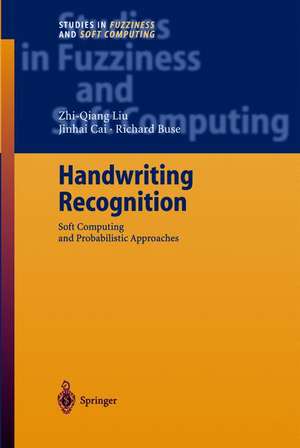
Handwriting Recognition: Studies in Fuzziness and Soft Computing, cartea 133
Autor Zhi-Qiang Liu, Richard Buse, Jin-Hai Caien Limba Engleză Hardback – 21 iul 2003
Din seria Studies in Fuzziness and Soft Computing
- 20%
 Preț: 1039.08 lei
 - 20%
 Preț: 674.21 lei
 - 20%
 Preț: 672.50 lei
 - 20%
 Preț: 1023.23 lei
 - 20%
 Preț: 1014.25 lei
 - 20%
 Preț: 1004.51 lei
 - 20%
 Preț: 1118.28 lei
 - 18%
 Preț: 1011.71 lei
 - 20%
 Preț: 1038.66 lei
 - 20%
 Preț: 1033.79 lei
 - 18%
 Preț: 983.83 lei
 - 20%
 Preț: 319.49 lei
 - 20%
 Preț: 335.46 lei
 - 18%
 Preț: 984.26 lei
 -
 Preț: 402.25 lei
 - 20%
 Preț: 666.88 lei
 - 20%
 Preț: 1017.95 lei
 - 18%
 Preț: 988.46 lei
 - 20%
 Preț: 1028.07 lei
 - 20%
 Preț: 1031.83 lei
 - 15%
 Preț: 665.77 lei
 - 20%
 Preț: 671.27 lei
 - 20%
 Preț: 959.13 lei
 - 15%
 Preț: 659.90 lei
 - 20%
 Preț: 1039.78 lei
 - 20%
 Preț: 1024.11 lei
 -
 Preț: 401.51 lei
 - 18%
 Preț: 1261.42 lei
 - 20%
 Preț: 674.29 lei
 - 18%
 Preț: 985.51 lei
Preț: 669.06 lei
Preț vechi: 836.33 lei
-20%
Puncte Express: 1004
Carte tipărită la comandă
Livrare economică 26 noiembrie-10 decembrie
Livrare prin curier în România Termenul estimat este afișat lângă disponibilitate.
Transport gratuit pentru acest produs Plată online sau ramburs, în funcție de opțiunile comenzii.
Retur gratuit în 14 zile Comandă securizată și suport în română.
Specificații
ISBN-13: 9783540401773
ISBN-10: 3540401776
Pagini: 252
Ilustrații: XV, 230 p.
Dimensiuni: 160 x 241 x 19 mm
Greutate: 0.5 kg
Ediția:2003
Editura: Springer Berlin, Heidelberg
Colecția Studies in Fuzziness and Soft Computing
Seria Studies in Fuzziness and Soft Computing
Locul publicării:Berlin, Heidelberg, Germany
ISBN-10: 3540401776
Pagini: 252
Ilustrații: XV, 230 p.
Dimensiuni: 160 x 241 x 19 mm
Greutate: 0.5 kg
Ediția:2003
Editura: Springer Berlin, Heidelberg
Colecția Studies in Fuzziness and Soft Computing
Seria Studies in Fuzziness and Soft Computing
Locul publicării:Berlin, Heidelberg, Germany
V-ar putea interesa
-
 Space-Time BroadbandGiannakis-20%Preț: 767.41 lei959.26 lei
 -
 Stereo Scene Flow for 3D Motion AnalysisAndreas Wedel-20%Preț: 666.11 lei832.64 lei
 -
 Digital FingerprintingCliff Wang-20%Preț: 722.41 lei903.01 lei
 -
 -20%Preț: 257.61 lei322.01 lei
 -
 Belief Functions: Theory and ApplicationsJi¿ina Vejnarová-20%Preț: 343.01 lei428.76 lei
 -
 String Processing and Information RetrievalShunsuke Inenaga-20%Preț: 334.59 lei418.24 lei
 -
 Machine Learning and Knowledge Discovery in DatabasesPaolo Frasconi-20%Preț: 678.57 lei848.21 lei
 -
 Artificial Neural Networks in Pattern RecognitionFriedhelm Schwenker-20%Preț: 461.76 lei577.20 lei
 -
 Algorithmic Learning TheoryRonald Ortner-20%Preț: 339.95 lei424.94 lei
 -
 Nature of Computation and CommunicationPhan Cong Vinh-20%Preț: 329.48 lei411.85 lei
 -
 Patch-Based Techniques in Medical ImagingGuorong Wu-20%Preț: 327.16 lei408.95 lei
 -
 -20%Preț: 324.22 lei405.27 lei
 -
 Latent Variable Analysis and Signal SeparationPetr Tichavský-20%Preț: 361.01 lei451.26 lei
 -
 Pattern Recognition and Information ProcessingViktor V. Krasnoproshin-20%Preț: 320.58 lei400.72 lei
 -
 Reproducible Research in Pattern RecognitionBertrand Kerautret-20%Preț: 316.62 lei395.77 lei
 -
 Guide to Convolutional Neural NetworksHamed Habibi Aghdam-20%Preț: 519.95 lei649.94 lei
 -
 -20%Preț: 309.93 lei387.41 lei
 -
 -20%Preț: 988.58 lei1235.72 lei
 -
 -20%Preț: 319.75 lei399.68 lei
 -
 Advances in Multimedia Information Processing - PCM 2008Yueh-Min Ray Huang-20%Preț: 684.55 lei855.69 lei
 -
 MICAI 2009: Advances in Artificial IntelligenceArturo Hernández Aguirre-20%Preț: 647.64 lei809.56 lei
 -
 -20%Preț: 627.33 lei784.16 lei
 -
 Preț: 387.82 lei
 -
 -20%Preț: 642.40 lei803.00 lei
 -
 -20%Preț: 647.01 lei808.76 lei
 -
 -20%Preț: 346.00 lei432.50 lei
Public țintă
ResearchCuprins
1 Introduction.- 1.1 Feature Extraction Methods.- 1.2 Pattern Recognition Methods.- 2 Pre-processing and Feature Extraction.- 2.1 Pre-processing of Handwritten Images.- 2.2 Feature Extraction from Binarized Images.- 2.3 Feature Extraction Using Gabor Filters.- 2.4 Concluding Remarks.- 3 Hidden Markov Model-Based Method for Recognizing Handwritten Digits.- 3.1 Theory of Hidden Markov Models.- 3.2 Recognizing Handwritten Numerals Using Statistical and Structural Information.- 3.3 Experimental Results.- 3.4 Conclusion.- 4 Markov Models with Spectral Features for Handwritten Numeral Recognition.- 4.1 Related Work Using Contour Information.- 4.2 Fourier Descriptors.- 4.3 Hidden Markov Model in Spectral Space.- 4.4 Experimental Results.- 4.5 Discussion.- 5 Markov Random Field Model for Recognizing Handwritten Digits.- 5.1 Fundamentals of Markov Random Fields.- 5.2 Markov Random Field for Pattern Recognition.- 5.3 Recognition of Handwritten Numerals Using MRF Models.- 5.4 Conclusion.- 6 Markov Random Field Models for Recognizing Handwritten Words.- 6.1 Markov Random Field for Handwritten Word Recognition.- 6.2 Neighborhood Systems and Cliques.- 6.3 Clique Functions.- 6.4 Maximizing the Compatibility with Relaxation Labeling.- 6.5 Design of Weights.- 6.6 Experimental Results.- 6.7 Conclusion.- 7 A Structural and Relational Approach to Handwritten Word Recognition.- 7.1 Introduction.- 7.2 Gabor Parameter Estimation.- 7.3 Feature Extraction.- 7.4 Conditional Rule Generation System.- 7.5 Experimental Results.- 7.6 Conclusion.- 8 Handwritten Word Recognition Using Fuzzy Logic.- 8.1 Introduction.- 8.2 Extraction of Oriented Parts.- 8.3 System Training.- 8.4 Word Recognition.- 8.5 Experimental Results.- 8.6 Conclusion.- 9 Conclusion.- 9.1 Summary and Discussions.- 9.2 Future Directions.- 9.3 References.
Caracteristici
A fresh look at the problem of unconstrained handwriting recognition from the soft computing viewpoint
Notă biografică
Prof. Jia ZENG is currently working at the School of Computer Science and Technology, Soochow University, Suzhou 215006, China. Before that, he was a Visiting Research Scholar with the Department of Computer Science, Hong Kong Baptist University from 2009 to 2010 and a Research Fellow in the Department of Electronic Engineering, City University of Hong Kong from 2006 to 2008. He obtained Ph.D. from School of Creative Media, City University of Hong Kong in October 2006, and B.Eng. with excellent academic honors at Wuhan University of Technology, China in 2002. His research interests have been mainly in the areas of type-2 fuzzy systems, probabilistic graphical models, pattern recognition and computational biology. He has authored and co-authored a number of publications appearing in high-profile journals and leading conferences. He won the 2006 Postgraduate Student Paper Contest, Second Prize, IEEE Region 10 and 2005 Postgraduate Student Paper Contest, First Prize, IEEE Region 10, respectively. He has also been invited to serve in a number of journals and conferences as the reviewer.
Prof Zhi-Qiang LIU received the M.A.Sc. degree in Aerospace Engineering from the Institute for Aerospace Studies, the University of Toronto, and the Ph.D. degree in Electrical Engineering from The University of Alberta, Canada. He is currently at the School of Creative Media, City University of Hong Kong. He has taught computer architecture, computer networks, artificial intelligence, programming languages, machine learning, pattern recognition, computer graphics, and art & technology. His interests are neural-fuzzy systems, machine learning, media computing and computer vision.