
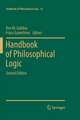
Handbook of Philosophical Logic: Handbook of Philosophical Logic, cartea 7
Editat de Dov M. Gabbay, Franz Guenthneren Limba Engleză Paperback – 23 aug 2012
Preț: 911.05 lei
Preț vechi: 1111.04 lei
-18% Nou
Puncte Express: 1367
Preț estimativ în valută:
161.26€ • 188.71$ • 141.08£
161.26€ • 188.71$ • 141.08£
Carte tipărită la comandă
Livrare economică 23 ianuarie-06 februarie 26
Preluare comenzi: 021 569.72.76
Specificații
ISBN-13: 9789048160112
ISBN-10: 9048160111
Pagini: 368
Ilustrații: XIII, 350 p. 1 illus.
Dimensiuni: 155 x 235 x 19 mm
Greutate: 0.51 kg
Ediția:2nd ed. 2002
Editura: SPRINGER NETHERLANDS
Colecția Springer
Seria Handbook of Philosophical Logic
Locul publicării:Dordrecht, Netherlands
ISBN-10: 9048160111
Pagini: 368
Ilustrații: XIII, 350 p. 1 illus.
Dimensiuni: 155 x 235 x 19 mm
Greutate: 0.51 kg
Ediția:2nd ed. 2002
Editura: SPRINGER NETHERLANDS
Colecția Springer
Seria Handbook of Philosophical Logic
Locul publicării:Dordrecht, Netherlands
V-ar putea interesa
-
 Collected PapersGareth Evans-9%Preț: 353.11 lei388.81 lei
 -
 -11%Preț: 328.57 lei369.17 lei
 -
 Metaphor: Its Cognitive Force and Linguistic StructureEva Feder Kittay-31%Preț: 367.43 lei533.13 lei
 -
 -11%Preț: 513.85 lei577.37 lei
 -
 Intermediate LogicDavid Bostock-11%Preț: 371.17 lei417.05 lei
 -
 The Law of Non-Contradiction: New Philosophical EssaysGraham Priest-31%Preț: 423.42 lei610.24 lei
 -
 Vagueness and ContradictionRoy Sorensen-15%Preț: 361.08 lei425.03 lei
 -
 Absolute GeneralityAgustín Rayo-19%Preț: 377.58 lei468.38 lei
 -
 Moore's Paradox: New Essays on Belief, Rationality, and the First PersonMitchell S. Green-34%Preț: 691.75 lei1053.13 lei
 -
 -23%Preț: 253.70 lei328.62 lei
 -
 Understanding Wittgenstein's on CertaintyD. Moyal-Sharrock-15%Preț: 612.55 lei720.65 lei
 -
 A New Introduction to Modal LogicM.J. CresswellPreț: 378.52 lei
 -
 LogicPaul TomassiPreț: 324.26 lei
 -
 Relating Narratives: Storytelling and SelfhoodAdriana CavareroPreț: 375.82 lei
 -
 Power: A New Social AnalysisBertrand RussellPreț: 134.87 lei
 -
 Inductive LogicDov M. Gabbay-27%Preț: 1186.61 lei1619.89 lei
 -
 Preț: 227.54 lei
 -
 The Pragmatic TurnR BernsteinPreț: 182.52 lei
 -
 Logic: Key Concepts in PhilosophyLaurence Goldstein-18%Preț: 169.33 lei206.93 lei
Public țintă
ResearchCuprins
Basic Tense Logic.- Advanced Tense Logic.- Combinations of Tense and Modality.- Philosophical Perspectives on Quantification in Tense and Modal Logic.- Tense and Time.
Recenzii
"The best starting point for exploring any of the topics in logic"
Encyclopaedia Britannica
Encyclopaedia Britannica
Caracteristici
Contains major contributions on Basic Tense Logic, Advanced Tense Logic, Combinations of Tense and Modality, Philosophical Perspectives on Quantification in Tense and Modal Logic as well as Tense and Time Includes supplementary material: sn.pub/extras
Notă biografică
DOV M. GABBAY FRSC FAvH FRSA FBCS, Augustus De Morgan Professor of Logic (Emeritus), King's College London and Visiting Professor, University of Luxembourg. Dov Gabbay is one of the world’s most active and influential researchers in logic. He has been active in the logic landscape for over 50 years. He authored / co-authored over five hundred and fifty research papers and over thirty research monographs.He has initiated several new and active research areas. He is editor of several international Journals, and over 50 Handbooks of Logic. Gabbay is Chairman and founder of several international conferences, Executive of the European Foundation of Logic Language and Information and President of the International IGPL Logic Group .Founder, Executive and Vice President of the International Federation of Computational Logic, (UK Charity, Number 1112512 ). He is one of the four founders and council member for many years of FoLLI, the Association of Logic, Language and Information. Now retired and a Life Member.
Franz Guenthner is a professor of Computational Linguistics at the Centre for Information and Language Processing (CIS) at the Ludwig-Maximilians-Universitaet (LMU) in Munich, Germany. His background is in philosophy and linguistics.Guenthner's research interests include computational linguistics, and has collaborated to the development of a number of online search platforms since 1996: AltaVista, Fast Search and Transfer (now purchased by Microsoft), RealNames, JobaNova, Exorbyte, and All The Web. He was a professor of General and Computational Linguistics at the University of Tübingen (1977–1989) before joining the LMU in 1990. His research interests include all areas of text processingand in particular the transformation of textual corpora in lexical and grammatical representations (i.e. computationally deployable electronic dictionaries and local grammars). He was also instrumental in the design and realization of a number of search engines, in particular of the first large-scale scientific search engine on the web www.scirus.com. His present work concerns the use of linguistic techniques in page and link analysis on the web, especially for the construction of vertical search engines.
Franz Guenthner is a professor of Computational Linguistics at the Centre for Information and Language Processing (CIS) at the Ludwig-Maximilians-Universitaet (LMU) in Munich, Germany. His background is in philosophy and linguistics.Guenthner's research interests include computational linguistics, and has collaborated to the development of a number of online search platforms since 1996: AltaVista, Fast Search and Transfer (now purchased by Microsoft), RealNames, JobaNova, Exorbyte, and All The Web. He was a professor of General and Computational Linguistics at the University of Tübingen (1977–1989) before joining the LMU in 1990. His research interests include all areas of text processingand in particular the transformation of textual corpora in lexical and grammatical representations (i.e. computationally deployable electronic dictionaries and local grammars). He was also instrumental in the design and realization of a number of search engines, in particular of the first large-scale scientific search engine on the web www.scirus.com. His present work concerns the use of linguistic techniques in page and link analysis on the web, especially for the construction of vertical search engines.
Textul de pe ultima copertă
This eighteenth volume of the acclaimed Handbook of Philosophical Logic includes many contributors who are among the most famous leading figures of applied philosophical logic of our time. Coverage includes deontic logic, practical reasoning, homogeneous and heterogeneous logical proportion, and talmudic logic. Overall, it will appeal to students, practitioners, and researchers looking for an authoritative resource in these areas.
The contributors first explore models in terms of dynamic logics for information-driven agency. The paradigm they use is dynamic-epistemic logics for knowledge and belief and their current extensions to the statics and dynamics of agents’ preferences. Next, in the presentation of preference based agency, coverage examines a large number of themes, including interactive social agents and scenarios with long term patterns emerging over time. From here, the book moves on to offer an introduction to homogeneous and heterogeneous logical proportions.
Readers will also learn more about the general challenge that the problem of formalizing practical reasoning presents to logical theory. The contributors survey the existing resources that might contribute to the development of such a formalization. They conclude that, while a robust, adequate logic of practical reasoning is not yet in place, the materials for developing such a logic are now available.
The last chapter explores topics that deal with the logic of Jewish law and the logic of the Talmud. This includes obligations and prohibitions in Talmudic deontic logic, the handling of loops in Talmudic logic, Temporal Talmudic logic, and quantum states and disjunctive attacks in Talmudic logic. The Talmudic logic system presented are also exported to general logic and to Artificial Intelligence.
The contributors first explore models in terms of dynamic logics for information-driven agency. The paradigm they use is dynamic-epistemic logics for knowledge and belief and their current extensions to the statics and dynamics of agents’ preferences. Next, in the presentation of preference based agency, coverage examines a large number of themes, including interactive social agents and scenarios with long term patterns emerging over time. From here, the book moves on to offer an introduction to homogeneous and heterogeneous logical proportions.
Readers will also learn more about the general challenge that the problem of formalizing practical reasoning presents to logical theory. The contributors survey the existing resources that might contribute to the development of such a formalization. They conclude that, while a robust, adequate logic of practical reasoning is not yet in place, the materials for developing such a logic are now available.
The last chapter explores topics that deal with the logic of Jewish law and the logic of the Talmud. This includes obligations and prohibitions in Talmudic deontic logic, the handling of loops in Talmudic logic, Temporal Talmudic logic, and quantum states and disjunctive attacks in Talmudic logic. The Talmudic logic system presented are also exported to general logic and to Artificial Intelligence.
Descriere
Descriere de la o altă ediție sau format:
Contains major contributions on the Logic of Questions, Sequent Systems for Modal Logics, Deontic Logic as well as Deontic Logic and Contrary-to-duties. This book is aimed at students and researchers whose work or interests involve philosophical logic and its applications.
Contains major contributions on the Logic of Questions, Sequent Systems for Modal Logics, Deontic Logic as well as Deontic Logic and Contrary-to-duties. This book is aimed at students and researchers whose work or interests involve philosophical logic and its applications.