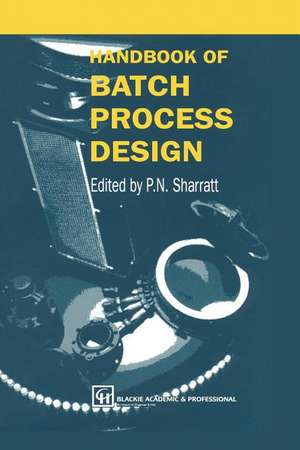
Handbook of Batch Process Design
Editat de P.N. Sharratten Limba Engleză Paperback – 21 sep 2011
Preț: 1171.41 lei
Preț vechi: 1428.55 lei
-18%
Puncte Express: 1757
Carte tipărită la comandă
Livrare economică 12-26 noiembrie
Livrare prin curier în România Termenul estimat este afișat lângă disponibilitate.
Transport gratuit pentru acest produs Plată online sau ramburs, în funcție de opțiunile comenzii.
Retur gratuit în 14 zile Comandă securizată și suport în română.
Specificații
ISBN-13: 9789401071505
ISBN-10: 9401071500
Pagini: 340
Ilustrații: XIV, 320 p.
Dimensiuni: 155 x 235 x 18 mm
Greutate: 0.48 kg
Ediția:Softcover reprint of the original 1st ed. 1997
Editura: SPRINGER NETHERLANDS
Colecția Springer
Locul publicării:Dordrecht, Netherlands
ISBN-10: 9401071500
Pagini: 340
Ilustrații: XIV, 320 p.
Dimensiuni: 155 x 235 x 18 mm
Greutate: 0.48 kg
Ediția:Softcover reprint of the original 1st ed. 1997
Editura: SPRINGER NETHERLANDS
Colecția Springer
Locul publicării:Dordrecht, Netherlands
V-ar putea interesa
-
 Unit Operations of Chemical Engineering (Int'l Ed)Warren McCabe-25%Preț: 385.92 lei517.76 lei
 -
 Chemical Engineering Design: SI EditionRay Sinnott-29%Preț: 496.63 lei698.51 lei
 -
 -30%Preț: 614.15 lei872.48 lei
 -
 Bioprocess Engineering PrinciplesRoss Carlson-33%Preț: 584.94 lei868.94 lei
 -
 -23%Preț: 901.21 lei1170.41 lei
 -
 -25%Preț: 1021.88 lei1355.18 lei
 -
 Unit Operations in Winery, Brewery, and Distillery DesignDavid E. Block-8%Preț: 446.11 lei484.90 lei
 -
 Computational Intelligence in Design and ManufacturingAndrew Kusiak-14%Preț: 908.20 lei1056.05 lei
 -
 -19%Preț: 448.91 lei554.20 lei
 -
 Product and Process Design PrinciplesDaniel R. Lewin-19%Preț: 420.06 lei518.59 lei
 -
 -23%Preț: 660.63 lei857.96 lei
 -
 Practical Process Control Design with Industrial ApplicationsAlan M Kugelman-23%Preț: 969.06 lei1258.52 lei
 -
 -20%Preț: 275.28 lei343.46 lei
 -
 Bioreactors – Design, Operation and Novel ApplicationsC–F Mandenius-14%Preț: 943.34 lei1096.91 lei
 -
 -11%Preț: 480.34 lei539.70 lei
 -
 -5%Preț: 833.47 lei877.33 lei
 -
 Advanced Control Methods for Industrial ProcessesPablo A. López-Pérez-23%Preț: 689.32 lei895.22 lei
Public țintă
ResearchCuprins
1 Chemicals manufacture by batch processes.- 1.1 Introduction.- 1.2 Industrial background.- 1.3 Reasons for the use of batch processing.- 1.4 Batch process design for fine and speciality chemical production.- 1.5 Plant design.- 1.6 Summary.- References.- 2 Scheduling and simulation of batch processes.- 2.1 Introduction.- 2.2 Batch process features.- 2.3 The scheduling problem.- 2.4 Batch process simulation.- 2.5 Design implications.- References.- 3 Solvents in chemicals production.- 3.1 Introduction.- 3.2 Solvent properties.- 3.3 Solubility.- 3.4 Solvent effects on reactions.- 3.5 Solvent recovery.- 3.6 Solvent destruction.- 3.7 Conclusion.- 3.8 Nomenclature.- References.- 4 Agitation.- 4.1 Agitator selection.- 4.2 Calculation of agitator power, discharge flow and mixing time.- 4.3 Power and circulation in non-Newtonian fluids.- 4.4 Design to disperse solid particles.- 4.5 Design for two or more liquid phases.- 4.6 Design for dispersing gas.- 4.7 Design for heat transfer.- 4.8 Nomenclature.- References.- 5 Mixing and the selectivity of fast chemical reactions.- 5.1 The problem.- 5.2 Mixing mechanisms and modelling.- 5.3 Applications.- 5.4 Extensions.- 5.5 Concluding remarks.- 5.6 Nomenclature.- References.- 6 Batch filtration of solid—liquid suspensions.- 6.1 Introduction.- 6.2 Filtration process fundamentals.- 6.3 Batch operated filtration machinery.- 6.4 Nomenclature.- References.- 7 Design and engineering of a batch plant.- 7.1 Introduction.- 7.2 Project definition.- 7.3 Project strategy.- 7.4 Project organization.- 7.5 ‘Fast track’ projects.- 7.6 Regulations and other controls.- 7.7 Design techniques.- 7.8 Layout considerations.- 7.9 Plant relocation/reuse of existing equipment.- 7.10 Modular plant.- 8 Control.- 8.1 Introduction.- 8.2 Control of continuous processes.- 8.3 Control of batch processes.- 8.4 Batch control systems — structure and functions.- 8.5 Computer control.- 8.6 Procedural control.- 8.7 Acknowledgements.- References.- 9 Hazards from chemical reactions and flammable materials in batch reactor operations.- 9.1 Introduction.- 9.2 Hazard identification.- 9.3 Chemical reaction hazards.- 9.4 Fire and explosion hazards.- 9.4 Conclusions.- References.- 10 Environmental protection and waste minimization.- 10.1 Introduction.- 10.2 Batch reactor waste minimization.- 10.3 Equipment for the production of solid products.- 10.4 Fugitive and other minor emissions.- 10.5 Cleaning wastes.- 10.6 Waste treatment and solvent management.- 10.7 Environmental protection.- 10.8 Conclusions.- References.- 11 Future developments in batch process design and technology.- 11.1 Influences for and against change.- 11.2 New technologies.- 11.3 New processes.- 11.4 New design methods.- 11.5 New skill requirements.- References.