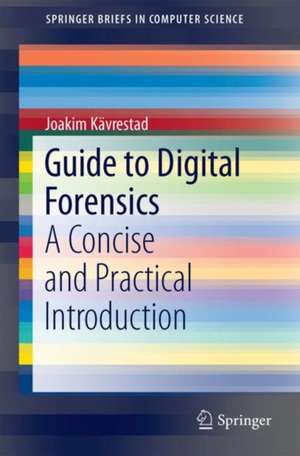
Guide to Digital Forensics: SpringerBriefs in Computer Science
Autor Joakim Kävrestaden Limba Engleză Paperback – 6 oct 2017
Guide to Digital Forensics: A Concise and Practical Introduction is intended for students that are looking for an introduction to computer forensics and can also be used as a collection of instructions for practitioners. The aim is to describe and explain the steps taken during a forensic examination, with the intent of making the reader aware of the constraints and considerations that apply during a fo
rensic examination in law enforcement and in the private sector. Upon reading this book, the reader should have a proper overview of the field of digital forensics, starting them on the journey of becoming a computer forensics expert.
Din seria SpringerBriefs in Computer Science
- 20%
 Preț: 318.06 lei
 - 20%
 Preț: 175.41 lei
 - 20%
 Preț: 324.81 lei
 - 20%
 Preț: 312.38 lei
 - 20%
 Preț: 315.57 lei
 -
 Preț: 448.42 lei
 - 20%
 Preț: 282.99 lei
 - 20%
 Preț: 334.13 lei
 -
 Preț: 394.76 lei
 -
 Preț: 477.41 lei
 - 20%
 Preț: 353.26 lei
 - 20%
 Preț: 311.84 lei
 -
 Preț: 379.07 lei
 - 20%
 Preț: 364.93 lei
 - 20%
 Preț: 338.72 lei
 - 20%
 Preț: 323.75 lei
 - 20%
 Preț: 311.04 lei
 - 20%
 Preț: 309.78 lei
 - 20%
 Preț: 321.60 lei
 - 20%
 Preț: 310.23 lei
 - 20%
 Preț: 325.87 lei
 - 47%
 Preț: 251.63 lei
 - 20%
 Preț: 309.30 lei
 - 20%
 Preț: 311.50 lei
 -
 Preț: 392.17 lei
 -
 Preț: 359.92 lei
 - 20%
 Preț: 310.73 lei
 - 20%
 Preț: 310.73 lei
 -
 Preț: 361.22 lei
 - 20%
 Preț: 311.84 lei
 - 20%
 Preț: 310.56 lei
 - 20%
 Preț: 310.73 lei
 - 20%
 Preț: 311.84 lei
 - 20%
 Preț: 311.04 lei
 - 20%
 Preț: 309.93 lei
 - 20%
 Preț: 311.18 lei
 - 20%
 Preț: 310.23 lei
 - 20%
 Preț: 311.04 lei
 - 20%
 Preț: 323.94 lei
 - 20%
 Preț: 311.18 lei
 - 20%
 Preț: 309.78 lei
 - 20%
 Preț: 321.39 lei
 - 20%
 Preț: 310.73 lei
 - 20%
 Preț: 325.21 lei
 - 20%
 Preț: 309.93 lei
 - 20%
 Preț: 311.50 lei
 - 20%
 Preț: 333.12 lei
 - 20%
 Preț: 312.17 lei
 -
 Preț: 362.51 lei
 - 20%
 Preț: 312.17 lei
Preț: 338.04 lei
Preț vechi: 422.54 lei
-20%
Puncte Express: 507
Carte tipărită la comandă
Livrare economică 23 noiembrie-07 decembrie
Livrare prin curier în România Termenul estimat este afișat lângă disponibilitate.
Transport gratuit de la 400.00 lei Plată online sau ramburs, în funcție de opțiunile comenzii.
Retur gratuit în 14 zile Comandă securizată și suport în română.
Specificații
ISBN-13: 9783319674490
ISBN-10: 3319674498
Pagini: 160
Ilustrații: XII, 147 p. 79 illus.
Dimensiuni: 155 x 235 x 9 mm
Greutate: 0.25 kg
Ediția:1st edition 2017
Editura: Springer
Colecția SpringerBriefs in Computer Science
Seria SpringerBriefs in Computer Science
Locul publicării:Cham, Switzerland
ISBN-10: 3319674498
Pagini: 160
Ilustrații: XII, 147 p. 79 illus.
Dimensiuni: 155 x 235 x 9 mm
Greutate: 0.25 kg
Ediția:1st edition 2017
Editura: Springer
Colecția SpringerBriefs in Computer Science
Seria SpringerBriefs in Computer Science
Locul publicării:Cham, Switzerland
V-ar putea interesa
-
 Incident Response & Computer Forensics, Third EditionJason Luttgens-30%Preț: 317.57 lei453.04 lei
 -
 Blackstone's Handbook of Cyber Crime InvestigationAndrew Staniforth-13%Preț: 302.99 lei350.06 lei
 -
 Oxford Handbook of Forensic MedicineJonathan P. WyattPreț: 277.21 lei
 -
 Preț: 311.16 lei
 -
 Guide to Computer Forensics and InvestigationsBill Nelson-24%Preț: 662.43 lei867.60 lei
 -
 Introduction to Security and Network ForensicsWilliam J. Buchanan-8%Preț: 542.83 lei590.04 lei
 -
 -8%Preț: 577.41 lei627.62 leiRecomandat
 -
 Crime Scene Investigator (CSI) Field GuideSarah LambertPreț: 377.94 lei
 -
 Forensic IntelligenceRobert Milne-15%Preț: 445.58 lei524.21 lei
 -
 -18%Preț: 761.74 lei928.95 lei
 -
 -20%Preț: 219.82 lei274.78 lei
 -
 Practical Skills in Forensic ScienceAlan Langford-8%Preț: 462.10 lei502.29 lei
 -
 -23%Preț: 769.26 lei999.04 lei
 -
 Practical Forensic ImagingBruce Nikkel-36%Preț: 231.78 lei361.76 lei
 -
 ForensicsCarla MooneyPreț: 97.78 lei
 -
 -36%Preț: 300.09 lei465.40 lei
 -
 The Crime Writers Casebook: Third EditionStuart Gibbon-17%Preț: 72.32 lei87.45 lei
 -
 -16%Preț: 74.95 lei89.14 lei
 -
 Crime Scene to CourtNiamh NicdaeidPreț: 471.78 lei
 -
 Digital Forensics for Enterprises Beyond Kali LinuxAbhirup GuhaPreț: 308.45 lei
Cuprins
Part I: Theory.- What is Digital Forensics?.- What is Cybercrime?.- Computer Theory.- Collecting Evidence.- Analyzing Data and Writing Reports.- Part II: Putting it into Practice.- Collecting Data.- Indexing, Searching and Cracking.- Finding Artifacts.- Some Common Questions.- FTK Specifics.- Basic Memory Analysis.- Part III: Vocabulary.- Vocabulary.- Part IV: Appendices.- Appendix A: Solutions.- Appendix B: Useful Scripts.- Appendix C: Sample Report Template.- Appendix D: List of Time Zones.- Appendix E: Complete Jitsi Chat Log.
Recenzii
“The short length provides a very good introduction to digital forensics without bogging the reader down in excessive detail and in-depth discussions. It is well written and worthy of your attention.” (Brad Reid, Computing Reviews, April, 2018)
Notă biografică
Joakim Kävrestad is a Lecturer in informatics at the University of Skövde, Sweden, with several years of experience as a forensic expert with the Swedish police.
Textul de pe ultima copertă
This work introduces the reader to the world of digital forensics in a practical and accessible manner. The text was written to fulfill a need for a book that introduces forensic methodology and sound forensic thinking, combined with hands-on examples for common tasks in a computer forensic examination. The author has several years of experience as a computer forensics examiner and is now working as a university-level lecturer.
Guide to Digital Forensics: A Concise and Practical Introduction is intended for students that are looking for an introduction to computer forensics and can also be used as a collection of instructions for practitioners. The aim is to describe and explain the steps taken during a forensic examination, with the intent of making the reader aware of the constraints and considerations that apply during a fo
rensic examination in law enforcement and in the private sector. Upon reading this book, the reader should have a proper overview of the field of digital forensics, starting them on the journey of becoming a computer forensics expert.
Guide to Digital Forensics: A Concise and Practical Introduction is intended for students that are looking for an introduction to computer forensics and can also be used as a collection of instructions for practitioners. The aim is to describe and explain the steps taken during a forensic examination, with the intent of making the reader aware of the constraints and considerations that apply during a fo
rensic examination in law enforcement and in the private sector. Upon reading this book, the reader should have a proper overview of the field of digital forensics, starting them on the journey of becoming a computer forensics expert.
Caracteristici
Provides a strong theoretical discussion on forensic concepts and important considerations in a forensic examination Explains the computer concepts of particular relevance to forensics Includes a detailed section that describes and discusses important artifacts Includes supplementary material: sn.pub/extras