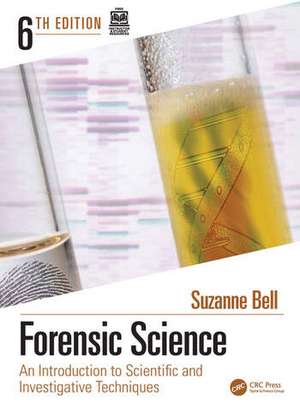
Forensic Science: An Introduction to Scientific and Investigative Techniques
Autor Suzanne Bellen Limba Engleză Hardback – 23 apr 2025
Recomandăm această ediție a cincea (revizuită în descriere ca a șasea) a volumului Forensic Science ca resursă fundamentală pentru nivelul de licență, fiind concepută special pentru un curs universitar de un semestru. Lucrarea se distinge prin capacitatea de a face tranziția de la teorie la aplicații practice, ghidând studentul prin întregul parcurs al probelor, de la locul faptei până în laboratorul de analize și pe masa de autopsie. Structura este riguroasă, fiind împărțită în șapte secțiuni tematice care încep cu cadrul legal al justiției și continuă cu investigarea morții, biologie, chimie și dovezi microscopice.
Considerăm că punctul forte al acestei ediții este actualizarea metodologică, în special în ceea ce privește analiza ADN și utilizarea bazelor de date statistice pentru interpretarea probelor. Secțiunea „Return to the Scene of the Crime” oferă scenarii complexe care permit studenților să compare dovezile fizice cu rezultatele testelor de laborator, dezvoltând gândirea critică. Extinde cadrul propus de Introduction to Forensic Science and Criminalistics, Second Edition de Howard A. Harris prin introducerea unor date noi despre genealogia genetică investigativă și prin includerea secțiunilor „Advanced Topics”, destinate celor care doresc o aprofundare cantitativă. Spre deosebire de Fundamentals of Forensic Science de Max M. Houck, care pune accent pe perspectivele profesioniștilor din teren, volumul coordonat de Suzanne Bell oferă o abordare academică mai echilibrată, integrând peste 525 de ilustrații color care clarifică procedurile tehnice complexe. În contextul operei sale, această lucrare sintetizează expertiza din Forensic Chemistry, oferind însă o viziune de ansamblu mult mai vastă asupra disciplinelor criminalistice.
Preț: 681.18 lei
Preț vechi: 748.55 lei
-9% Recomandat
Carte disponibilă
Livrare economică 13-27 noiembrie
Livrare express 29 octombrie-04 noiembrie pentru 92.58 lei
Specificații
ISBN-10: 1032525215
Pagini: 632
Ilustrații: 1072
Dimensiuni: 210 x 280 x 48 mm
Greutate: 1.95 kg
Ediția:6. Auflage
Editura: Taylor & Francis
Colecția CRC Press
Locul publicării:Oxford, United Kingdom
V-ar putea interesa
-
 Forensic CasebookN E Genge-25%Preț: 120.58 lei159.96 lei
 -
 Forensic Science: A Very Short IntroductionJim Fraser-20%Preț: 56.62 lei70.82 lei
 -
 Forensic Nursing ScienceVirginia A. Lynch-29%Preț: 517.25 lei724.57 lei
 -
 Crime Scene InvestigationRoy Fenoff-9%Preț: 679.83 lei747.06 lei
 -
 Principles of Bloodstain Pattern Analysis: Theory and PracticeStuart H. James-9%Preț: 668.49 lei734.60 lei
 -
 -8%Preț: 595.90 lei647.72 lei
 -
 Forensic Anthropology: A Comprehensive Introduction, Second EditionNatalie R. Langley-8%Preț: 525.84 lei571.56 lei
 -
 Simpson's Forensic MedicineJason Payne-JamesPreț: 445.14 lei
 -
 Forensic Justice: A Global PerspectiveBeulah ShekharPreț: 419.34 lei
 -
 Crime Scene Investigator (CSI) Field GuideSarah LambertPreț: 383.67 lei
 -
 Forensics For DummiesD. P. LylePreț: 140.60 lei
 -
 Forensic ChemistrySuzanne Bell-9%Preț: 839.84 lei922.90 lei
 -
 Criminalistics: An Introduction to Forensic Science, Global EditionRichard Saferstein-15%Preț: 657.45 lei773.47 lei
 -
 Practical Skills in Forensic ScienceAlan Langford-8%Preț: 462.10 lei502.29 lei
 -
 -9%Preț: 1174.28 lei1290.42 lei
 -
 Techniques of Crime Scene InvestigationDavid Fisher-9%Preț: 827.18 lei908.99 lei
 -
 ForensicsCarla MooneyPreț: 98.40 lei
 -
 Forensic ScienceJay SiegelPreț: 78.63 lei
 -
 Crime Scene to CourtNiamh NicdaeidPreț: 465.99 lei
 -
 Textbook of Forensic SciencePankaj Shrivastava-23%Preț: 765.96 lei994.75 lei
Public țintă
UndergraduateDe ce să citești această carte
Este manualul de referință pentru orice student la criminologie sau științe juridice. Cititorul câștigă o înțelegere clară a modului în care știința devine probă admisibilă în instanță. Recomandăm cartea pentru echilibrul dintre accesibilitatea limbajului și rigoarea științifică a secțiunilor avansate, fiind un instrument esențial pentru pregătirea unei cariere în laboratoarele criminalistice sau în investigarea scenelor de crimă.
Despre autor
Suzanne Bell, PhD, este o figură proeminentă în domeniul educației criminalistice, deținând un doctorat în chimie de la New Mexico State University și un master în științe criminalistice de la University of New Haven. În prezent, ocupă funcția de profesor asociat de chimie și director al Bell Research Group la West Virginia University. Experiența sa vastă este reflectată în numeroase articole publicate în Journal of Forensic Science și în lucrări de referință precum A Dictionary of Forensic Science, premiată pentru excelență academică. Expertiza sa în chimie și microscopie îi permite să abordeze tehnicile de investigație cu o precizie analitică remarcabilă.
Cuprins
1. Justice and Science
2. Evidence, Analysis, and Interpretation
3. Crime Scene Investigation
4. Bloodstain Patterns
5. Medicolegal Investigation of Death
6. Forensic Toxicology
7. Forensic Anthropology
8. Forensic Entomology
9. Biological Evidence
10. DNA Profiling
11. Advanced Topics in DNA Analysis
12. Illicit Drugs and Poisons
13. Fire Investigation
14. Explosives
15. Fingerprints
16. Firearms and Tool Marks
17. Tread Impressions
18. Questioned Documents
19. Trace Evidence
20. Digital Forensics
21. Forensic Engineering
22. Behavioral Science
Notă biografică
Dr. Suzanne Bell is an Emeritus Professor and Chair of the Department of Forensic and Investigative Sciences at West Virginia University. She has been involved in forensic science as a practitioner and educator for decades. Her career began at the New Mexico State Police Crime Laboratory where she worked in forensic chemistry and crime scene response. Positions with Los Alamos National Laboratory and Eastern Washington University followed before arriving at WVU in 2003. Among other roles, she served as professor and chair of the department of Forensic Science. She has published many papers in and has taught and mentored students in forensic science and chemistry from undergraduate through post-doctoral levels. Her career has been dedicated to forensic education for students, forensic practitioners, and the public.
Dr. Bell served on the National Commission on Forensic Science (NCFS) from 2014-2017. She is the author of 13 books including multiple editions of a comprehensive introductory text and three editions of Forensic Chemistry. Her latest title is Understanding Forensic DNA Typing, which she co-wrote with Dr. John Butler, an internally recognized DNA working at the National Institutes of Science and Technology.
Descriere scurtă
Forensic Science: An Introduction to Scientific and Investigative Techniques, Sixth Edition covers a full range of fundamental, cutting-edge topics essential to modern forensic casework and investigation. The new edition is fully updated to outline best practices—including recent technology and techniques—providing an engaging account of current advances in the field.
Going beyond theory to application, Forensic Science begins by discussing the intersection of law and forensic science, how things become evidence, and how courts decide if an item or testimony is admissible. It presents the broadest array of forensic disciplines among available textbooks on the market, addressing forensic anthropology, death investigation (including anthropology and entomology), bloodstain pattern analysis, firearms, tool marks, and forensic analysis of questioned documents, among others. Students follow evidence all the way from the crime scene into laboratory analysis and even onto the autopsy table.
Updates to this edition include a new chapter on DNA analysis covering lineage markers and investigative genetic genealogy. Chapter 2 addresses statistics, probability, and frequency databases in interpreting forensic evidence. A section called Return to the Scene of the Crime describes scenarios that allows students to compare the physical evidence with the analyzed testing results. Advanced Topics sections present quantitative or advanced aspects of each chapter's subject matter. This material is geared toward students with a strong math and science background, forensic science majors, and honors students.
Designed for a single-term course at the undergraduate level, the book’s writing is straight-forward and accessible—explaining in-depth concepts clearly and accurately. Textboxes throughout the book provide case studies, current events, and advice for career advancement. Each chapter begins with an overview and ends with a summary, key terms, review questions, and up-to-date references. This includes a list of books, articles, and open-access sources for further reading and research projects.
Forensic Science: An Introduction to Scientific and Investigative Techniques, Sixth Edition continues to serve as the essential, go-to textbook for introduction to forensic science courses.
Features include:
- Highlights real-life case examples and current best practices, illustrating all with more than 525 engaging, full-color photographs and illustrations
- Presents chapters and topics in the sequence that is most popular and standard introductory level courses and coursework
- Includes comprehensive coverage of all forms of evidence, including the collection, analysis process, and how findings can influence forensic casework
- Provides interesting sidebars that highlight historic advances, crime scene case scenarios, and advice for skills improvement and career development
- Offers chapter summaries, key terms, review questions, and further reading to enhance student learning
Ancillaries for Instructors:
- PowerPoint® lecture slides for every chapter
- A full Instructor’s Manual with Test Bank that provides hundreds of questions and answers―including multiple choice
Free Online Digital Learning Resources:
Free Digital Learning Resources for instructors and students include:
Individual chapter Web pages with:
- Flash Cards for Glossary terms
- Interactive Matching, Drag-and-Drop and “Hot Spot” Mapping Exercises
- Numerous Self-Test Questions, and ...
- Recorded Videos of practicing forensic scientists speaking to chapter topics in their given area of expertise.