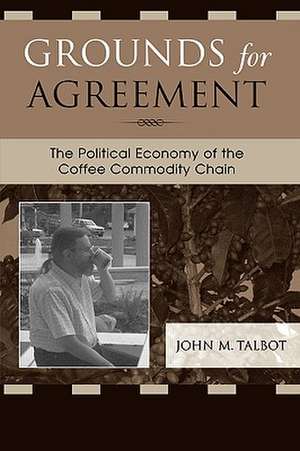
Grounds for Agreement: The Political Economy of the Coffee Commodity Chain
Autor John M. Talboten Limba Engleză Paperback – 29 iul 2004
Preț: 351.00 lei
Preț vechi: 461.03 lei
-24%
Puncte Express: 527
Carte tipărită la comandă
Livrare economică 01-15 decembrie
Livrare prin curier în România Termenul estimat este afișat lângă disponibilitate.
Transport gratuit de la 400.00 lei Plată online sau ramburs, în funcție de opțiunile comenzii.
Retur gratuit în 14 zile Comandă securizată și suport în română.
Specificații
ISBN-13: 9780742526297
ISBN-10: 0742526291
Pagini: 256
Dimensiuni: 183 x 224 x 14 mm
Greutate: 0.34 kg
Ediția:New.
Editura: Bloomsbury Publishing
Colecția Rowman & Littlefield
Locul publicării:New York, United States
ISBN-10: 0742526291
Pagini: 256
Dimensiuni: 183 x 224 x 14 mm
Greutate: 0.34 kg
Ediția:New.
Editura: Bloomsbury Publishing
Colecția Rowman & Littlefield
Locul publicării:New York, United States
V-ar putea interesa
-
 Intellectual Property Law of PlantsMark D. Janis-33%Preț: 1885.75 lei2810.25 lei
 -
 Agriculture: A Very Short IntroductionPaul Brassley-20%Preț: 56.23 lei70.53 lei
 -
 Preț: 263.13 lei
 -
 Joint VenturesTrish ReganPreț: 146.03 lei
 -
 Defending the Social Licence of FarmingJacqueline WilliamsPreț: 271.62 lei
 -
 -23%Preț: 279.43 lei362.84 lei
 -
 Agricultural FinanceHelyette Geman-8%Preț: 685.46 lei745.07 lei
 -
 Coffee: A Comprehensive Guide to the Bean, the Beverage, and the IndustryRobert W. Thurston-35%Preț: 688.81 lei1059.99 lei
 -
 Jail Bird - The Life and Crimes of an Essex Bad GirlTracy Mackness-41%Preț: 41.50 lei70.84 lei
 -
 MeatonomicsDavid Robinson SimonPreț: 125.94 lei
 -
 Brazilian Agricultural Competitiveness & TradeLisa M. Griffin-27%Preț: 1774.06 lei2416.54 lei
 -
 U.S. Rice Industry: Elements & Global CompetitivenessLillian Brewer-27%Preț: 1798.82 lei2450.38 lei
 -
 Extra VirginityTom Mueller-20%Preț: 85.14 lei106.08 lei
Cuprins
Chapter 1 Introduction
Chapter 2 Theoretical and Methodological Grounds for the Analysis
Chapter 3 Material and Historical Grounds for the Analysis
Chapter 4 The Coffee Commodity Chain under U.S. Hegemony, 1945-1972
Chapter 5 Struggles Over Regulation of the Chain, 1973-1989
Chapter 6 Globalization and Coffee Crises, 1990-?
Chapter 7 The Struggle for Control of the Instant Coffee Commodity Chain
Chapter 8 Outcomes of the Struggles: Where Does Your Coffee Dollar Go?
Chapter 9 Solutions? Specialty, Organic, and Fair-Trade Coffees
Chapter 10 Conclusion: Toward a Reregulated Market
Chapter 2 Theoretical and Methodological Grounds for the Analysis
Chapter 3 Material and Historical Grounds for the Analysis
Chapter 4 The Coffee Commodity Chain under U.S. Hegemony, 1945-1972
Chapter 5 Struggles Over Regulation of the Chain, 1973-1989
Chapter 6 Globalization and Coffee Crises, 1990-?
Chapter 7 The Struggle for Control of the Instant Coffee Commodity Chain
Chapter 8 Outcomes of the Struggles: Where Does Your Coffee Dollar Go?
Chapter 9 Solutions? Specialty, Organic, and Fair-Trade Coffees
Chapter 10 Conclusion: Toward a Reregulated Market
Recenzii
John Talbot's account of the relations of the world coffee industry is a model of analytical lucidity. While the story line concerns coffee, it is also an important study of the politics and ecology of the world market, revealing its contending institutional forces, cycles of regulation, and the social implications of its crises for the producing regions. Most intriguing is the way Talbot explores struggles over control of the coffee chain to chart the rise of specialty coffees, extending to organic and fair-trade coffees, as solutions to contention and crisis. More than commodity chain analysis, this is an in-depth examination of the social and power relations of the global circuits of coffee.
Talbot's study is a gripping tale of how transnational corporations exploit the labor of farmers in the tropics. His historically deep analysis supports the claims of the movement for globalization from below?-that democratic global institutions are needed to reduce poverty and environmental degradation.
This is a valuable addition to the literature on coffee and an interesting case study of an important commodity. Highly recommended.
John M. Talbot accomplishes an exceptional feat in his new book. This work should serve as a model for other critical studies of the dynamics of actually existing global capitalism.
This rigorous, insightful analysis of one of the most critical aspects of the global economy could not be more timely. In a world where the economic fate of most poor countries depends increasingly on commodity exports, understanding how markets and institutions shape the economic opportunities and potential benefits embodied in such exports is essential. Talbot's rich, careful analysis of the world's most important agricultural export should be required reading for anyone who wants to understand globalization.
Talbot's study is a gripping tale of how transnational corporations exploit the labor of farmers in the tropics. His historically deep analysis supports the claims of the movement for globalization from below?-that democratic global institutions are needed to reduce poverty and environmental degradation.
This is a valuable addition to the literature on coffee and an interesting case study of an important commodity. Highly recommended.
John M. Talbot accomplishes an exceptional feat in his new book. This work should serve as a model for other critical studies of the dynamics of actually existing global capitalism.
This rigorous, insightful analysis of one of the most critical aspects of the global economy could not be more timely. In a world where the economic fate of most poor countries depends increasingly on commodity exports, understanding how markets and institutions shape the economic opportunities and potential benefits embodied in such exports is essential. Talbot's rich, careful analysis of the world's most important agricultural export should be required reading for anyone who wants to understand globalization.